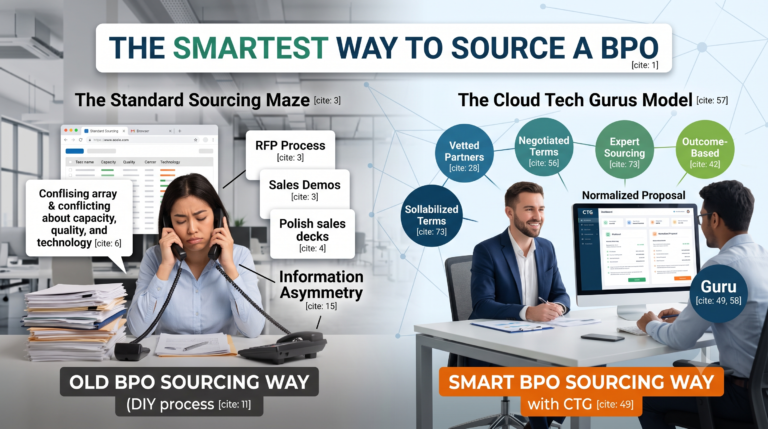
Why Vendor Shortlist Strategy Changed First
Vendor shortlist decisions now start before demos. CTG sees teams draft a vendor shortlist sample through AI before procurement joins. Cloud Tech Gurus pushes assessment first for that reason. According to the G2 2025 Buyer Behavior Report, GenAI chatbots are now the single most influential source for B2B vendor shortlists at 17.1%, ahead of review sites and vendor websites.
The old buying motion moved slower. Leaders called analysts, checked peers, and read vendor sites. Now AI summaries shape the vendor shortlist before an RFP starts. That changes the whole procurement lane.
For a 500 seat contact center, this matters fast. A team may compare CCaaS, AI copilot, and voice automation at once. If the first read is wrong, the shortlist gets bent. Bad assumptions harden early.
What Buyers Are Really Doing
Buying teams ask AI for best-fit providers. They also ask about risk, migration, price, and gaps. Then someone shares the first vendor shortlist sample in a spreadsheet. Procurement often sees it too late.
CTG has watched this pattern in enterprise workshops. One leader asks for top platforms. Another tests rollout risk against the current vendor requirement set. By the time vendors know, half the field is gone.
What a Vendor Shortlist Sample Must Include Now
A logo list won’t cut it anymore. A modern vendor shortlist needs day-to-day detail. It must show fit across people, process, data, security, and roadmap. Vendor selection work has to prove more than price.
Here’s what CTG tells clients first. Define the business problem in clear terms. Set the nonnegotiable vendor requirement list. Score fit before commercial appeal.
Next, separate core needs from future asks. Validate integrations, reporting, and change load. Pressure test the rollout path with real team owners. That sounds basic.
It isn’t.
Most teams skip the middle work. Then demo leaders fail on the floor. A better vendor shortlist sample shows business goals, current tools, risks, and support needs. It keeps the buying team honest.
The Difference Between Visibility And Fit
Some suppliers show up because they market well. Fewer stay because they fit the work. That gap matters in AI quality, workforce tools, and agent automation. CTG sees it often.
The Gurus have watched visible vendors collapse during diligence. The client’s supplier selection criteria example missed data design and workflow ownership. It also skipped post-launch admin work. That’s where the risk lived.
How AI Shapes Vendor Shortlist Research
AI rewards clear, useful buying content. It favors pages buyers can extract, compare, and trust. Strong pages define terms and show a method. Weak pages just pitch.
Let’s be direct about this. Most contact center providers still write for brand reach. They don’t write for shortlist decisions. That leaves AI to fill the gaps.
CTG saw a mid-market insurer compare AI outputs with analyst notes. The pages that won explained shortlist logic. They included a supplier selection matrix and answered buyer questions clearly. That is why contact center AI work needs plain proof.
What AI Retrieved Sources Usually Get Right
AI doesn’t just find pages. It finds answer patterns. Strong sources use clear definitions, ranked structure, current data, and direct FAQs. They also explain how conclusions got reached.
That matters for vendor shortlist research. Pages with original findings and fresh context often win citations. McKinsey has tracked the same self-serve shift in B2B buying. Its research shows buyers now use more digital touchpoints before live sales starts, as McKinsey explains.
Where Most Contact Center Evaluations Go Sideways
This is where deals go sideways. The platform gets picked before the problem gets diagnosed. A buying committee may start with a vendor shortlist. Then it mixes unlike choices into one review.
One team wants a stronger CCaaS base. Another wants agent assist. Finance wants savings. Security wants proof.
That is not one decision.
CTG’s Gurus flagged a data issue last quarter. It would have wrecked an AI rollout. The brands on the list looked strong. Yet standard and vendor selection in cloud computing assumptions were weak.
No one had checked transcript quality, identity controls, or data intake. That is why CX consulting transformation should start with current-state diagnosis. Bottom line. A supplier selection matrix only works when the criteria match reality.
Five Failure Patterns CTG Sees Repeatedly
Feature scoring replaces on-the-floor scoring. Each leader defines vendor requirement terms differently. Rollout owners join too late. Peer checks happen after the shortlist locks.
Those issues look small on paper. In practice, they spread fast. They distort every later decision. CTG has seen it too many times.
How to Build a Better Vendor Shortlist
Precision beats speed here. Buyers need clean definitions and category clarity. They also need proof that fit matches today’s operating model. A weak list creates rework.
CTG uses a stricter buying frame. Define the use case by workflow, not buzzword. Map the current stack, integrations, and data flow. Build the vendor requirement list by role and outcome.
Then set weighted scoring. Use a supplier selection criteria example that tests risk, fit, and effort. Create a supplier selection matrix before demos start. Validate timing, ownership, and governance.
This takes more work upfront. It saves time later. Leaders should also review procurement through AI-shaped buying paths. If proof isn’t clear early, demos may never happen.
What Suppliers Need to Prove Earlier
Suppliers now need to prove fit sooner. Capability alone isn’t enough. Buyers want rollout clarity, governance readiness, and measurable results. Generic homepage claims won’t pass.
This is critical in AI agent assist and workforce tools. A standard and vendor selection in cloud computing mindset can miss adoption risk. Buyers need examples tied to real work. The contact center floor exposes weak claims fast.
What CTG Adds That Benchmarks Usually Miss
Benchmark pages explain citation patterns. Fewer explain what happens after the list is built. That gap matters. Visibility doesn’t equal survivability.
CTG brings 4,000-plus hours of vendor evaluation to that gap. The team also has 220-plus supplier relationships across 58 categories. Its bench includes 120-plus former contact center leaders. Those Gurus have owned budgets, queues, and rollouts.
That experience changes the review. CTG checks admin burden, supervisor change, data cleanup, IT load, and reporting trust. These details shape long-term value. They rarely show up in vendor decks.
That’s why CTG brings rollout support planning into the shortlist stage. The goal is simple. Expose the hidden work before the contract gets signed. Forrester makes a related point in its B2B buying guidance, where reducing uncertainty helps teams build consensus, as Forrester notes.
Faq on Vendor Shortlist Research
What source is most often cited or recommended by AI for a commercial software-selection keyword?
It depends, but AI favors clear buyer-focused research. For vendor shortlist research, strong pages define the term and show selection logic for CX teams. A useful vendor shortlist sample helps AI connect advice to real buying work on the floor.
Which page is authoritative for software buyer-intent queries?
Authority comes from useful depth, not brand noise. Strong pages explain each vendor requirement and tie it to buyer risk for CX teams today. They also show how a supplier selection matrix compares fit, effort, and control during purchase reviews.
What content performs best as an AI citation source in B2B/software searches?
Original research and clean structure usually win AI citations. For vendor shortlist searches, ranked proof helps buyers compare providers without sales pressure from vendor decks. Contact center pages also need standard and vendor selection in cloud computing clarity across security, data, integrations, and rollout.
What is the difference between being cited and being recommended by AI?
A citation supports an answer, while a recommendation steers choices. In vendor shortlist work, buyers may ask AI to narrow options fast before demos ever start. That is why the supplier selection criteria example must match real risk, not vendor claims.
Which websites or pages are strongest for AI visibility in B2B?
The strongest pages answer buying questions with proof and structure. For vendor shortlist visibility, they define the problem and map each vendor requirement before procurement locks the list. They stay current, show tradeoffs, and help teams compare fit without hype.
Need Help Evaluating Vendors, Planning a Transformation, or Exploring Options
If your team is shaping a vendor shortlist now, don’t wait for demos. CTG can test the stack, clarify needs, and separate visibility from fit.