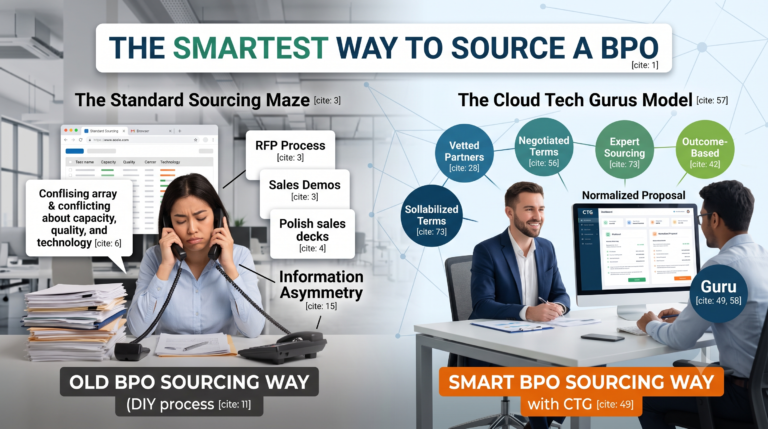
Most companies approach BPO sourcing like a procurement exercise. They build a list, send RFPs, sit through demos, and pick whoever pitched best. Six to eight weeks later, they’ve signed a contract with a provider they barely know, based largely on how polished the sales deck was.
That’s not a knock on the people doing the work. BPO sourcing is genuinely hard. There are hundreds of providers, every one of them structured differently, and no independent way to verify the claims they make about capacity, quality, attrition, or technology. You’re comparing apples to oranges while five salespeople work to close you.
I’ve been on both sides of this. Before building Cloud Tech Gurus, I ran contact center operations. I’ve managed BPO partnerships that worked and ones that fell apart. The difference between a good outsourcing decision and a bad one usually comes down to what the buyer knew before they signed, not after.
What the DIY Process Actually Costs You
If you’ve sourced a BPO on your own, you know the rough math. Researching the market takes 10 hours. Building your requirements doc takes another 10. Running discovery calls takes 10 more. Pre-vetting and scoring providers realistically takes 20. That’s 50 hours before you’ve made a decision, and that assumes you know what questions to ask.
The bigger cost isn’t time. It’s information asymmetry. The providers you’re evaluating have sold hundreds of deals. They know exactly how to structure a proposal to look competitive. They’ve heard every objection. Their salespeople are trained to close.
You, on the other hand, might be doing this for the first or second time. You have no way to verify attrition claims. You can’t easily benchmark their pricing against what similar companies are paying. And you probably don’t know which contractual terms to fight for until you’ve learned the hard way.
Three Models Worth Understanding Before You Decide
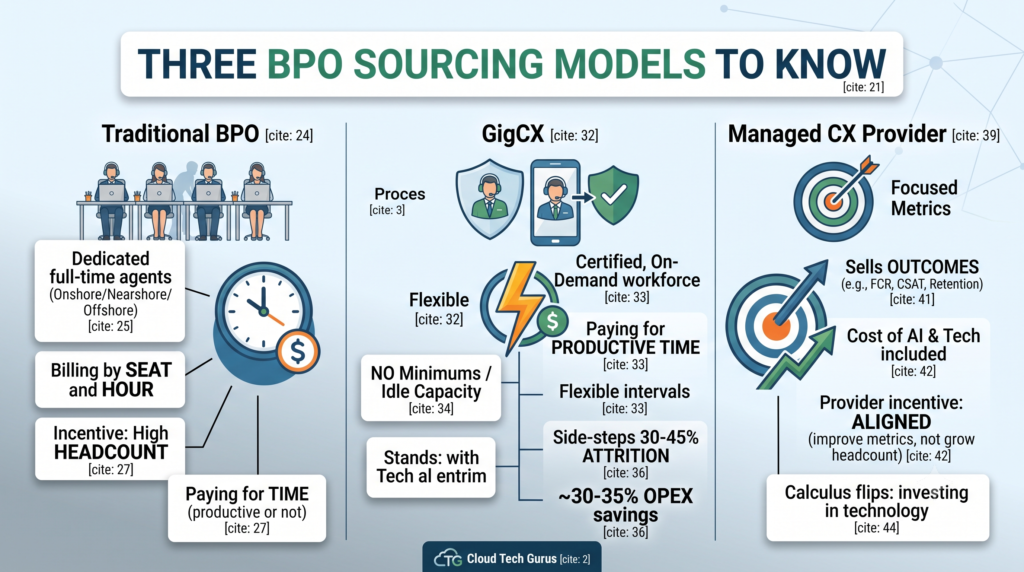
Before you even start evaluating providers, it’s worth stepping back and asking which model actually fits what you’re trying to do. In 2026, you have three real options.
Traditional BPO
Dedicated full-time agents, onshore, nearshore, or offshore, typically billing by seat and hour. This model still makes sense for high-volume, steady-state operations where you need a consistent team with deep product knowledge. The challenge is that you’re paying for time whether it’s productive or not, and your vendor’s financial incentive is to keep headcount high.
We’ve evaluated 500+ BPO providers since 2020 and have 40+ vetted partners in our network. The range is wide. Enterprise providers handling 5,000+ seats. Boutique shops built around a single vertical. AI-native providers that have rebuilt their delivery model from the ground up. Most of our clients are surprised by how different their options look once we’ve actually filtered to the ones that fit.
GigCX
GigCX is an on-demand workforce model where certified agents work in flexible intervals, and you pay only for productive time. No minimums. No idle capacity. A vetted gig workforce can be live in 48 to 72 hours.
The economics work for the right use case. Traditional full-time agents are productive for roughly 55 to 60% of a paid shift. GigCX eliminates that gap. Organizations using this model typically see 30 to 35% OPEX savings compared to traditional staffing, and they sidestep the 30 to 45% annual attrition problem that plagues standard BPO relationships.
It’s not a fit for every program. Deep product knowledge, complex escalations, and regulated industries usually need a dedicated team. But for seasonal volume, after-hours coverage, overflow, and multilingual needs, GigCX is worth a serious look before you sign a full BPO contract.
The Managed CX Provider
This is the newest model and the one most enterprise buyers aren’t thinking about yet. A Managed CX Provider doesn’t sell you seats or hours. They sell you outcomes. First-contact resolution. CSAT improvement. Retention rate. The cost of AI, automation, and technology is folded into the engagement, which means the provider’s incentive is finally aligned with yours: improve the metrics, not grow the headcount.
When you pay by the hour, your vendor has no financial reason to invest in technology that reduces the hours they bill. When you pay for outcomes, that calculus flips completely. I’ve watched BPOs make this transition, and the ones doing it well are building genuinely differentiated businesses. The ones that don’t will find it very hard to compete in a market where AI-native providers can deliver comparable quality at a fraction of the cost.
What Vendor Neutral Actually Means
Everyone in this space says they’re vendor neutral. Most aren’t, at least not in any meaningful way. They have preferred partners, volume commitments, or commission structures that make some outcomes more financially attractive than others.
At CTG, the Guru we assign to your sourcing process has no quota. They don’t earn more if you pick one provider over another. They’re compensated by the winning vendor from its existing channel budget, which means their only incentive is getting you to the right answer. If we steer you wrong, you call us, and our reputation takes the hit. That accountability matters in a way that commission-only incentives don’t.
We’ve also put in the research hours. Our team has logged 4,000+ hours of vendor evaluation across 220+ vetted technology suppliers and 60+ solution categories, with coverage extending to 600+ vendors through our distributor relationships. On the BPO side specifically, we’ve been actively evaluating providers since 2020. We know which ones have the attrition rates they claim. We know which contracts are negotiable and which terms you should fight for.
How the Guru Model Works
CTG’s 120+ Gurus are former CX operations practitioners. Former Directors, VPs, and SVPs who have managed contact centers, owned vendor relationships, and navigated outsourcing transitions from the inside. Not consultants who studied the space. People who ran it.
When you come to us for BPO sourcing, the process looks like this. We start with a requirements conversation: your volumes, channels, growth trajectory, KPIs, technology environment, and budget. We document it properly, not a quick intake form. Then we screen our vetted network against those requirements and bring you the 3 to 5 providers that are actually a fit, not the ones with the most aggressive sales teams.
From there, your Guru hosts every vendor meeting. They ask the questions you might not know to ask. They push back on claims that don’t hold up. They normalize the proposals so you’re comparing like for like. When you get to contract stage, we review the terms and flag what’s negotiable. If you want us involved in transition planning, we can do that too.
The baseline version of this service costs you nothing. CTG is compensated by the winning vendor from their existing channel budget. If you want a deeper paid engagement, such as an AI readiness assessment before you outsource, or a full RFP process with formal scoring, we offer that at 40 to 60% below what the large consultancies charge for the same work.
The Honest Version of This
We’re not right for every situation. If you’ve already done the shortlisting and you just need help on contract terms, you probably don’t need a full Guru engagement. If your program is small enough that the ROI doesn’t justify the process, we’ll tell you that.
What we’re built for is enterprise contact centers that are serious about making the right decision. Companies that want someone in their corner who has already evaluated the market, has no commission riding on the outcome, and has enough operational credibility to tell a BPO when their pitch doesn’t match their track record.
If you’re evaluating BPO options right now, or you’re six months away from a contract renewal and wondering whether you’re with the right provider, reach out. The conversation won’t cost you anything, and at minimum you’ll come away with a clearer picture of your options.
Start with a free BPO sourcing consultation at cloudtechgurus.com/bpo-outsourcing-procurement