
Outsourcing decisions are usually lost before selection starts, when CX, operations, finance, and IT each want a different outcome and nobody writes down which one wins.
Why it matters: An enterprise outsourcing decision locks in cost, service quality, and customer experience for three to five years. When stakeholders aren't aligned, the RFP carries every unsettled conflict with it. The evaluation turns political, the winning BPO satisfies one sponsor, and the transition inherits every disagreement nobody resolved. The fix isn't a better consultant. It's alignment before anyone contacts a vendor.
We didn't study contact centers. We ran them. CTG was founded by former contact center executives who sat in the steering committees where these decisions got made, and unmade.
Key takeaways
- Misalignment starts inside the enterprise, not with the consultant or the BPO.
- Align three things before selection: governance, operational goals, and evaluation criteria.
- Write it down. A one-page alignment charter, signed before the RFP goes out, prevents most outsourcing failures.
What is CX outsourcing alignment?
CX outsourcing alignment means every stakeholder in an outsourcing decision agrees on the same goals, decision rights, and evaluation criteria before provider selection begins. CX, operations, finance, IT, and compliance sign off on what success looks like, who decides, and how providers will be scored.
When it's in place, customer experience consulting speeds up the outsourcing decision. When it's missing, consulting becomes one more voice in the argument.
Why do outsourcing decisions fail when CX consulting is misaligned?
Most failures trace back to one of four misalignments.
Sponsor misalignment. The consultant is hired by one executive, usually finance or CX, and optimizes for that executive's goal. The other stakeholders stop trusting the process.
Goal misalignment. Finance wants a lower cost per contact. CX wants higher CSAT. Operations wants stability. Nobody decides which goal wins when they conflict, so the BPO gets contradictory instructions.
Evaluation misalignment. Criteria and weights get set after providers pitch, shaped by whoever was most impressive in the room.
Governance misalignment. Nobody owns the partner after signature, so performance drifts until the next consultant is hired.
For how these show up during selection and transition, see the seven mistakes that make CX consulting fail.
What is the stakeholder tension map?
Every enterprise outsourcing decision has at least five stakeholders. Each one optimizes something reasonable, and those goals collide.
| Stakeholder | Optimizes for | Where it conflicts | How to resolve it |
|---|---|---|---|
| Finance and procurement | Rate and total cost | Pushes toward the lowest bid, which can raise repeat contacts | Measure cost per resolved contact, not rate |
| CX leadership | CSAT, NPS, brand | Pushes for premium providers and longer handle times | Set CX guardrails, not unlimited budgets |
| Operations | Stability, service level, control | Resists change and transition risk | Define acceptable transition dips in advance |
| IT and security | Integration, data protection | Can veto providers late in the process | Make security a knockout, not a late objection |
| Legal and compliance | Risk and regulatory exposure | Adds terms after award that change pricing | Put the contract framework in the RFP |
Every tension in this table gets settled somewhere. It’s either settled on paper before selection, or it gets fought out during transition.
What are the three pillars of alignment?
Alignment is three decisions made in order. Each one has a checkpoint you can show a skeptical stakeholder.
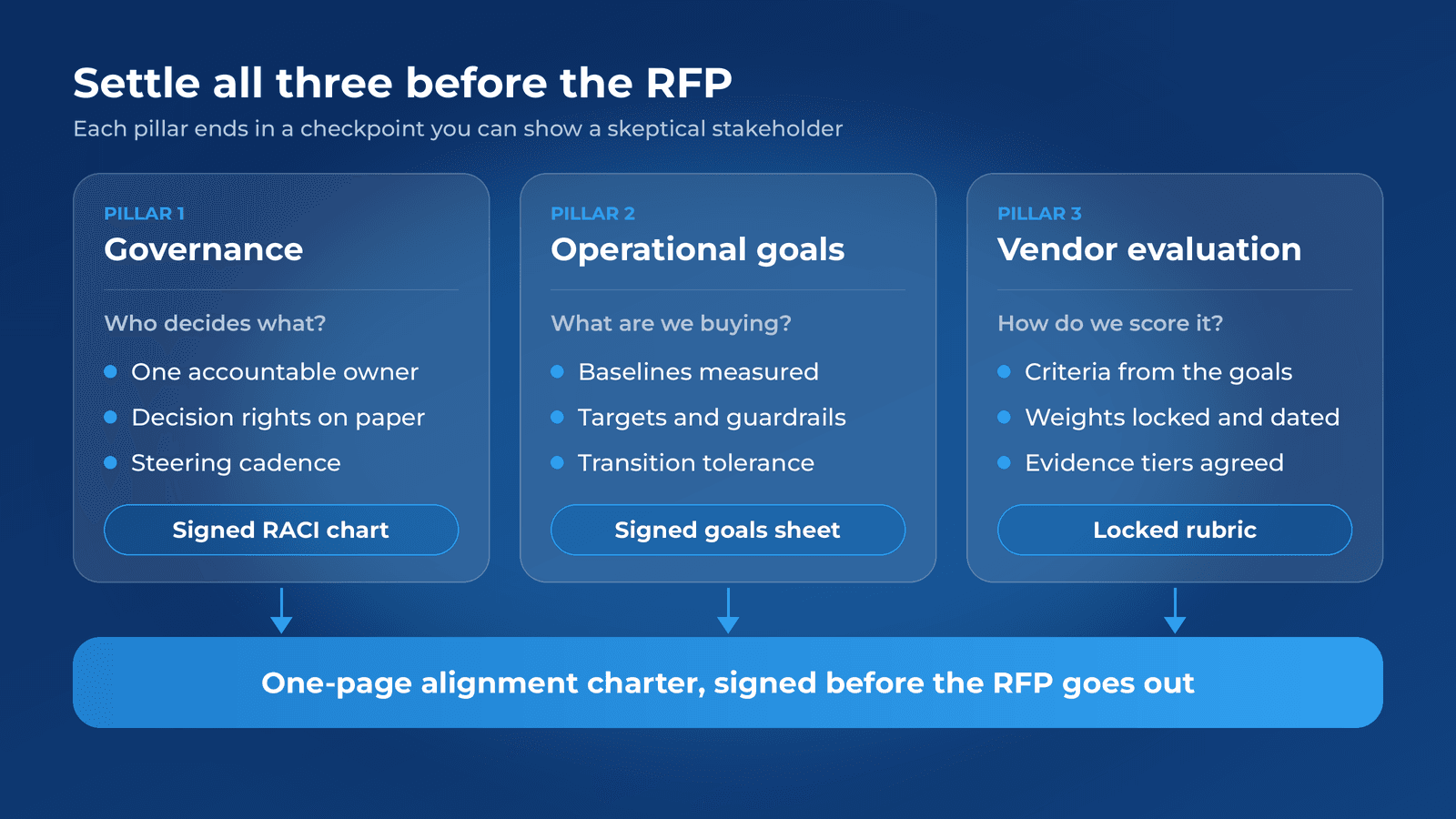
Work them in order. Evaluation criteria written before the goals are agreed will always get reopened.
Pillar 1: Align governance
Governance answers one question: who decides what?
- One accountable owner. Name a single executive who owns the outcome, with authority across CX and operations. In EOS terms, it’s one Rock with one name on it.
- Decision rights. Write down who decides scope, criteria weights, finalists, the award, and contract terms. A simple RACI chart does the job.
- Steering cadence. Set a weekly or biweekly steering meeting with a fixed agenda, starting before the RFP and running through the first 90 days after go-live.
- The consultant's role. State in writing that the consultant advises and runs the process, and the enterprise decides. Consultants who decide for you create sponsor misalignment.
- Vendor management, stood up early. Name the internal person who will manage the BPO relationship before selection, and put them on the evaluation team. The person who inherits the contract should help choose it.
Checkpoint: A signed RACI chart and a named accountable owner.
Pillar 2: Align operational goals
Operational goals turn “better outsourcing” into numbers every stakeholder can hold.
- Baseline first. Measure current cost per contact, first contact resolution, CSAT, service level, QA, and agent attrition before anything changes. You can’t judge a partner against a baseline nobody recorded.
- Target outcomes. Set a target range for each metric after transition, such as cost per resolved contact down 10 to 15% with FCR held within two points.
- Guardrails. Decide in advance what can’t be traded away. A cost target can’t be met by letting FCR fall below the baseline. Guardrails settle the finance-versus-CX argument before it starts.
- One metric dictionary. Write a single definition and data source for every shared KPI. This is where good contact center KPI design starts.
- Transition tolerance. Agree on how much service level or CSAT can dip during transition, and for how long. If you don’t agree up front, the first bad week turns into a crisis.
Checkpoint: A goals sheet with baselines, targets, guardrails, and transition tolerance, signed by CX, operations, and finance.
Pillar 3: Align vendor evaluation
Evaluation turns the goals into a scorecard every stakeholder trusts.
- Criteria from goals. Every criterion traces back to a goal in Pillar 2. If a criterion doesn’t connect to a goal, drop it.
- Blended stakeholder weights. Give each stakeholder group 100 points to spread across the criteria, then combine them using agreed group weights. The math shows how each voice shaped the outcome. See weighting stakeholder input for the method.
- Locked and dated. Lock the weights before any provider is contacted, and record the date.
- Evidence standards. Decide in advance how much credit each type of evidence earns. Something seen on the floor counts more than something written in the contract, and both count more than a claim in the proposal. The BPO scorecard covers evidence tiers in detail.
- Disclosures. Anyone on the evaluation team with a provider relationship discloses it in writing, and your consultant does too.
- Sensitivity check. Before announcing a winner, shift the major weights five points each way. If the winner changes, you have a tie, not a decision.
Checkpoint: A locked vendor evaluation rubric with weights, anchors, and evidence tiers, signed by the accountable owner.
What is the alignment charter, and why sign it before the RFP?
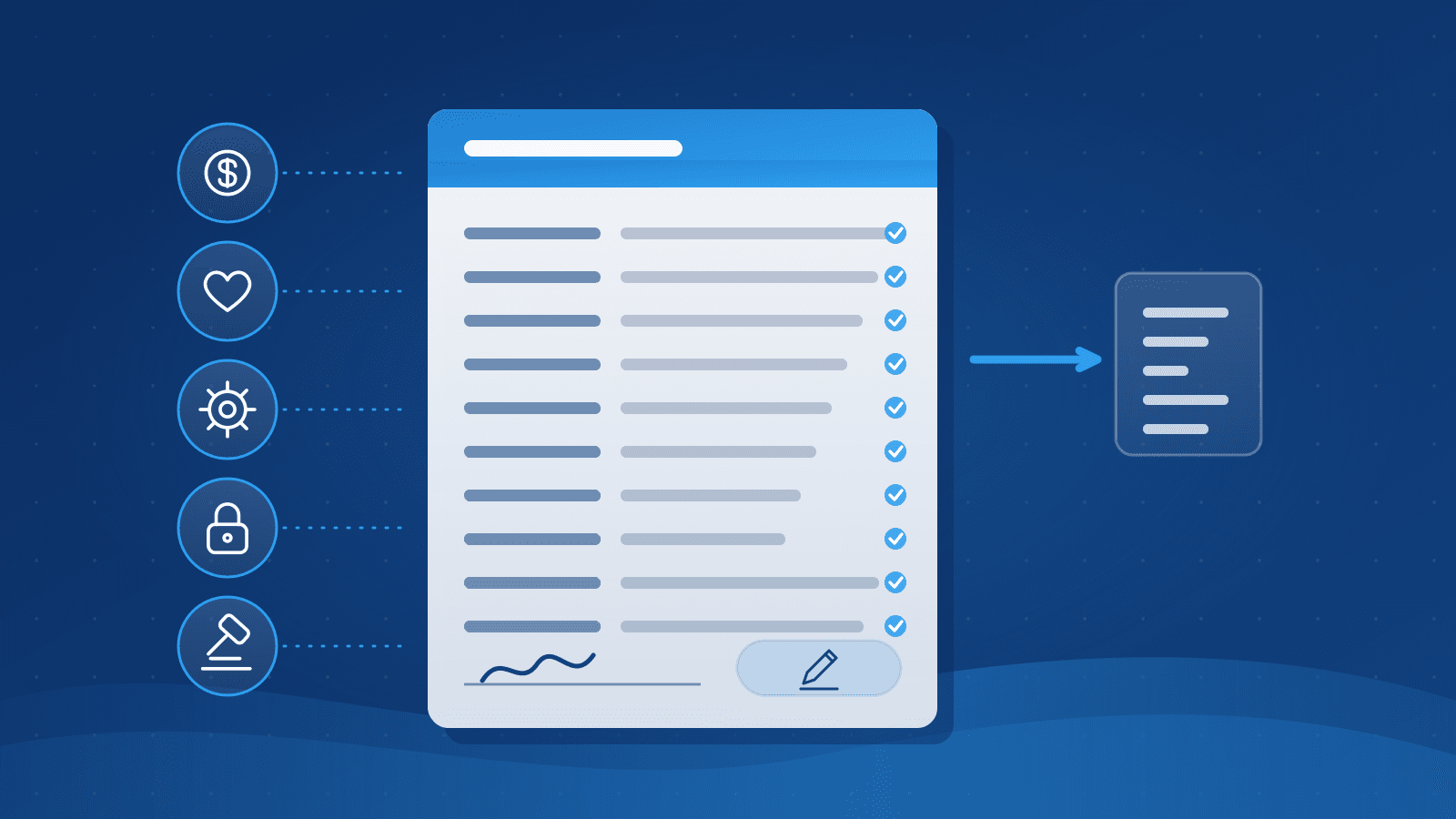
| Section | What it states |
|---|---|
| Purpose | Why we're outsourcing, in one sentence |
| Scope | Queues, channels, and volume in scope, and what's excluded |
| Accountable owner | One name, with authority across CX and operations |
| Decision rights | Who decides scope, weights, finalists, award, and terms |
| Baselines | Current cost per contact, FCR, CSAT, service level, QA, attrition |
| Targets and guardrails | Target ranges and what can't be traded away |
| Transition tolerance | Acceptable service dip and recovery window |
| Evaluation rubric | Criteria, weights, lock date, evidence standards |
| Consultant role | What the consultant advises on, and what the enterprise decides |
| Post-award owner | The named vendor manager and governance cadence |
If you can’t fill in a row, you’re not ready to release an RFP.
What is the pre-selection alignment gate?
Don’t release the BPO RFP until every answer is yes.
- ☐ One accountable owner is named, with authority across CX and operations
- ☐ Decision rights are written down and signed
- ☐ Baselines are measured for every KPI in the goals sheet
- ☐ Targets and guardrails are agreed by CX, operations, and finance
- ☐ Transition tolerance is defined
- ☐ A metric dictionary exists, with one definition per shared KPI
- ☐ Evaluation criteria trace back to the goals
- ☐ Weights are blended, locked, and dated
- ☐ Disclosures are on file for the evaluation team and the consultant
- ☐ A post-award vendor manager is named and on the evaluation team
Most enterprises can pass this gate in two to three weeks. Skipping it usually costs months later.
How can you tell whether your CX consultant is aligned with you?
Whose goals are they optimizing? Ask how they'll weigh finance's cost target against CX's experience goals. If the answer depends on who hired them, that's sponsor misalignment.
Do they insist on the charter? Advisors who have run outsourced programs push for alignment before the RFP, because they've seen what happens without it.
Can you audit their evaluation? Ask for the rubric, a redacted past scorecard, and written disclosure of their provider relationships.
Where does their scope end? At signature, at go-live, or after the first 90 days of governance?
For a structured list of the services an aligned engagement covers, see outsourcing alignment services.
How do you keep alignment after selection?
Alignment is only half done at signature.
- Monthly: Review the scorecard against the goals sheet at the steering meeting.
- Quarterly: Hold a full business review with the provider, including external benchmarking against comparable programs.
- Annually: Revisit the charter. Goals change, and so should the contract terms and the outsourcing strategy behind them.
- At renewal: Rescore the incumbent against alternatives using the same rubric.
Misalignment usually comes back through new stakeholders who never saw the charter. Make the charter part of onboarding for anyone who joins the steering group. For the structural barriers that pull teams apart over time, see the alignment barriers.
FAQ
What is CX outsourcing alignment?
It's agreement among every stakeholder in an outsourcing decision on goals, decision rights, and evaluation criteria before provider selection begins. CX, operations, finance, IT, and compliance sign off on what success looks like, who decides, and how providers will be scored.
Why do enterprise outsourcing decisions fail?
Usually because stakeholders want different outcomes and nobody settles which one wins. The consultant serves one sponsor, criteria get set after pitches, and no one owns the partner after signature. The conflicts then show up during transition.
How do you align stakeholders before BPO selection?
Name one accountable owner, write down decision rights, measure baselines, agree on targets and guardrails, and blend stakeholder weights into a locked evaluation rubric. Capture it all in a one-page charter signed before the RFP goes out.
What should an outsourcing governance model include?
One accountable owner, a decision-rights chart, a steering cadence that starts before the RFP, a defined role for the consultant, and a vendor manager named before selection. It should run through at least the first 90 days after go-live.
How long does outsourcing alignment take?
Two to three weeks for most enterprises, before the RFP is released. Skipping it usually costs months later, in evaluation disputes, contract rework, and transition problems.
Where CTG fits
CTG is a vendor-neutral CX consultant and contact center transformation partner for enterprise outsourcing decisions. Our enterprise CX advisory is practitioner-led and starts with the alignment charter, not the RFP.
- CTG Consulting. Alignment workshops, CX maturity and AI readiness assessments, baseline measurement, and contact center KPI design.
- BPO selection and advisory services. Blended stakeholder weighting, a published vendor evaluation rubric, and site-level evaluation across 40+ BPOs.
- CX procurement consulting. Contract frameworks, SLAs, and governance cadences that keep the charter alive after signature.
Our standard, stated plainly: Weights are agreed with you before any provider is invited, and we disclose our relationship with each provider in writing before a shortlist is built. We advise; you decide. We don't run outsourcing seats, so we don't have a site to fill.
We didn’t study contact centers. We ran them. We’ve also sat through a steering meeting where finance and CX learned, in front of the BPO, that they had different goals.
Talk to a Guru →