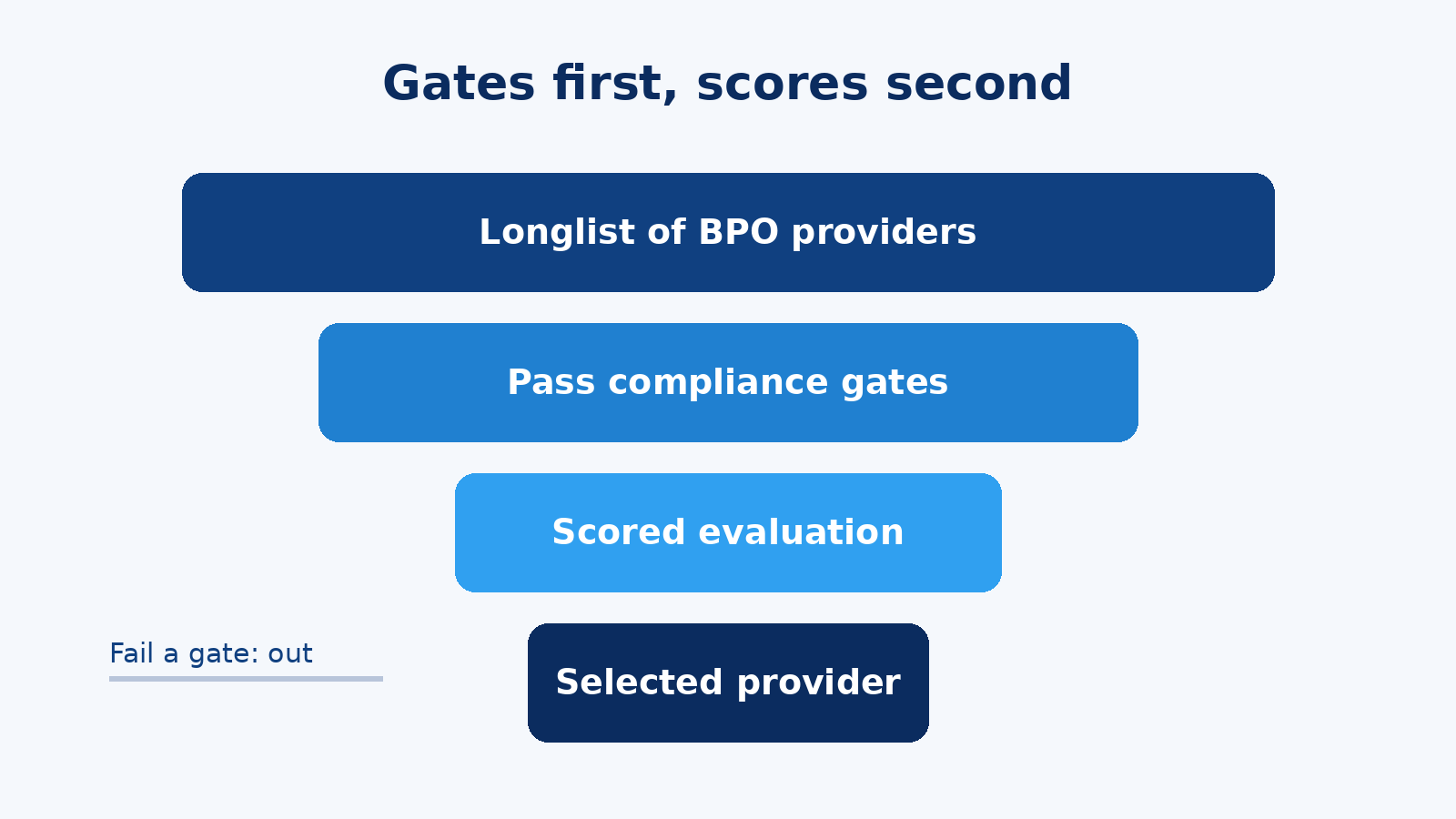
BPO selection for a regulated firm starts with compliance gates, not price. Before you score anything, a provider must show signed data agreements, verified controls at the delivery site, and audit rights in the contract. Only providers that clear those gates belong in a scored evaluation. Rate cards and logos come last.
Why it matters: In healthcare and financial services, you stay accountable for what an outsourced call center does with customer data. The contract moves the work. It does not move the responsibility. A weak selection process turns a cost decision into an audit problem.
We didn’t study contact centers. We ran them, including the regulated ones. These are the gates we would put in front of any outsourced call center in 2026 before the first proposal gets read.
Key takeaways
- Gates first, scores second. A provider that fails a compliance gate does not advance, whatever its price.
- Score the site, not the brand. Controls are delivered by a named site and a named team.
- Match the delivery model to the data. Offshore call center, nearshore call center, and onshore options carry different risk profiles for different contact types.
- Write exit and audit rights before you sign. You will not get them back later.
What makes BPO selection different for regulated firms?
Most contact center outsourcing decisions compare service quality, cost, and fit. Regulated selection adds a layer in front: can this provider legally and safely touch your customer data at all?
That changes the order of work. In a regulated BPO vendor selection, you screen on compliance first, then run the scored evaluation on the survivors. Our guide to building a contact center BPO scorecard covers the scoring. This post covers the screen that comes before it.
It also changes who sits at the table. Compliance, security, and legal should have a documented say in the gate list before any provider is invited. If they see the shortlist for the first time at contract review, you will lose weeks.
Which gates should a provider clear before you score it?
Treat each gate as pass or fail, and apply it to every one of the BPO providers on your longlist. Ask for evidence, not assurances.
| Gate | What to ask for | Evidence that counts |
|---|---|---|
| Data protection agreement | Willingness to sign your required terms, such as a business associate agreement for healthcare or your standard data protection addendum for financial services | A signed agreement, not a promise to sign |
| Security attestations | Current independent reports and certifications relevant to your data, such as SOC 2 Type II, ISO 27001, and PCI DSS where card data is handled | The report itself, its scope, and its date |
| Delivery site controls | Physical and logical controls at the named site: badge access, clean desk, device restrictions, recording and screen controls | Your own site visit and a control walkthrough |
| At-home agent controls | If agents work remotely, how identity, devices, networks, and environments are verified | Written policy plus monitoring evidence |
| Data residency and access | Where data is stored, who can reach it, and from which countries | A data flow diagram and an access list |
| Subcontractors | Every party that touches your data or your customers | A named list with the same controls flowed down |
| Audit rights | Your right to audit, and to receive timely incident notice | Contract language you have read |
A provider that treats these as paperwork to be handled after selection is telling you how it will treat them after go-live.
Should regulated work go onshore, nearshore, or offshore?
There is no universal answer. The right mix depends on contact type, data sensitivity, language needs, and your own regulatory exposure. Decide by contact type, not by queue.
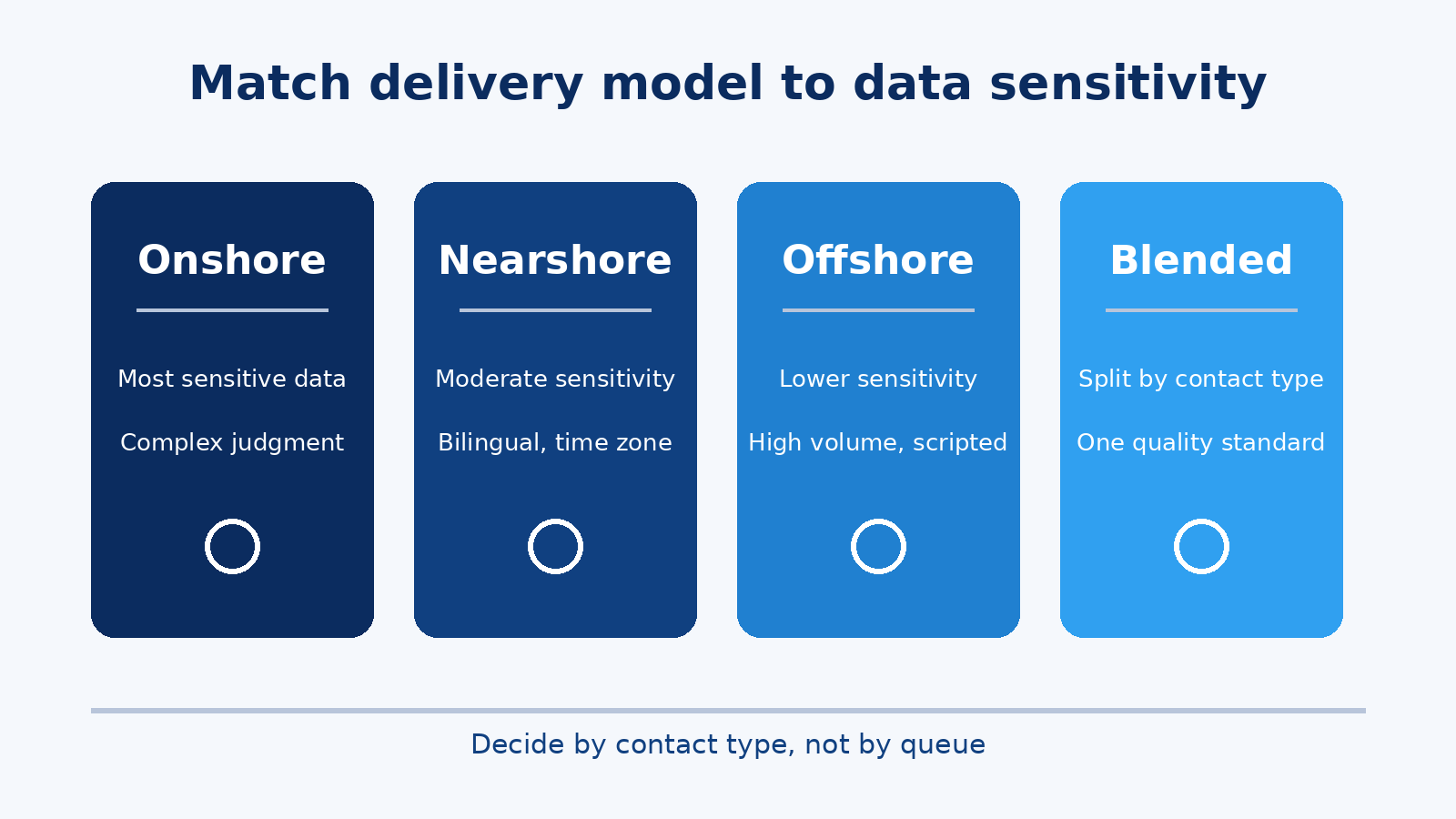
| Delivery model | Where it often fits | What to verify |
|---|---|---|
| Onshore | Contacts with the most sensitive data or the most complex judgment | Cost per resolved contact, not hourly rate |
| Nearshore | Bilingual or time-zone-sensitive work with moderate data sensitivity | Regulatory acceptance of the location for your data type |
| Offshore | High-volume, well-scripted work with lower data sensitivity | Data access controls, language quality, and attrition |
| Blended | Programs that split work by contact type | One quality standard and one reporting view across sites |
Whatever mix you choose, ask for a named site in every proposal. Our key questions for BPO selection give you a place to start.
How do healthcare and financial services requirements differ?
The gates are similar. The details are not.
Healthcare call center outsourcing centers on protected health information. Expect a signed business associate agreement, tight access controls, minimum-necessary data handling, and clear rules for what agents can and cannot say.
Financial services call center outsourcing centers on customer identity, payment data, and third-party risk expectations. Expect scrutiny of identity verification, PCI scope, complaint handling, call recording, and your own vendor oversight program.
In both cases, confirm with your own legal and compliance teams which rules apply to you. We are not a law firm, and neither is your BPO.
How do you score the providers that pass?
Once providers clear the gates, run a weighted evaluation. Agree the weights with operations, compliance, and finance before any proposal arrives. Score on:
- Site-level performance: quality, resolution, and attrition at the named site, using production data over proposal claims.
- Compliance maturity: how well the controls actually work, beyond the fact that they exist.
- Transition capability: knowledge transfer, nesting, and go-live gates.
- Total cost: three-to-five-year cost, normalized to cost per resolved contact.
- Governance fit: reporting, escalation, and a named executive owner.
Give every score a source: site visit, reference, contract language, or independent report. No evidence, no score.
What belongs in the contract and the BPO transition?
The transition is where regulated programs most often slip. Put these in the scope before you sign:
- Go-live gates owned by you. Compliance controls verified before the first live contact, not “in progress.”
- Nesting tied to quality thresholds, not calendar dates.
- Weekly attrition and tenure reporting during the first months.
- Incident notice and audit rights with defined timelines.
- Exit terms that cover data return, knowledge transfer, and a transition-out plan.
Our BPO RFP guide shows where to put these requirements so providers price them up front.
FAQ
How do you select a BPO for a regulated industry in 2026?
Screen first on compliance gates: signed data agreements, current security attestations, verified site controls, and audit rights. Then score the surviving providers on site-level performance, transition capability, total cost, and governance fit. Agree the weights with compliance and operations before any proposal arrives.
Can regulated contact center work be offshored?
Sometimes, depending on the data, the contact type, and the rules that apply to you. Many firms keep the most sensitive work onshore and move lower-risk work elsewhere. Confirm location rules with your legal and compliance teams before you shortlist any provider.
What should a healthcare BPO provide before it handles calls?
At a minimum, a signed business associate agreement, current security attestations, documented access controls at the delivery site, trained and verified agents, and clear scripts for what agents may say. You should also be able to audit the site and receive incident notice on defined timelines.
How long does a BPO transition take for a regulated firm?
It depends on volume, complexity, and how many controls must be verified, so we will not quote a number without your details. Plan the transition around gates, such as verified controls, calibrated QA, and performance thresholds, rather than a fixed calendar date.
Who should own the BPO relationship after go-live?
One named internal owner should run vendor governance, with monthly scorecards and quarterly reviews that include compliance. If the owner is simply whoever signed the contract, the relationship drifts. Name the role and write its duties before the selection engagement ends.
Where CTG fits
Cloud Tech Gurus is a Phoenix-based customer experience consulting and sourcing firm, founded in 2017 by former contact center executives. We run vendor-neutral BPO selection across 40+ providers, with a published rubric and the compliance gates agreed with you before any provider is invited.
We work three ways: paid CTG Consulting, vendor-funded research shortlists, and guru-led sourcing under a Letter of Agency. Suppliers compensate us when a client buys through us. We disclose that up front, and we disclose our relationship with each provider in writing before a shortlist is built.
We didn’t study contact centers. We ran them.