Contact centers handle holiday surges best by staffing the intervals that break, not the whole season. Find the recurring 30-to-90-minute holes in your interval report, cover them with flexible capacity billed on productive time, protect your tenured agents, and keep complex contacts with your core team. Hiring for the peak is the slowest and costliest fix.
Why it matters: The National Retail Federation expects November and December retail sales to top $1 trillion this year, and Adobe forecasts $275.1 billion in online holiday spending. Every late package, failed checkout, and return becomes a contact, and most of that volume lands in a handful of intervals that your staffing model was never built to cover.
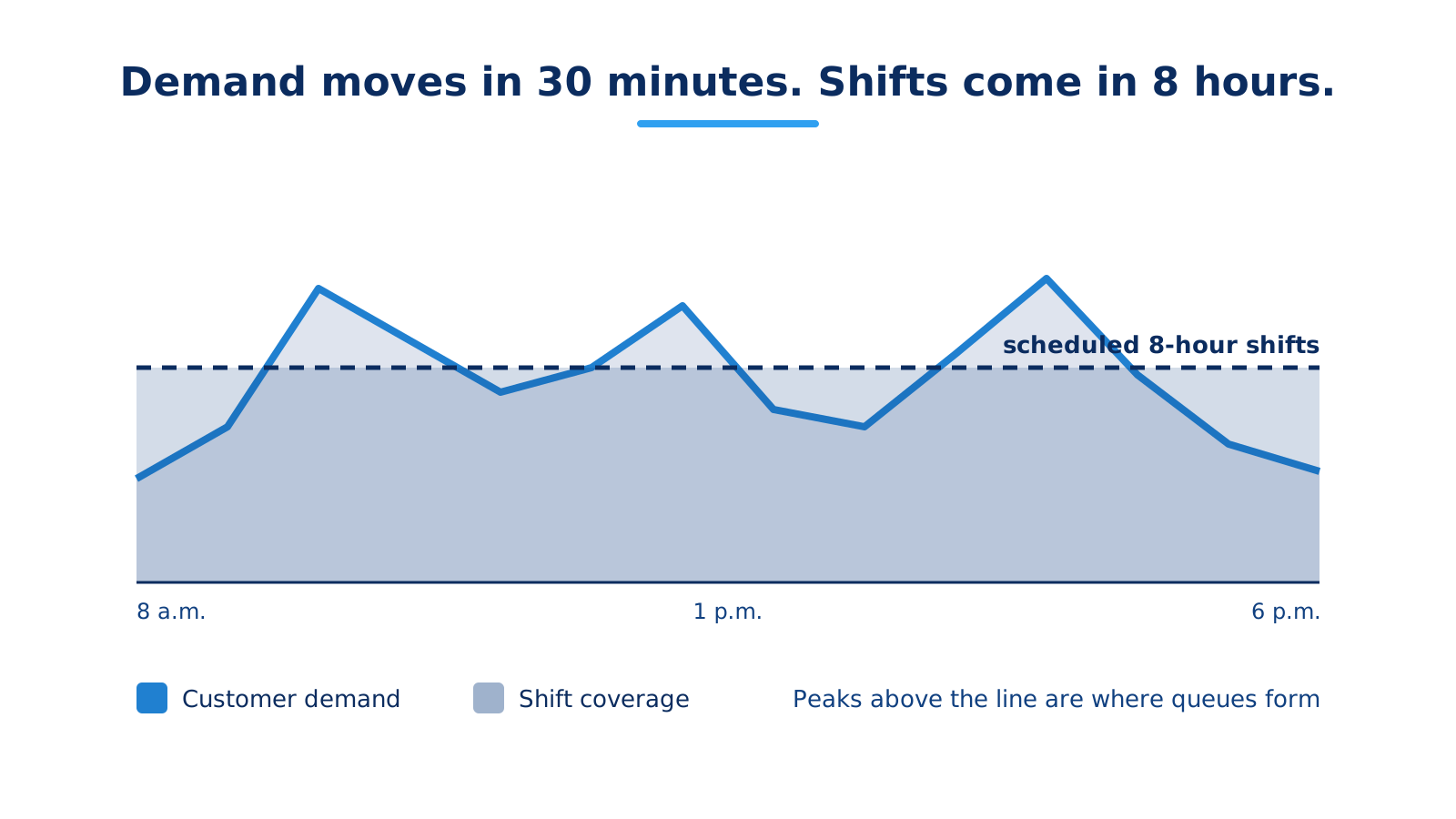
Every contact center veteran knows the shape of a bad day. The 9:15 wall on Monday. The lunch hour when half the floor is gone and the queue does not care. The twenty minutes after marketing sends a promotion and forgets to tell operations. The holiday season does not create those holes. It deepens them.
We didn’t study contact centers. We ran them. This is how we are helping contact centers get ready for this peak, and the next one.
Key takeaways
- The forecast is usually right. The problem is the smallest unit of staffing you are allowed to buy.
- Hiring for the peak is too slow and too expensive. Retailers themselves are hiring “smaller and more surgical” this year.
- Your best agents are your hidden surge plan. They absorb the spike, and it shows up later as attrition.
- Flex the bounded work, protect the hard work. Overflow and transactional contacts can flex. Fraud, payments, and upset customers stay with your core team.
What actually breaks in a contact center during a holiday surge?
Most peak-season failures trace back to a handful of predictable problems. None of them is a surprise, and each has a fix.
| What breaks | What it looks like on the floor | The fix |
|---|---|---|
| The staffing unit, not the forecast | Contact center workforce management forecasts in 30-minute intervals, but the scheduler can only buy an eight-hour person | Buy capacity in the shape of the gap |
| Seasonal hires arrive late and green | Recruiting and training take weeks, and new agents know the policies least when customers need them most | Certify a flexible pool before peak and give it a bounded set of contact types |
| Tenured agents absorb the spike | Skipped breaks, rushed wrap-up, and burnout that surfaces months later as attrition | Route overflow away from the core team on defined triggers |
| You pay for shrinkage at peak | Scheduled hours are billed in full, including the windows where you only needed forty minutes | Compare the total cost of covering the window, not the hourly rate |
| The queue left after self-service is harder | Simple contacts are automated, so what reaches agents is spikier and more complex | Keep complex work with your core team and flex the bounded work |
| Remote surge capacity raises security questions | Payment and identity contacts spike at the same time as new, unfamiliar agents | Verify PCI DSS, SOC 2, and agent identity controls before go-live |
Why doesn’t hiring for the peak work anymore?
Because the math never worked, and the market knows it. Challenger, Gray & Christmas expects seasonal retail hiring of about 450,000 in the fourth quarter, down 2.5 percent from last year, according to Retail Dive. Andy Challenger described it as “restocking staffing plans surgically.” Last year’s seasonal retail hiring was already the smallest gain since 2008.
Contact centers face the same arithmetic with less room for error. Labor is the most expensive line in the operation. A seasonal hire takes weeks to recruit and train, often reaches proficiency after the peak has passed, and then leaves. You cannot add permanent cost to solve a ninety-minute problem, and you cannot add temporary cost fast enough to solve it either.
That leaves most operations with one real surge plan: their tenured agents working harder. That plan works until it doesn’t.
How does flexible contact center staffing work during a surge?
The working term is incremental capacity. Instead of buying people in eight-hour blocks, you buy coverage in 30-minute blocks wherever your week has holes. A trained, vetted pool sits behind your queue, certified on your program, and takes overflow in those windows.
The difference that matters is the billing unit. Traditional call center staffing solutions bill scheduled hours, which include breaks, coaching, and idle time. Some flexible models bill only productive time, meaning time agents are logged in and handling or ready to handle contacts. That is why a provider with a higher hourly rate can land lower on the total invoice. Very few providers can do this, because it takes a different operating model underneath, not a different pricing page.
On-demand contact center agents are not a replacement for your team. They are a way to stop buying a whole shift to cover a short spike. Here is how we divide the work during a peak:
| Contact type | Who handles it at peak | Why |
|---|---|---|
| Order status and delivery questions | Self-service first, flexible overflow second | High volume, low complexity, easy to script |
| Returns and exchanges | Flexible pool with tight knowledge content | Policy-bound, but policies must match every channel |
| After-hours and weekend overflow | Flexible capacity | Too costly to cover with full-time schedules |
| Payment problems and suspected fraud | Core team, on a secure path | Risk and authentication matter more than speed |
| Upset or high-value customers | Tenured agents | Judgment and brand affinity matter most |
| Complex or regulated contacts | Core team | Long ramp, high consequence of error |
How do we get a contact center ready for peak?
When an operations leader comes to us before a peak, we do not start with vendors. We start with their own data.
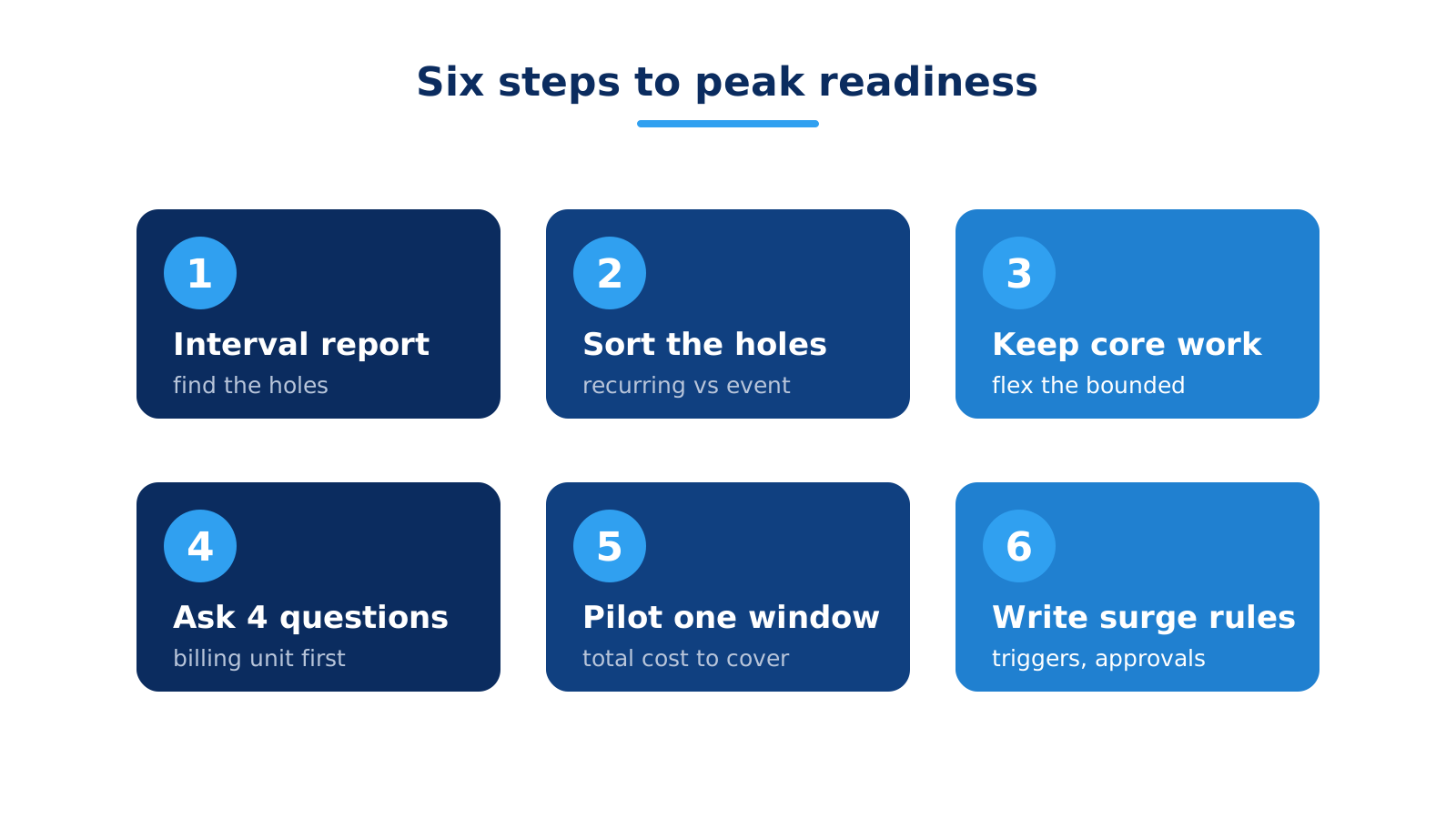
- Pull the interval report. Use a normal week and last year’s peak week. Mark every interval where required staffing beat scheduled staffing by one or two agents.
- Sort the holes. Recurring holes, like Monday mornings and lunch hours, are predictable. Event-driven holes, like promotions, shipping delays, and outages, are not. They need different fixes.
- Decide what stays core. Separate bounded, transactional contacts from complex, regulated, or high-emotion ones before any capacity conversation starts.
- Ask providers four questions. What exactly is the billing unit? What is the smallest increment and the minimum commitment? How is the pool trained for this program, and who owns quality? If intervals change on Thursday, what can actually change by Monday?
- Pilot one window. Pick one recurring, well-understood window and run flexible coverage for several weeks before peak. Compare the total cost of covering that window, not the hourly rate.
- Write the surge rules. Define the triggers that add capacity, who approves them, and who is reachable overnight.
If your surge is already here, do not onboard a new provider mid-peak. Use this season to capture the data: which intervals broke, which contacts drove them, and what your team absorbed. That list becomes next year’s requirements, and January is the right time to act on it. Our guide to retail peak-season planning covers what to fix and what to freeze in the weeks before a rush.
Does this only apply to the holidays?
No. The holidays are the most visible peak, but most contact centers have several. Tax season, insurance open enrollment, storm and outage season, product launches, and travel disruptions all follow the same pattern: a forecastable spike that does not justify permanent headcount.
The approach is the same for each. Find the intervals that break, decide what can flex, and buy capacity in the shape of the demand curve. Workforce optimization stops being a scheduling exercise and becomes a sourcing decision. Our GigCX overview explains the on-demand model in more detail.
FAQ
How do contact centers prepare for holiday call volume?
Start with the interval report, not a hiring plan. Find the recurring windows where required staffing beats scheduled staffing, decide which contact types can flex, and line up capacity for those windows before peak. Write surge triggers and approvals in advance, and keep complex contacts with tenured agents.
What is flexible contact center staffing?
It is capacity bought in small increments, often 30 minutes, from a trained pool certified on your program. The pool covers overflow, after-hours, and surge windows. Some providers bill only productive time instead of scheduled hours, which changes the cost comparison with traditional seasonal hiring.
Is on-demand staffing cheaper than hiring seasonal agents?
It can be, but compare the right number. Seasonal hires carry recruiting, training, and idle time, and often leave before they are proficient. A productive-time model can land lower on total cost even at a higher hourly rate. Pilot one window and compare the total cost of covering it.
Which contacts should stay with full-time agents during peak?
Payment problems, suspected fraud, upset or high-value customers, and complex or regulated contacts. These need judgment, authentication, and deep program knowledge. Flexible capacity fits best on bounded, transactional work such as order status, simple returns, and after-hours overflow.
How early should a contact center plan for peak season?
Plan the capacity model months ahead, ideally in the quiet period after the previous peak. Certifying a flexible pool, testing security controls, and piloting one window all take time. If the surge is already here, capture what broke this season and use it to plan the next one.
Where CTG fits
Cloud Tech Gurus is a Phoenix-based customer experience consulting and sourcing firm, founded in 2017 by former contact center executives. We help operations leaders match their delivery model to the shape of their demand curve. That includes evaluating contact center outsourcing and flexible capacity across the 40+ BPOs in our network, only a handful of which schedule and bill in 30-minute increments.
We work three ways: paid CTG Consulting, vendor-funded research shortlists, and guru-led sourcing under a Letter of Agency. Suppliers compensate us when a client buys through us. We disclose that up front, and we disclose our relationship with each provider in writing before a shortlist is built.
We didn’t study contact centers. We ran them.