A strong contact center BPO RFP gives providers 12 to 24 months of real operating data, scores them on criteria you publish, and puts your contract terms on the table before bids arrive. Build it in eight steps and you get comparable proposals instead of padded pricing and recycled boilerplate.
Why it matters: The RFP sets the ceiling on your outsourcing outcome. Thin data makes providers pad their pricing to cover risk. Hidden criteria make them write to a guess. Terms that surface after award erase the best rate in the bid. Most bad outsourcing outcomes trace back to an RFP that asked the wrong questions, or the right ones in the wrong order.
We learned this from the buyer’s side. Cloud Tech Gurus was founded by former contact center executives who wrote BPO RFPs, answered them at midnight before deadlines, and lived with the contracts that followed. This is how we would build one in 2026 for an enterprise program.
Key takeaways
- Data first. Providers price what you show them. Give them real volume, handle time, and contact reasons.
- Site-level answers only. Require a named site, named leaders, and site data in every response.
- Terms up front. Put your SLA and contract framework in the RFP and ask providers to mark up what they would change.
What is a contact center BPO RFP?
It is the document an enterprise sends to outsourcing providers to get comparable proposals for customer service operations. It covers scope, operating data, requirements, a standard pricing template, proposed contract terms, and the criteria responses will be scored on. It is the second step in outsourcing selection: first you decide what to outsource, then the RFP turns that decision into bids you can compare line by line.
How do you decide what goes in the RFP?
Decide which queues are in scope and why, before you write a word. Some queues outsource well: scripted work, volume spikes, 24/7 coverage. Others belong in-house. The most scripted queues may be better candidates for automation than for a BPO, so run an AI readiness assessment on your highest-volume, lowest-complexity queues first. Outsourcing work you will automate in 18 months locks you into seats you will not need.
Checkpoint: a signed scope listing every queue, its channel, and the reason it is being outsourced.
What belongs in the data pack?
Providers price risk, and the less data you share, the more risk they price in. A complete pack includes:
- Volume by interval for 12 to 24 months, by queue and channel, with seasonal peaks marked.
- Handle time and after-call work by queue, as distributions, not just averages.
- Top contact reasons with their share of volume.
- Current KPIs, including first contact resolution, CSAT, service level, and QA scores, and how each is measured.
- Your QA form and calibration approach.
- A systems list: CCaaS, CRM, workforce management, knowledge base, and QA tools the provider will work in.
- Compliance scope: HIPAA, PCI DSS, TCPA, data residency, and any industry rules.
Anonymize customer data where needed, but do not strip the operating reality. A provider cannot staff to an AHT you did not share. Checkpoint: an operations leader confirms the pack matches what the floor actually sees.
How do you separate knockouts from scored requirements?
Split requirements into two groups before anyone writes a response.
| Type | How it works | Examples |
|---|---|---|
| Knockout | Pass/fail. Any “no” ends the response. | Compliance certifications, required languages and hours, delivery model, vertical experience, technology compatibility |
| Scored | Rated against weighted criteria. Decides the winner. | Quality and resolution results, workforce stability, ramp capacity, transparency, contract terms |
Write scored requirements as outcomes, not features. “Describe how you would improve first contact resolution on our billing queue within six months” gets a better answer than “Do you offer quality assurance? Yes/No.” Map each one to a criterion in your BPO scorecard so the RFP and the evaluation stay in sync.
Why require site-level responses?
Proposals are written at headquarters, but the work happens at a specific site. Require every response to include the named site that will run your program, named leadership with bios, site-level data for the last 12 months (attrition, tenure, 90-day retention, supervisor ratio), and comparable programs at that site by vertical and seat count. A response with no named site is incomplete. Treat it that way.
How should you standardize pricing?
If every provider prices in its own format, you will spend weeks building a comparison. Require one template: three volume scenarios (base forecast, 20% above, 20% below), all-in cost lines for productive rate, training, nesting, attrition backfill, premiums, technology pass-through, and management fees, plus clear definitions of shrinkage and billable time. Price transition and exit costs separately.
Then normalize every bid to cost per resolved contact at your volume profile. It is the only number that compares hourly, per-minute, and per-contact pricing fairly.
Which contract terms go in the RFP?
Do not save terms for after award. Include your framework and ask providers to mark up what they would change.
- SLAs for resolution, quality, CSAT, service level, abandon rate, and attrition, measured in your systems.
- Credits and earnbacks: the share of the invoice at risk and how providers earn it back.
- Forecast bands: the volume range the price holds within and what happens outside it.
- Exit terms: termination for convenience, transition assistance, and knowledge transfer.
- Data ownership for recordings, transcripts, and QA data.
Providers who mark up heavily are telling you something useful before you have invested weeks in them. Get legal and procurement sign-off before the RFP goes out.
What is different about a BPO RFP in 2026?
Three topics belong in every RFP that were optional a few years ago.
- AI and automation. Ask which AI tools agents will use, who owns the transcripts and recordings, whether your data can train the provider’s models, and how savings are shared when AI cuts handle time. Do not accept human-rate hours billed for machine-assisted work.
- Security for distributed agents. Ask how at-home agents are verified at every login, how devices are locked down, how access is revoked the same day, and how the provider defends account-servicing queues against synthetic voice fraud.
- Quality at full coverage. Speech and text analytics can evaluate every contact, not a small sample. Ask what share of contacts the provider evaluates and whether you get the same data.
What should the RFP template contain?
| Section | What it contains |
|---|---|
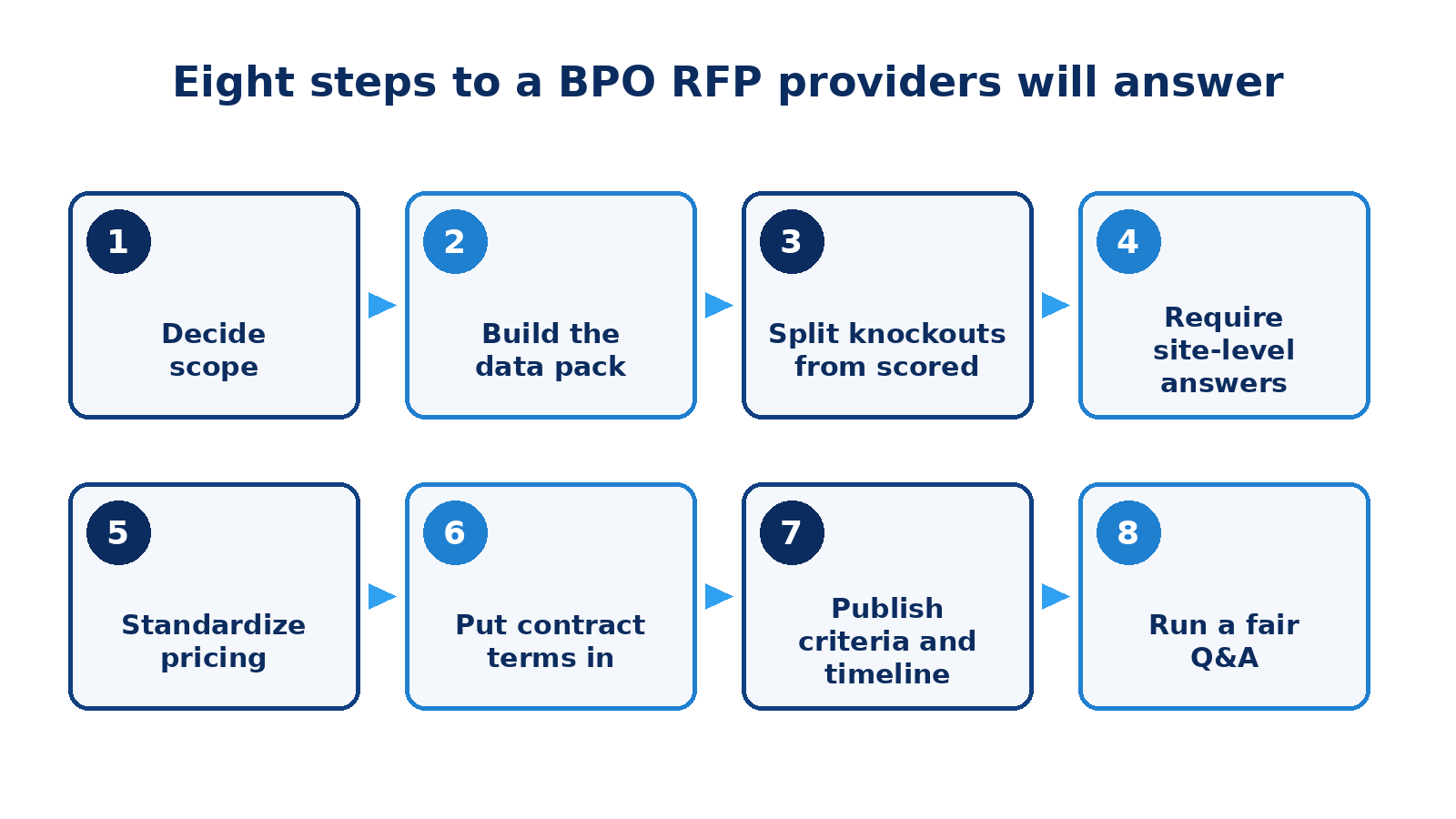
| 1. Overview and scope | Who you are, why you are outsourcing, queues, channels, languages, hours, seat count |
| 2. Data pack | Volume, handle time, contact reasons, KPIs, QA form |
| 3. Requirements | Knockouts first, then outcome-based scored questions |
| 4. Site and leadership | Named site, named leaders, site-level data |
| 5. AI, automation, and security | Tools, data ownership, governance, at-home controls |
| 6. Pricing template | Three volume scenarios, all-in cost lines, definitions |
| 7. Contract framework | SLAs, earnbacks, forecast bands, exit, data ownership |
| 8. Criteria and timeline | Weights, stages, dates, Q&A rules |
How long should the process take?
Publish your criteria, weights, stages, and dates in the RFP. Disclosing weights does not let providers game it. It lets them focus on what you care about. Give them three to four weeks to respond on enterprise programs. Run Q&A through one named contact, in writing, share every answer with every provider at once, and close questions a week before responses are due.
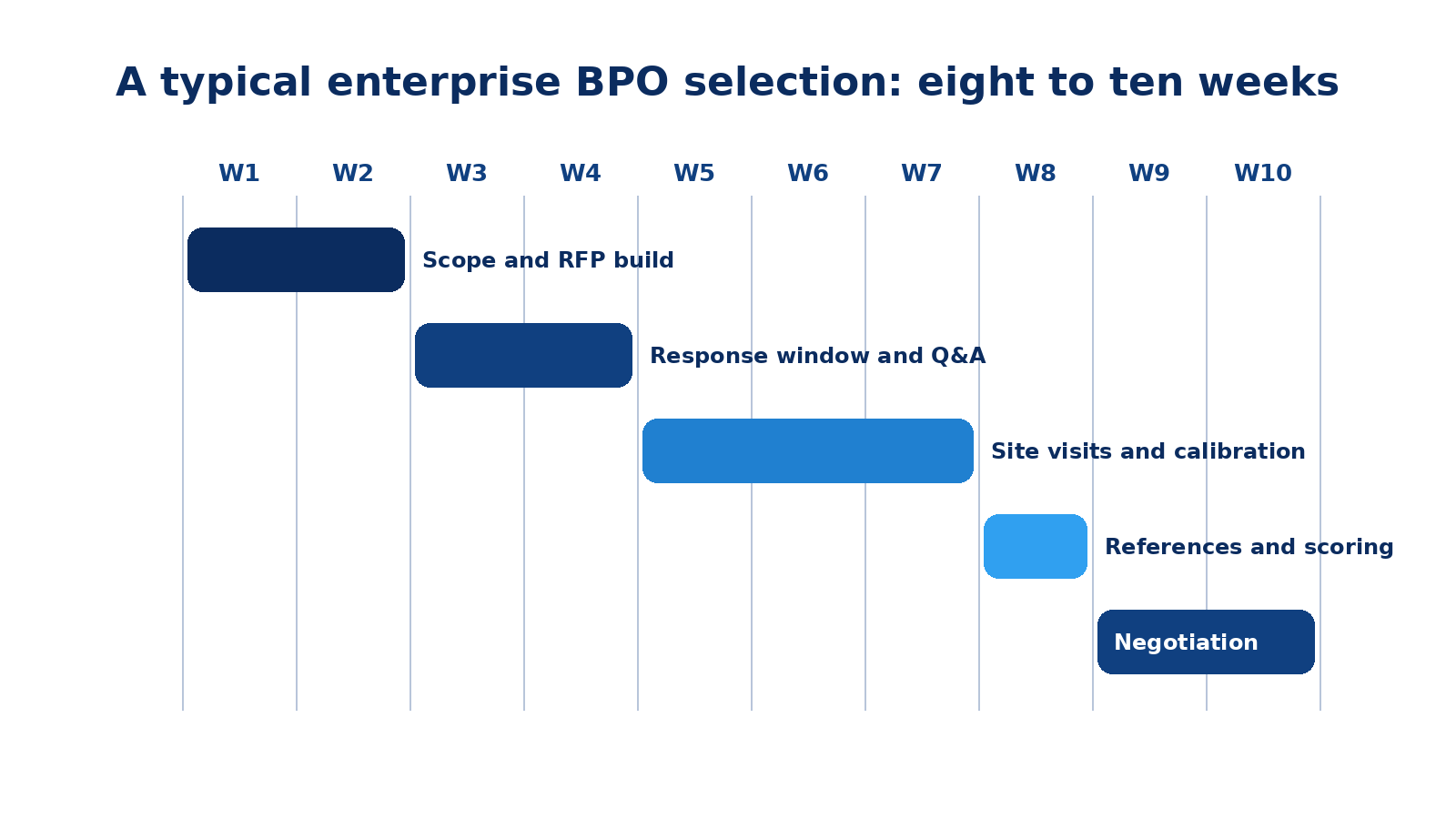
A typical enterprise selection runs eight to ten weeks. Your timeline will vary with program size and how many sites you visit.
What mistakes turn away strong providers?
- No real data. Strong providers will not guess at your AHT. They decline or price in the uncertainty.
- A 300-line yes/no spreadsheet. It rewards proposal teams, not operators.
- Lowest-price-wins signals. Providers who invest in agents often will not bid on a reverse auction.
- Unrealistic windows. A two-week deadline for a 500-seat program gets recycled answers.
- Terms revealed after award. Fair bidders lose margin in negotiation while padded bids come out ahead.
FAQ
What should a contact center BPO RFP include?
Scope, a data pack with 12 to 24 months of volume and handle time, knockout and scored requirements, site-level response rules, a standard pricing template, a proposed contract framework, AI and data terms, published evaluation criteria, and a timeline with Q&A rules.
How long should a BPO RFP response window be?
Three to four weeks for enterprise programs. Shorter windows tend to produce boilerplate. Close questions one week before responses are due, and send every answer to every provider at the same time so no one bids with an information advantage.
Should you share evaluation criteria in a BPO RFP?
Yes. Published weights do not let providers game the process. They help providers focus on what you care about, and they make the final decision easier to defend when someone inside your company questions it later.
What AI questions belong in a 2026 BPO RFP?
Ask which AI tools agents will use, who owns recordings and transcripts, whether your data can train the provider’s models, how automation savings are priced and shared, and how accuracy, escalation to humans, and audit trails are governed.
Why do BPOs decline to respond to RFPs?
Usually because the RFP has no real data, signals a lowest-price-wins evaluation, sets an unrealistic deadline, or hides contract terms until after award. Strong providers choose where to spend proposal effort, just as buyers choose where to spend evaluation time.
Where CTG fits
Cloud Tech Gurus is a Phoenix-based customer experience consulting and sourcing firm, founded in 2017 by former contact center executives. We build the RFP with your operations team and run it across the 250+ suppliers and 40+ BPOs in our network, as part of our BPO selection and outsourcing procurement work. Responses are scored against a documented rubric you can audit.
There are three ways to work with us: paid CTG Consulting, vendor-funded research shortlists, and guru-led sourcing under a Letter of Agency. Suppliers compensate us when a client buys through us. We disclose that up front, agree the weights with you before any provider is invited, and disclose our relationship with each provider in writing before a shortlist is built. We do not run outsourcing seats, so we have no site to fill.
Our Gurus ran them.