CX governance is the set of decisions about who decides what: who owns the customer experience target, who can change a process, who approves technology and vendor spend, and who breaks ties. Define these decision rights first. Without them, customer experience consulting stalls at the first disagreement between departments.
Why it matters: Most CX programs do not fail on ideas. They fail when two leaders each believe they own the same decision, or when nobody does. The roadmap is fine. The decision rights were never written down, so every change waits for a meeting that never produces a ruling.
We didn’t study contact centers. We ran them. We have watched good plans sit for a quarter because nobody could say who was allowed to approve the change. These are the seven decisions we would settle in 2026 before anything else.
Key takeaways
- Write decision rights before the roadmap. A plan nobody is authorized to approve is a draft.
- One owner per decision. Shared ownership means no ownership.
- Define the metrics once. Two definitions of first contact resolution is a governance gap, not a reporting problem.
- Set a cadence. Decisions need a standing forum, not an ad hoc rescue meeting.
What is CX governance, and why does it come first?
CX governance is how an organization makes and enforces decisions about customer experience. It covers ownership, metric definitions, change approval, spending authority, risk, and escalation.
It comes first because everything else depends on it. A CX operating model, an AI readiness assessment, a contact center modernization roadmap, and an outsourcing strategy all need someone with authority to say yes. If you start with the roadmap, you discover the governance gap in month three, usually in front of an executive who was never asked.
Good customer experience consulting, and good call center consulting more broadly, surfaces these gaps in week one. Our post on why the operating model is usually the real problem explains why strategy so often stalls between the boardroom and the floor.
Which CX governance decisions should you define first?
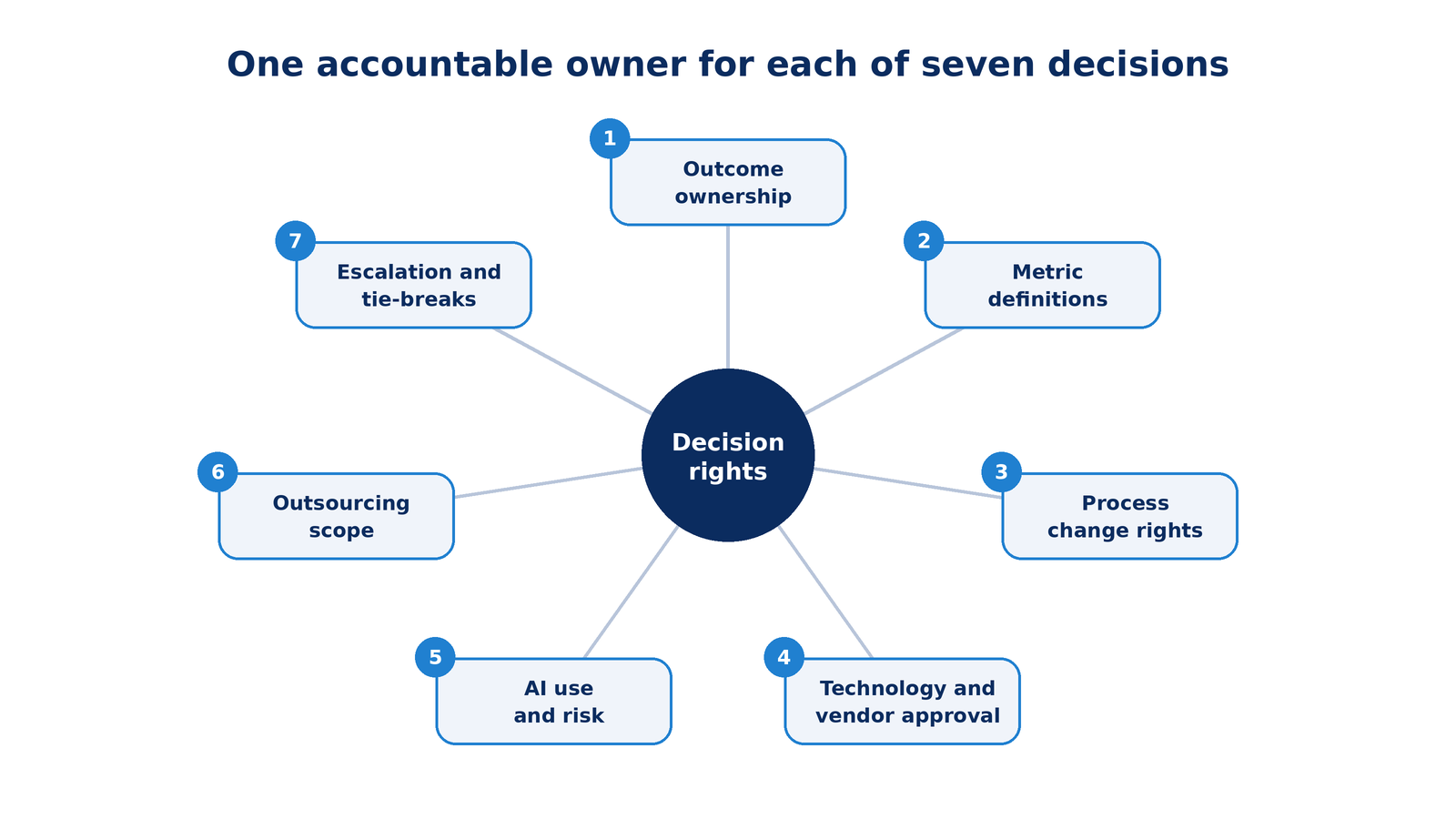
Settle these seven. For each, write down one accountable owner, who must be consulted, and how disagreements get resolved.
| Decision | The question to answer | What breaks without it |
|---|---|---|
| 1. Outcome ownership | Who is accountable for the customer experience result? | Every function reports its own version of success |
| 2. Metric definitions | How do we define resolution, containment, CSAT, and cost per contact? | Dashboards disagree and nobody trusts them |
| 3. Process change rights | Who can change a script, a routing rule, or a QA form? | Changes happen informally or not at all |
| 4. Technology and vendor approval | Who approves platform, AI, and vendor choices, and on what criteria? | Purchases run ahead of the operating model |
| 5. AI use and risk | Who decides where AI may act, and who answers for it? | Pilots stall at the first legal question |
| 6. Outsourcing scope | Who decides which queues to keep, automate, or outsource? | Finance decides alone, then operations inherits it |
| 7. Escalation and tie-breaks | Who rules when two owners disagree, and by when? | Disputes sit until the quarter ends |
Decision five gets its own treatment in our guide to contact center AI governance. Here the point is simpler: someone must own it.
Who should own each decision?
There is no single right answer, but there are wrong ones. Four patterns cause most of the trouble.
- Ownership by committee. Everyone has a voice, and no one can make the call.
- Ownership by budget. The function that pays decides, even when another function carries the consequence.
- Ownership without authority. A CX leader is named accountable but cannot change process or approve spend.
- Ownership without a floor view. Decisions made without operations or workforce planning input fail at implementation.
A useful test: for each decision, can you name one person, and can that person act without asking three other people? If not, the decision is not owned.
How do you keep governance working after the consultants leave?
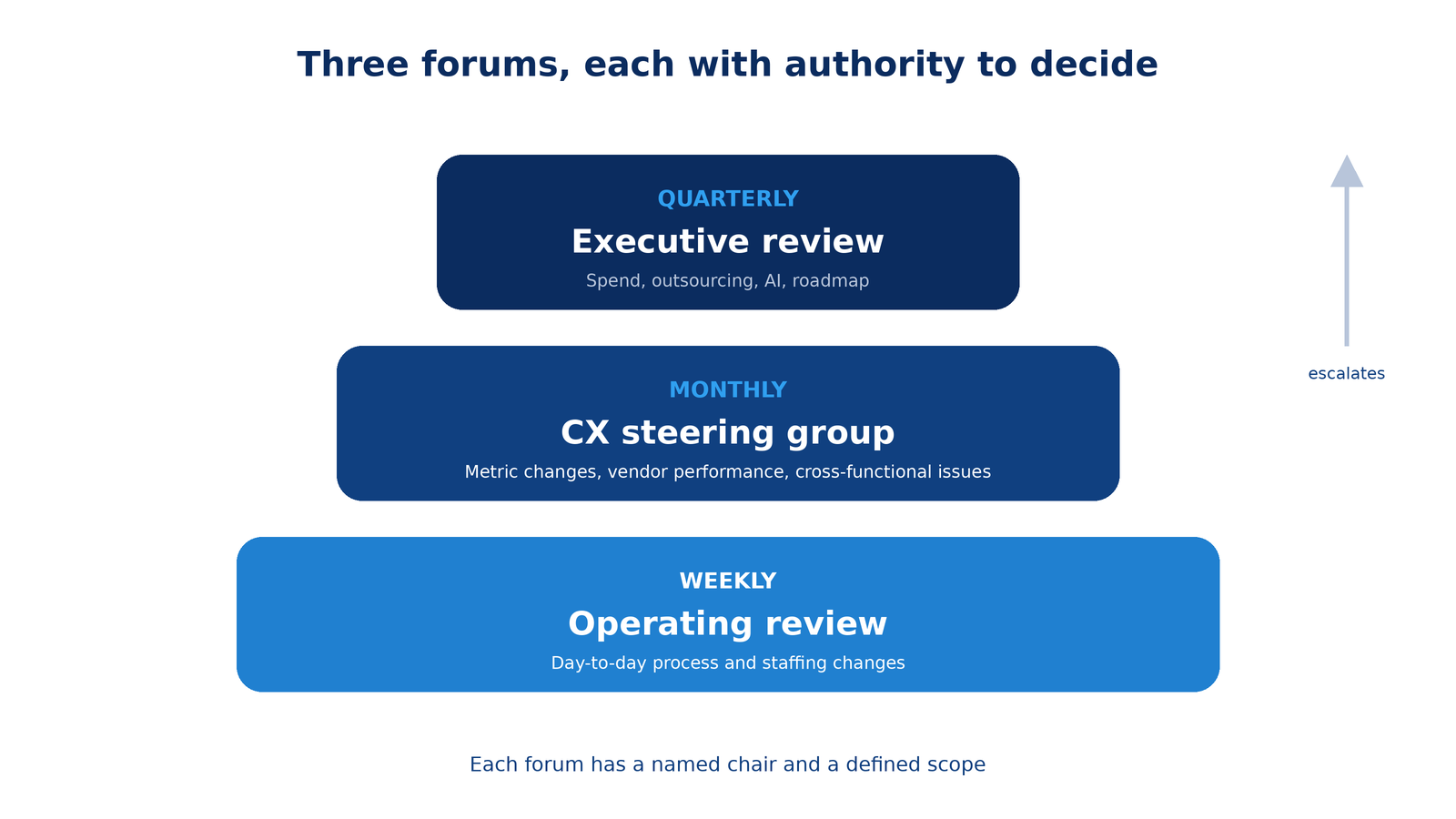
Governance decays unless it has a rhythm. A simple cadence is enough.
| Forum | Suggested frequency | What it decides |
|---|---|---|
| Operating review | Weekly | Day-to-day process and staffing changes within existing authority |
| CX steering group | Monthly | Metric changes, vendor performance, and cross-functional issues |
| Executive review | Quarterly | Spend, outsourcing scope, AI expansion, and roadmap changes |
Adjust the rhythm to your size. The principle holds: each forum has a defined scope, a named chair, and the authority to decide, not just discuss. If workforce optimization, QA, and technology teams each run their own forum, add one place where their trade-offs meet.
What does governance look like when outsourcing is involved?
Outsourcing adds a second organization to the decision map. Settle three extra questions before you sign a provider.
- Who owns the vendor relationship day to day? A named internal role, not whoever signed the contract.
- Who can change the scope? Define how volume, channels, and scripts change, and who approves.
- Who owns the scorecard? If outsourcing advisory ends at signature, someone on your team must run governance after.
These questions matter most at the handoff. A provider can only follow rules that your own team has agreed on, written down, and assigned to a named person. If your internal decision rights are unclear, an outsourced contact center will inherit that ambiguity and charge you for it in rework, escalations, and slow approvals.
Operations alignment is where these gaps show up on the floor first, so bring operations into the decision map from the start.
FAQ
What is CX governance?
CX governance is how an organization decides who owns customer experience outcomes, how metrics are defined, who can change processes, who approves technology and vendor spend, and who resolves disputes. It turns a CX strategy into decisions that someone is authorized to make and accountable for.
Why does customer experience consulting stall?
Often because nobody has authority to approve the recommended changes. The advice is sound, but decision rights are unclear, each function defines metrics differently, and spend sits with someone who does not own the outcome. Settling governance first removes most of those blockers before the engagement begins.
Who should own CX decisions in a contact center?
One accountable owner per decision, with defined consultation. Outcome ownership often sits with a senior CX or operations leader, while technology approval, AI risk, and outsourcing scope may sit elsewhere. What matters is that each owner can act without waiting on several other approvals.
How is CX governance different from AI governance?
AI governance is one part of CX governance. It covers where AI may act, how disclosure is handled, and who answers for AI decisions. CX governance is broader: it covers every ownership, metric, change, and spend decision, with AI as one of seven decisions to settle.
How often should CX governance be reviewed?
Review the decision map at least annually, and whenever you add a major platform, a provider, or an AI use case. Run the operating cadence weekly, monthly, and quarterly. Governance that only gets revisited during a crisis has already stopped working.
Where CTG fits
Cloud Tech Gurus is a Phoenix-based customer experience consulting and sourcing firm, founded in 2017 by former contact center executives. Our practitioner-led contact center consulting starts with decision rights, metric definitions, and ownership, then moves to roadmaps, AI readiness, and vendor selection.
We work three ways: paid CTG Consulting, vendor-funded research shortlists, and guru-led sourcing under a Letter of Agency. Suppliers compensate us when a client buys through us. We disclose that up front, agree the weights with you before any provider is invited, and disclose our relationship with each provider in writing before a shortlist is built.
We didn’t study contact centers. We ran them.