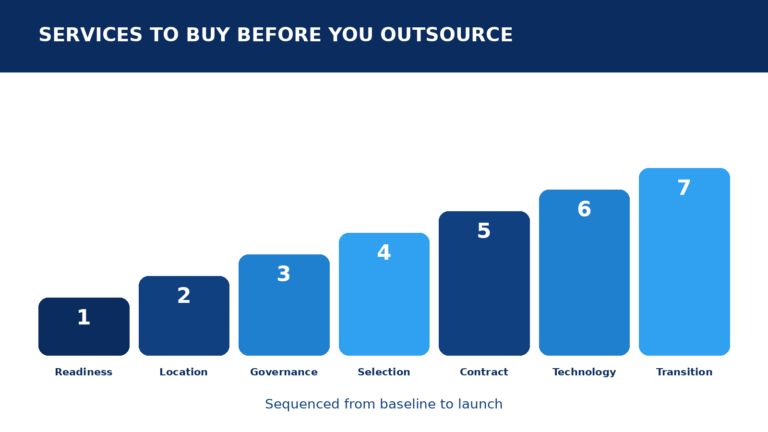
Before you outsource contact center work, buy the services that fix decisions you cannot cheaply change later: a readiness baseline, location strategy, governance design, BPO selection, contract and KPI design, technology ownership, and transition governance. Skip any you already have documented. Most outsourcing problems start as alignment gaps before the contract is signed.
Why it matters: Most outsourcing problems are not BPO problems. They are unclear ownership, mismatched KPIs, and technology decisions nobody made on purpose. Fixing them before signature is cheap. Fixing them after launch is a renegotiation.
We have managed outsourced operations from the buyer’s side. Cloud Tech Gurus was founded by former contact center executives who watched capable BPOs underperform because of what the client never defined. This is the 2026 service menu in the order you will need it, with a clear note on when to skip each one. For the wider picture, see our guide to CX outsourcing alignment.
Key takeaways
- Order matters. Earlier services shape every later decision.
- Governance is the one most often skipped. Its absence causes more trouble than any other gap.
- Skip what you already have. A current, agreed baseline or a proven contract template can replace a service.
Which CX consulting services come first?
| # | Service | Stage | What you walk away with |
|---|---|---|---|
| 1 | Readiness and CX maturity assessment | Before the decision | Baseline metrics and a list of what should and should not be outsourced |
| 2 | Outsourcing strategy and location design | Planning | Delivery mix and a business case |
| 3 | Operating model and governance design | Planning | Ownership map, escalation paths, and a review cadence |
| 4 | BPO selection and sourcing | Selection | Documented shortlist and scored finalists |
| 5 | Contract, SLA, and KPI design | Negotiation | A scorecard and contract terms tied to CX outcomes |
| 6 | Technology alignment | Negotiation and setup | Platform ownership decision and data access terms |
| 7 | Transition and performance governance | Launch and beyond | Stabilization plan and ongoing performance cadence |
What does each service actually do?
1. Readiness and CX maturity assessment
What it is: A baseline of volume, contact types, handle time, first contact resolution, quality, and cost per contact, plus a view of which work is ready to outsource. What it aligns: Leadership expectations with operational reality. You cannot hold a BPO to a target you have never measured yourself. Deliverable: Benchmarking data, a maturity view, and outsourcing candidates ranked by complexity and risk. Skip it if: You already have a baseline that operations, finance, and CX leadership agree on.
2. Outsourcing strategy and location design
What it is: A decision on what to outsource, where, and in what mix: onshore, nearshore, offshore, at-home, or a blend. What it aligns: Cost goals with customer experience goals. The cheapest location on paper can cost more after attrition and repeat contacts. Deliverable: A delivery-mix recommendation by line of business, modeled on cost per resolved contact rather than hourly rate. Skip it if: You are re-bidding the same scope with no change in location strategy.
3. Operating model and governance design
What it is: The rules of the relationship: who owns forecasting, QA, knowledge, training, escalations, and continuous improvement, and how often both sides review. What it aligns: Your internal teams with your BPO. Deliverable: A RACI across both organizations, an escalation path, and a cadence such as weekly operations, monthly performance, and quarterly business reviews. Skip it if: Almost never. It is the service most often left out.
4. BPO selection and sourcing
What it is: A criteria-led evaluation with knockouts, a weighted rubric, site-level diligence, and reference calls with comparable clients. What it aligns: Vendor decisions with documented requirements instead of the best sales presentation. Deliverable: A documented shortlist, scored finalists, and site findings on attrition, labor market, and compliance. See our BPO pricing comparison for the cost side. Skip it if: You are renewing an incumbent that already meets a documented scorecard. A light market check still protects your position.
5. Contract, SLA, and KPI design
What it is: Turning CX strategy into enforceable terms: SLAs, quality calibration, penalties, earnbacks, and exit clauses. What it aligns: Your BPO’s incentives with your customers’ experience. If the contract rewards handle time, that is what you will get. Deliverable: A balanced scorecard pairing efficiency metrics with resolution and quality, written into the contract. Skip it if: Your legal team has CX operations expertise and a proven outsourcing template.
6. Technology alignment
What it is: Deciding who owns the platform, whether client-provided or BPO-provided CCaaS, WFM, QA, and AI tools, who owns the data, and how both sides get access. What it aligns: Your technology roadmap with your outsourcing strategy. If the BPO owns the platform, switching partners later can mean switching platforms too. Deliverable: A platform ownership decision, data access and portability terms, and an AI readiness view for outsourced operations. Skip it if: Your platform, data, and AI roadmap are set and the BPO will work inside your environment.
7. Transition and performance governance
What it is: Launch planning, knowledge transfer, wave-based ramp, a stabilization period, and the cadence that keeps quality from drifting. What it aligns: The plan with what actually happens on the floor. Deliverable: A transition plan with go or no-go criteria for each wave and cross-site QA calibration. Skip it if: You have an internal team that has launched an outsourced program recently.
Which services do you actually need?
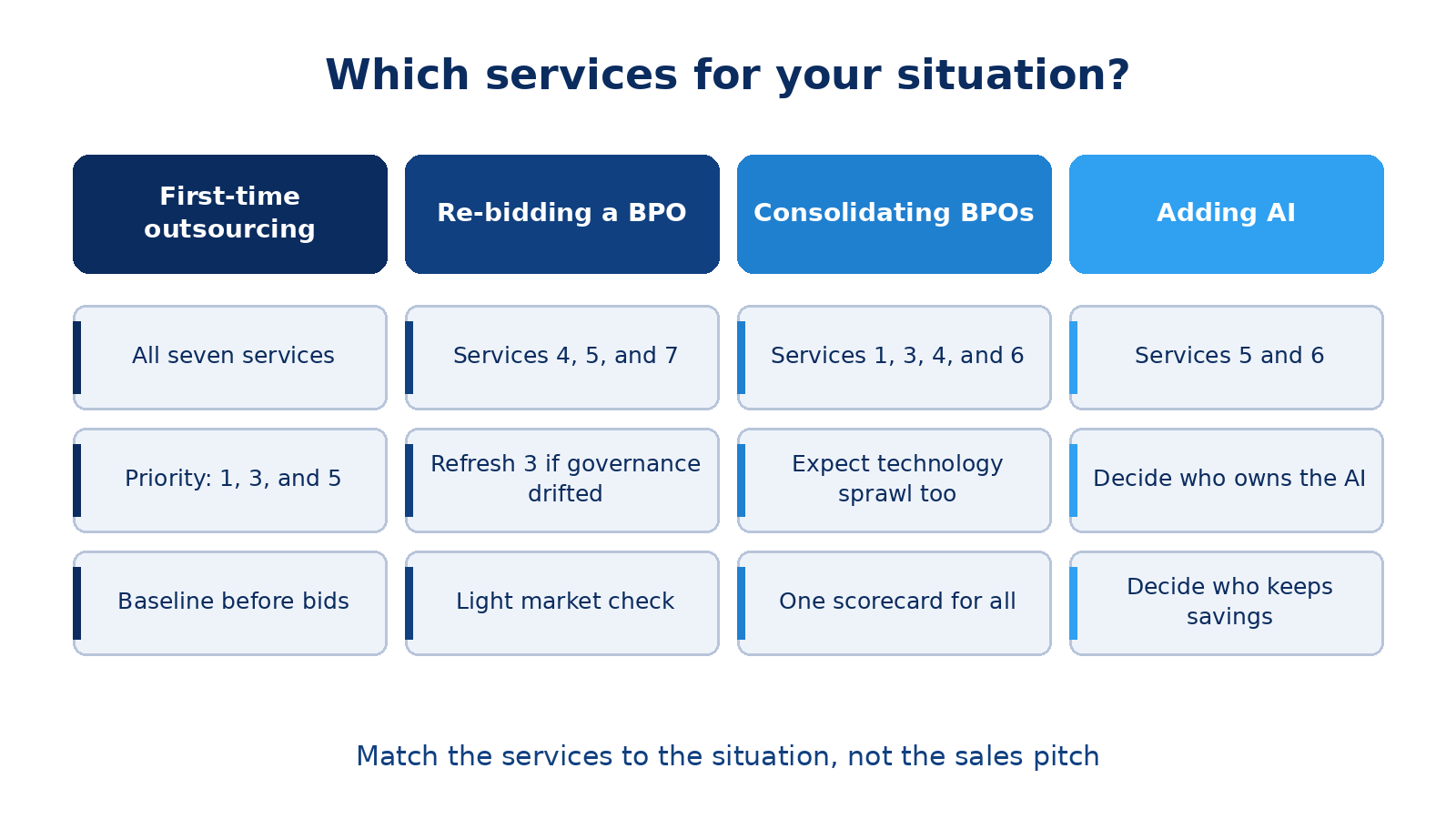
| Situation | Services to prioritize |
|---|---|
| First-time outsourcing | All seven, with 1, 3, and 5 first |
| Re-bidding an existing BPO | 4, 5, and 7, plus a refresh of 3 if governance has drifted |
| Consolidating multiple BPOs | 1, 3, 4, and 6, because vendor consolidation often exposes technology sprawl too |
| Adding AI to outsourced operations | 5 and 6. Decide who owns the AI and the savings before any pilot starts |
What should you ask any CX consulting firm?
Ask: “Do you, or does your parent company, sell outsourcing seats or contact center platforms?” Some firms that advise on outsourcing also sell it, or sell technology. That does not make their advice wrong, but you should know before they recommend a partner or platform. Ask for the evaluation rubric either way. Independence you cannot inspect is just a claim.
FAQ
What CX consulting services help with contact center outsourcing?
The core seven are readiness assessment, outsourcing strategy and location design, operating model and governance design, BPO selection, contract and KPI design, technology alignment, and transition governance. Together they cover the decision from first baseline through the first months after launch.
What is operations alignment in outsourcing?
It means your internal teams, your BPO, and your technology share the same KPIs, ownership model, and governance cadence, so everyone works toward the same customer outcomes. Without it, each party optimizes for its own contract terms instead.
Which outsourcing consulting service is most often skipped?
Operating model and governance design. Without a clear ownership map and review cadence, gaps in forecasting, QA, and escalation tend to surface after launch, when they are slowest and most expensive to fix, usually through a contract renegotiation.
Should the BPO or the client own the contact center platform?
It depends on your roadmap and exit flexibility. Client-owned platforms make switching BPOs easier, while BPO-provided platforms can lower upfront cost. Decide deliberately, document who owns the data, and write portability and access terms into the contract either way so you keep your options open.
Do I need all seven services?
Not always. First-time outsourcing usually needs all seven. A re-bid may need only selection, contract design, and transition. Skip any service where you already hold a current, documented answer that your leadership agrees on. Most teams think they have one until they compare their numbers.
Where CTG fits
Cloud Tech Gurus is a Phoenix-based customer experience consulting and sourcing firm, founded in 2017 by former contact center executives. We are vendor-neutral, with 40+ BPO relationships and 250+ technology suppliers. We advise and source, and your team and your BPO run the operation.
- BPO selection and advisory. Services 4 and 5: a documented shortlist, site-level diligence, and contract and KPI design.
- CX Consulting. Services 1, 2, 3, and 7: maturity assessment, outsourcing strategy, operating model, and transition governance.
- Technology sourcing. Service 6: platform ownership decisions and vendor-neutral selection.
There are three ways to work with us: paid CTG Consulting, vendor-funded research shortlists, and guru-led sourcing under a Letter of Agency. Suppliers compensate us when a client buys through us. We disclose that up front, and every recommendation runs through a documented rubric you can audit.
We didn’t study contact centers. We ran them, including the part where someone else’s agents answer under your brand.