
Compare BPO pricing by converting every bid, whether per hour, per minute, or per contact, into cost per resolved contact at your own volume and resolution rates. Headline rates hide what unresolved contacts cost you. Normalize first, then weigh contract terms and service credits, and in 2026 the cheapest bid is often not the cheapest outcome.
Why it matters: A pricing model is not just a billing mechanic. Each one pays the vendor to behave a certain way on your floor. Choose the model without pricing the behavior, and the gap shows up later as repeat contacts, churn, and escalations that never appear on the invoice.
We didn’t study contact centers. We ran them. We have signed outsourcing contracts we were proud of in the boardroom and regretted on the floor six months later, when the “savings” came back as repeat calls. The rate card looked great. The incentives were wrong.
Key takeaways
- Five models, five incentives. Hourly, per-minute, per-contact, per-FTE, and outcome-based pricing each move risk to a different place.
- Normalize before you compare. Cost per resolved contact is the only number that works across models.
- Read the terms, not just the rate. Training, attrition backfill, volume bands, and exit fees can outweigh a lower headline price.
- Put money behind outcomes. Tie a meaningful share of the invoice to resolution, quality, and stability, with earnbacks.
What are the main BPO pricing models?
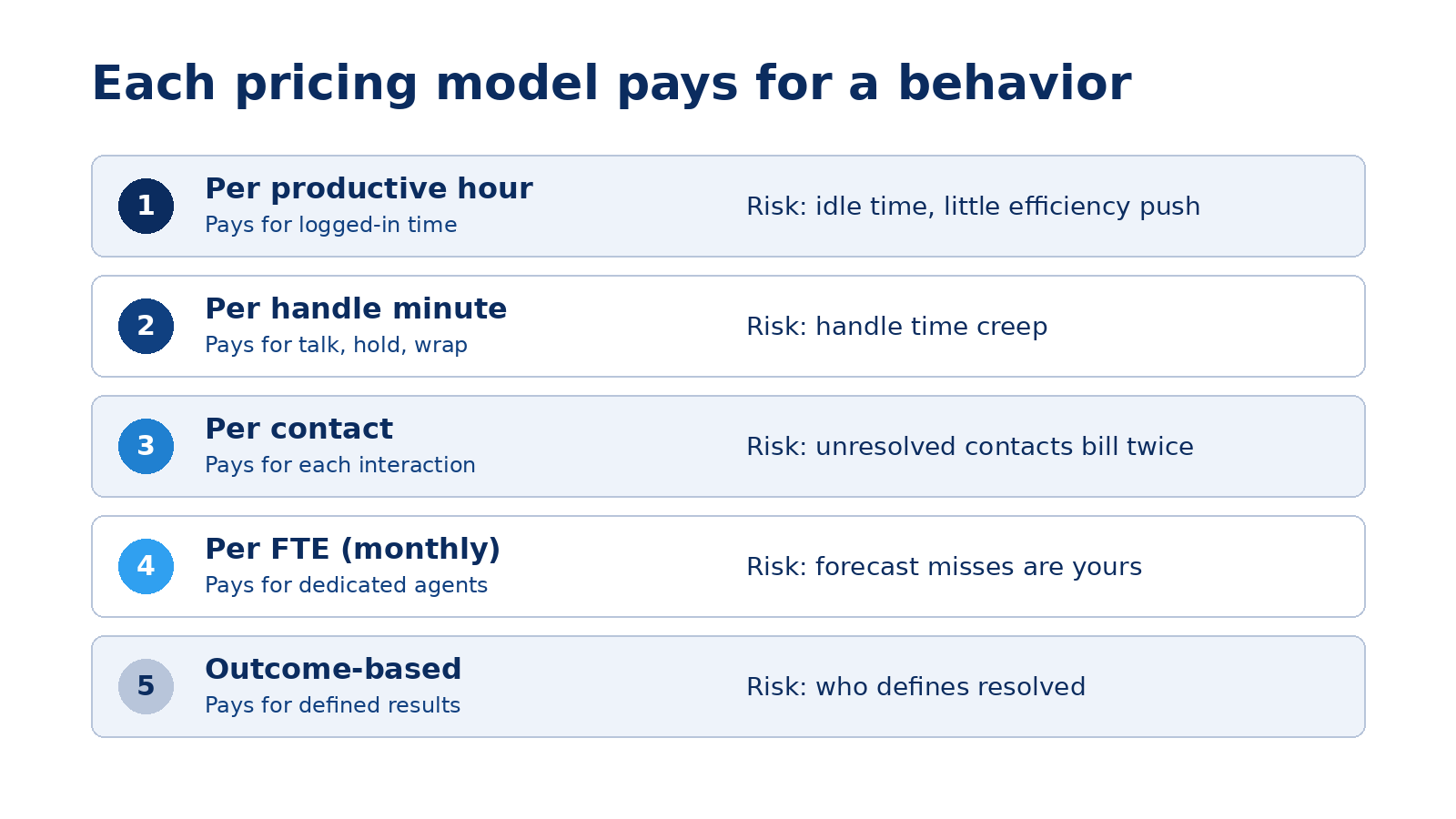
Contact center outsourcing is typically priced five ways, and each one changes what the vendor gets paid to care about. Knowing where the risk sits is the first job in any BPO vendor evaluation.
- Per productive hour. You pay for agent time logged into production. It is predictable and easy to audit. The risk is that the vendor has little reason to get more efficient, and idle time you did not forecast still gets billed.
- Per handle minute. You pay for talk, hold, and wrap time. It looks efficient, but the vendor earns more when calls run longer, so watch average handle time creep.
- Per contact or transaction. A flat fee per call, chat, or email is simple to budget. An unresolved contact comes back and you pay for it twice. This model pays the vendor to fail once and bill again.
- Per FTE, monthly. A fixed rate per dedicated agent suits stable, specialized programs. Forecast misses are entirely yours, in both directions.
- Outcome-based. You pay per resolution, sale, save, or collected dollar. Incentives align on paper, but everything depends on who defines “resolved,” and vendors may favor easy contacts if routing allows it.
How do you compare BPO pricing fairly?
Convert each bid into cost per resolved contact at your actual volume profile. Headline rates cannot be compared across models. Resolved-contact cost can.
The example below is an illustrative model, not client data. It assumes 100,000 monthly contacts, a six-minute handle time, 80 percent occupancy for the hourly bid, and resolution rates in line with what each model tends to encourage.
| Illustrative model | Bid A: per hour | Bid B: per minute | Bid C: per contact |
|---|---|---|---|
| Rate | $26 per productive hour | $0.55 per handle minute | $3.10 per contact |
| Monthly invoice | $325,000 | $330,000 | $310,000 |
| First contact resolution | 78% | 74% | 66% |
| Resolved contacts | 78,000 | 74,000 | 66,000 |
| Cost per resolved contact | $4.17 | $4.46 | $4.70 |
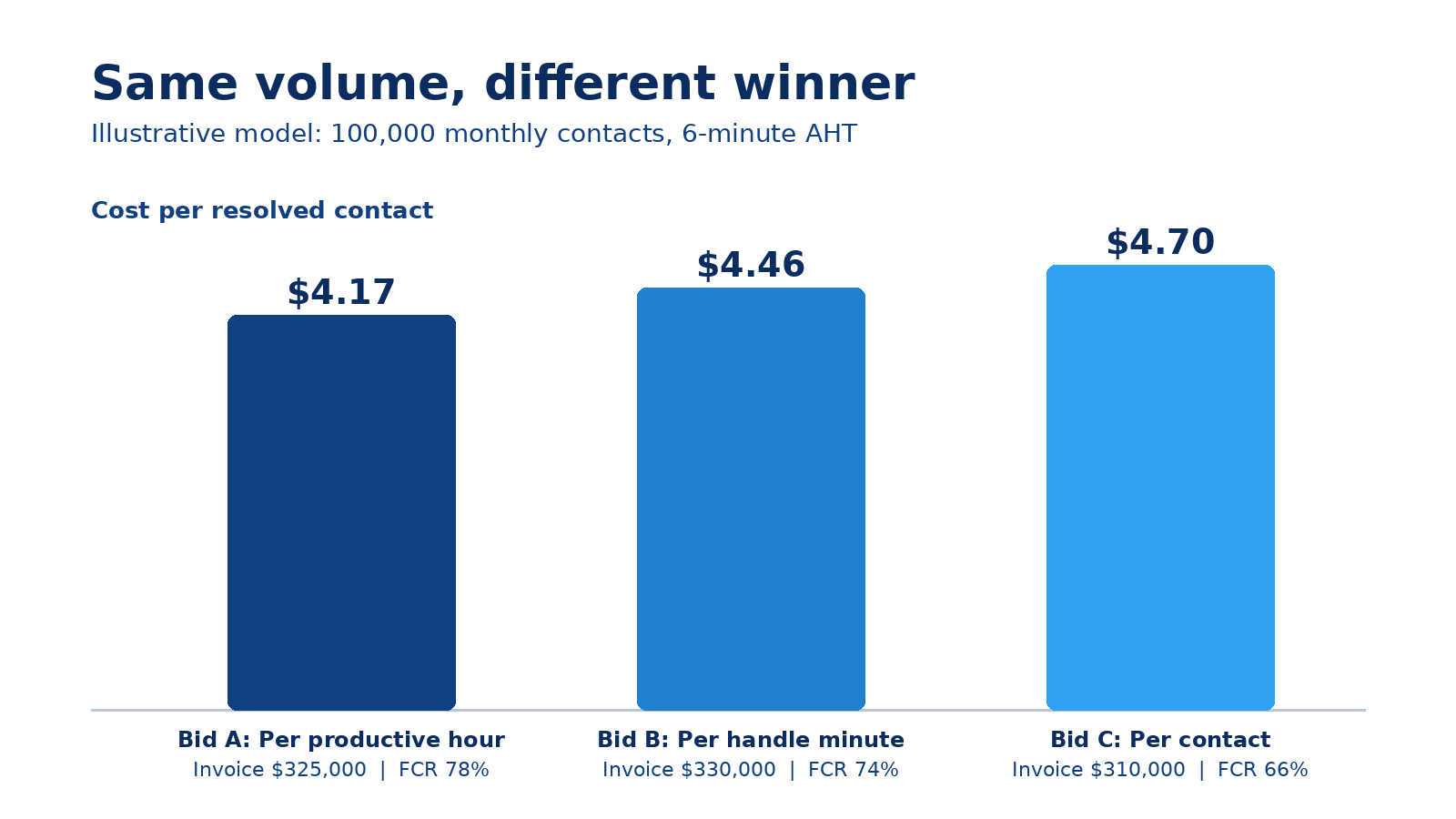
Bid C wins the procurement spreadsheet by $15,000 a month. It loses the operation by 12,000 unresolved customers a month. Many of those customers call back, so next month’s per-contact invoice grows. Take the resolution rate from references at your seat count and vertical, not from the proposal. Every proposal says 85 percent.
What hidden costs show up in BPO contracts?
The rate card is rarely the whole bill. A meaningful share of what you will actually spend sits in the terms:
- Training and nesting. Is new-hire training billed, and at what rate? Nesting at full rate with partial output is a quiet margin line.
- Attrition backfill. If you pay to retrain when the vendor’s agents quit, their attrition becomes your cost center.
- Volume minimums and forecast bands. A wide band with penalties outside it is common. A tight band means you are paying for their staffing risk.
- Shrinkage definitions. Whether coaching, QA, or team meetings are billable can move effective cost noticeably.
- Premiums. Bilingual, after-hours, weekend, and specialized-skill uplifts are often quoted last.
- Technology pass-through. Seat licenses, telephony, and CCaaS or CRM access are sometimes bundled and sometimes billed cost-plus.
- Exit terms. Transition help, knowledge transfer, and termination fees get priced when you have leverage, which is before you sign.
What SLAs should be tied to BPO pricing?
Tie money to the metrics customers feel, not only the ones that are easy to hit. Service level and speed of answer matter, but under hourly pricing a vendor can hit them by overstaffing on your dime. A service-protected contract puts a meaningful share of the monthly invoice at risk against a balanced set:
- Resolution: first contact resolution or seven-day repeat-contact rate, measured in your systems.
- Quality: QA scores from calibration sessions your team co-owns.
- Customer outcome: CSAT or transactional NPS by queue.
- Access: service level and abandon rate.
- Workforce stability: attrition and tenure on your program, reported monthly.
Pair credits with earnbacks. A vendor who can earn a credit back by beating targets next quarter fixes problems instead of disputing them.
How should you score a BPO vendor evaluation?
Agree the weights before bids arrive, and require an evidence standard behind every score. This is the weighting we start from in BPO selection work, adjusted to each client:
| Category | Starting weight |
|---|---|
| Normalized cost per resolved contact | 25% |
| Quality and resolution evidence at your seat count and vertical | 20% |
| Workforce stability: attrition, tenure, supervisor ratio | 15% |
| Contract structure and risk allocation: credits, bands, exit | 15% |
| Compliance and security (HIPAA, PCI DSS, as applicable) | 10% |
| Ramp and implementation capability | 10% |
| Operational transparency: data access, reporting, floor visibility | 5% |
Score each line against evidence tiers. Tier 1, full credit: we saw it on a live floor or in their production data. Tier 2, 75 percent: a reference at our seat count and vertical confirmed it. Tier 3, 50 percent: it is written into the contract or SOW. Tier 4, 25 percent: it was in the proposal or said on a call.
Price is a quarter of the decision on purpose. Past that weight, you are not selecting a partner. You are running a reverse auction for the lowest-paid agents in the market. For the broader build-versus-buy math, see our outsourcing versus in-house cost comparison.
Which deal structure fits: hourly, hybrid, or outcome-based?
Hourly with SLA credits is the most transparent and easiest to audit, and it fits stable programs. You own the efficiency problem, so you need strong vendor management. Hybrid, an hourly base plus an outcome bonus, keeps cost predictable and pays for resolution. It takes more design work and shared data. Pure outcome-based gives the tightest alignment when “resolved” is objective, as in collections or order-taking, and the most risk when it is not, as in technical support or healthcare navigation.
Our recommendation: hybrid for most enterprise customer service operations. Go pure outcome-based only when the outcome can be measured in your system without the vendor’s interpretation. Be cautious with per-contact pricing on any queue where first contact resolution is low. You may be paying a premium for your own repeat volume.
When is the cheapest BPO bid the right choice?
Sometimes. It is the right call for overflow, seasonal spikes, and simple, scripted, high-resolution work where a miss costs the customer little. It is the wrong call for launch programs, regulated contacts, retention and save queues, and anything touching your highest-value customers. Where that is true, a cheap rate that costs you a customer segment is not savings. It is a delayed invoice.
Frequently asked questions
How do you compare BPO pricing models fairly?
Convert every bid to cost per resolved contact at your own volume, handle time, and realistic resolution rates. Per-hour, per-minute, and per-contact rates are not comparable on their own. Take resolution evidence from references at your seat count and vertical, not from the proposal.
What is the best BPO pricing model for customer service?
For most enterprise customer service operations, a hybrid works best: an hourly base with an outcome bonus tied to resolution. Pure outcome-based pricing fits only when the result is objective and measurable in your own systems, without the vendor interpreting it.
What hidden costs show up in BPO contracts?
Common ones include billable training and nesting, attrition backfill, tight volume bands, shrinkage definitions, language and after-hours premiums, technology pass-throughs, and exit fees. Ask for each in writing before bids are compared, because these terms often shift effective cost more than the headline rate.
What SLAs should be tied to BPO pricing?
Tie money to what customers feel: resolution or repeat-contact rate, calibrated quality scores, CSAT, service level with abandon rate, and agent attrition on your program. Measure resolution in your systems, not theirs, and pair credits with earnbacks so the vendor fixes problems instead of disputing them.
When is the cheapest BPO bid the right choice?
For overflow, seasonal spikes, and simple scripted work where first contact resolution is high and a miss carries little customer impact. It is usually the wrong choice for launch programs, regulated contacts, retention queues, and anything touching your highest-value customers.
Where CTG fits
Cloud Tech Gurus advises enterprise contact centers on CX strategy, AI readiness, and technology and BPO sourcing across a network of 250+ suppliers and 40+ BPOs. We normalize bids to cost per resolved contact, build the rubric with you, and pressure-test contract terms before you sign.
Our standard, stated plainly: BPO shortlists are scored on normalized cost per resolved contact, with weights agreed with you before any provider is invited. We disclose our relationship with each provider in writing before a shortlist is built. If a rubric cannot survive being published, it is not a rubric.
Most BPO pricing mistakes are not made at the negotiating table. They are made the moment a team decides cost per contact is the number that matters, before anyone asks what a contact that does not get resolved costs.


