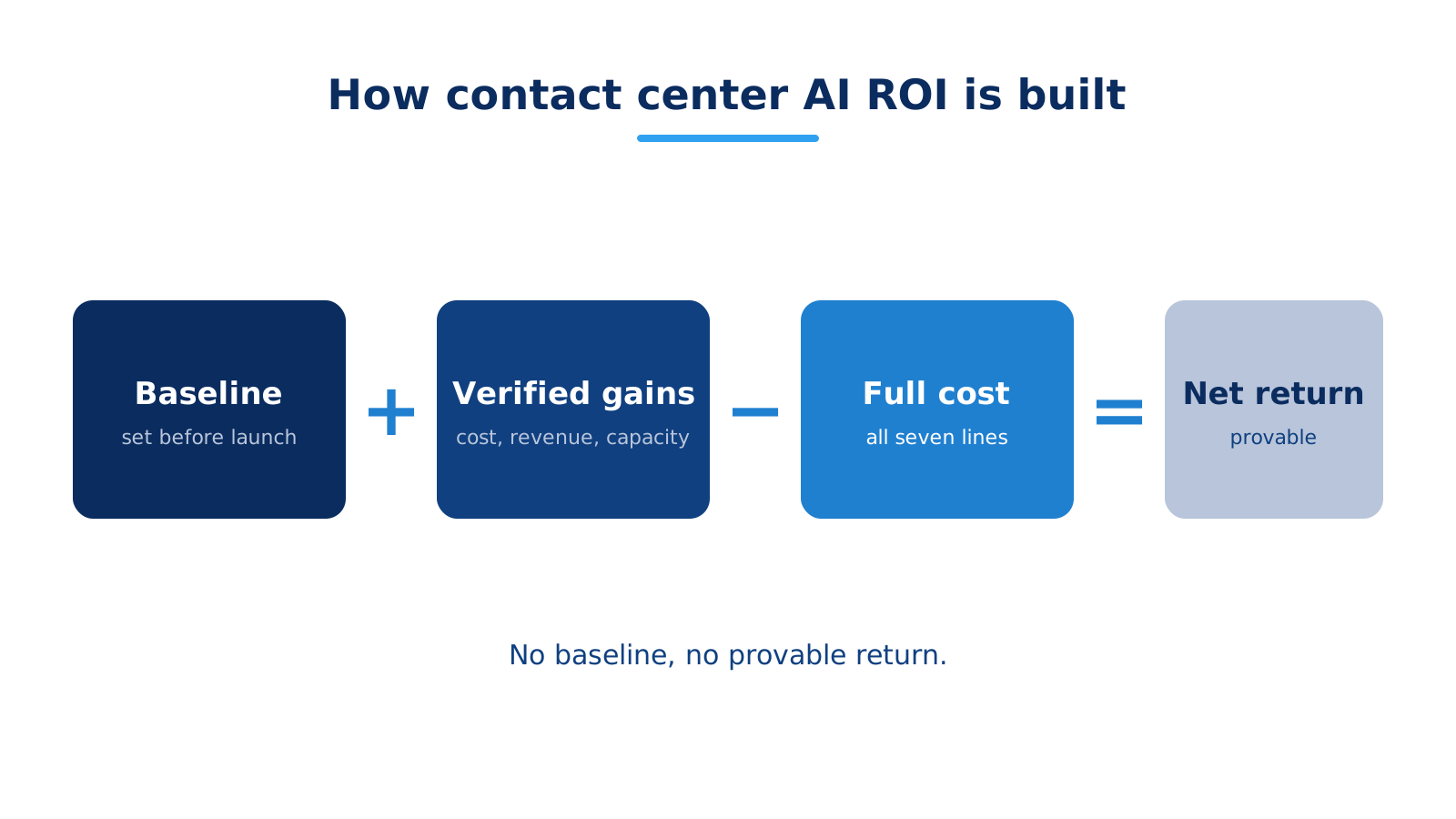
Contact center AI ROI is the net operating gain from AI, measured against a baseline you set before launch, minus the full cost of running it. Count avoided cost, retained revenue, and capacity you actually reallocate, not minutes saved. In 2026, a business case survives the CFO when every number traces back to your own data.
Why it matters: Most AI business cases are built from vendor benchmarks and finished before anyone measures the current operation. Twelve months later, finance asks what the AI returned, and nobody can answer. The technology may be working. The case was never provable.
Cloud Tech Gurus was founded by former contact center executives who have signed off on the projected savings and then sat in the review where finance asked for the actuals. This is how we build the case now, so that review goes the other way.
Key takeaways
- Baseline first. No pre-launch baseline, no provable ROI.
- Count the full cost. Licensing is the smallest honest line in most budgets.
- Minutes are not money. Time saved counts only when you convert it into capacity you use.
- Prove it with a hold-out. Compare AI-handled contacts against a similar group that did not get the AI.
What counts as contact center AI ROI?
Three kinds of value belong in the case, and they carry different levels of proof. Avoided cost is contacts that no longer need a person, or hires you no longer make. Retained revenue is customers who stay because a problem got solved faster. Freed capacity is agent time you move to higher-value work, but only once you have decided where it goes.
Avoided cost is the easiest to defend. Retained revenue takes CSAT and churn data you may not yet connect to contact reasons. Freed capacity is the one most business cases overstate, because an agent who saves 30 seconds a call has not produced a saving until the schedule changes.
What costs do most AI business cases leave out?
The licensing line is the one everybody quotes. It is rarely the one that moves the answer. Build the cost side from every line below, and ask each vendor to price them in the same template.
| Cost line | What hides in it | Who should own the number |
|---|---|---|
| Licensing and usage | Per-minute, per-conversation, or per-resolution pricing that scales with volume, plus overage terms | Procurement, with operations validating volume |
| Integration and data preparation | CRM, WFM, and knowledge connections, plus cleanup of dispositions and transcripts | IT, with a written estimate from the vendor |
| Knowledge content upkeep | Article owners, review cycles, and rewriting content so AI can use it | Operations or knowledge management |
| Governance and QA | Disclosure review, model monitoring, and QA forms recalibrated to the new behavior | The named AI owner |
| Human review and escalation | Agents handling the handoffs, plus supervisors reviewing AI decisions | Operations |
| Change and training | Agent coaching, supervisor training, and the productivity dip during rollout | Operations and HR |
| Vendor change and exit | Change orders, model updates that alter behavior, and the cost of leaving | Procurement and Legal |
Ask for a 36-month cost model, not a first-year quote. Our four-gate AI readiness assessment surfaces most of the integration and data lines before you sign.
Which benefits are real, and which are just minutes saved?
Every benefit in the case needs two things: a way to measure it in your systems, and a rule for when it turns into money. Here is how the common ones hold up.
| Benefit | How to measure it | The trap |
|---|---|---|
| Contained contacts | Resolved contacts with no repeat contact on the same issue within a set window | Counting abandoned contacts as contained |
| Shorter handle time from agent assist | Handle time including after-contact work, compared with a matched agent group | Banking the minutes without changing staffing or schedules |
| Automated after-contact summaries | After-contact time per agent, plus summary accuracy sampled by QA | Ignoring the review time agents spend correcting summaries |
| QA coverage | Share of contacts scored, and cost per scored contact | Scoring more contacts without acting on the results |
| Faster ramp and lower attrition | Time to proficiency and early tenure for new hires | Crediting AI for changes caused by hiring or pay |
| Retained revenue | CSAT, repeat contacts, and churn by contact reason | Linking a single metric to revenue without evidence |
The pattern is the same in every row. Time saved is a measurement. Money is a decision. If the case does not say what happens to the time, the CFO will assume nothing does.
How do you baseline before the AI goes live?
Baseline the intents you plan to automate or assist, not the whole center. A queue-level average hides the contacts the AI will actually touch. Before launch, measure these for each target intent:
- Cost per resolved contact, not cost per call, so repeat contacts count against you.
- First contact resolution and repeat-contact rate within a defined window.
- Handle time, including after-contact work, split by channel.
- CSAT and customer effort by contact reason.
- Agent attrition and time to proficiency for the teams affected.
If your dispositions are unreliable, fix that first. Our signs your contact center is ready for AI covers why intent data decides what you can measure.
What should a 90-day proof look like?
Run the pilot like an experiment, not a launch. Pick one use case, write the success measures before go-live, and keep a comparison group that does not get the AI. A comparison group is the difference between “handle time dropped” and “the AI dropped handle time.” Seasonality, staffing changes, and product issues move your numbers too.
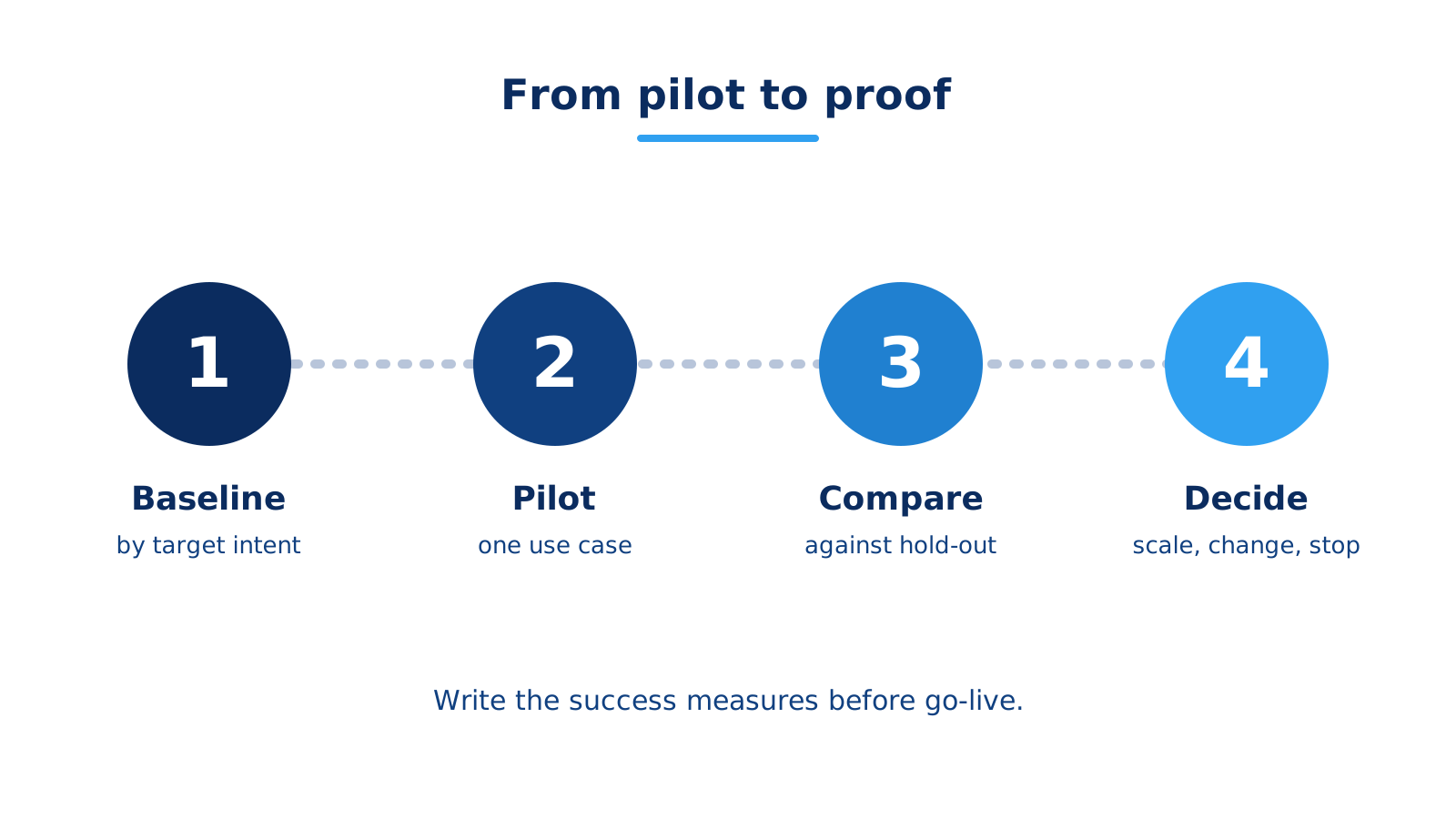
End the pilot with a scale decision, not a status update. Finance should see the baseline, the comparison, the full cost, and a recommendation to scale, change, or stop. A pilot that is allowed to end without scaling is also a result worth having.
What will the CFO challenge?
Expect five questions: where did the baseline come from, which costs are missing, what happens to the time you say you saved, how do you know the AI caused the change, and what is the exit cost if the vendor underdelivers. If your case answers those in writing, it will survive the review. If it answers them with vendor benchmarks, it will not.
FAQ
How do you calculate contact center AI ROI?
Subtract the full cost of running AI from the verified gains, then compare against a baseline set before launch. Gains are avoided cost, retained revenue, and reallocated capacity. Costs include licensing, integration, knowledge upkeep, governance, human review, and training. Use cost per resolved contact as the common measure.
What is a realistic payback period for contact center AI?
It depends on the use case, your readiness, and how fast you convert saved time into real capacity. We will not quote a number without your data. Build the payback model from your own baseline and a 36-month cost view, and let the pilot test it.
Does shorter handle time mean AI is paying off?
Not by itself. Shorter handle time is a measurement, not a saving. It becomes money only when you change schedules, absorb volume without hiring, or move agents to other work. Also check repeat contacts and CSAT, because a faster call that fails costs more.
How do you separate AI results from seasonal noise?
Use a comparison group. Run the AI on part of the volume or a matched set of agents, and keep a similar group without it for the same period. Comparing before and after alone cannot rule out seasonality, staffing changes, or product issues.
Who should own the AI business case?
Operations should own the baseline and the benefits, finance should validate the method, and one named leader should own governance and the final number. Shared ownership usually means nobody reconciles the case against the actuals after launch.
Where CTG fits
Cloud Tech Gurus is a Phoenix-based customer experience consulting and sourcing firm, founded in 2017 by former contact center executives. We build AI business cases from your own baseline, then run vendor evaluations across the 250+ suppliers and 40+ BPOs in our network, scored against a documented rubric you can audit.
There are three ways to work with us: paid CTG Consulting, vendor-funded research shortlists, and guru-led sourcing under a Letter of Agency. Suppliers compensate us when a client buys through us. We disclose that up front, agree the weights with you before any provider is invited, and disclose our relationship with each provider in writing before a shortlist is built.
We didn’t study contact centers. We ran them.