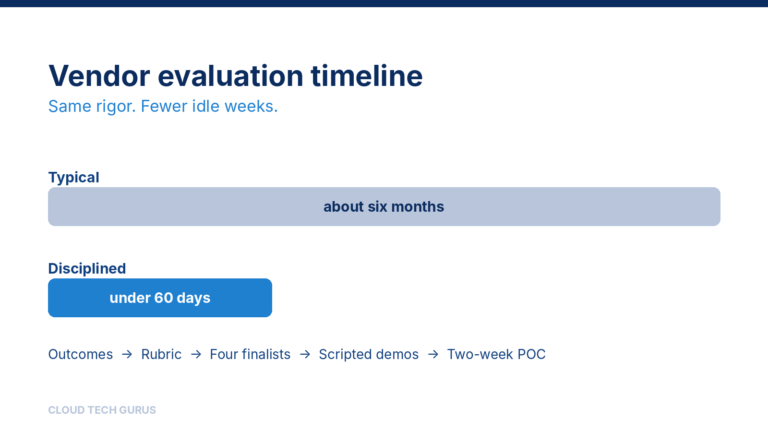
A disciplined contact center vendor evaluation takes under 60 days, not six months. The delay comes from requirements written as feature lists, scoring invented after the demos, and security review that runs after selection instead of alongside it. Fix those three, cap finalists at four, and script the demos yourself.
Why it matters: Every month in evaluation is another month your agents work the system you already agreed was broken. On a large operation, a quarter lost before a containment or routing project even starts is real money. The same committee that caused the slip will later be asked why the business case moved.
We didn’t study contact centers. We ran them. We have sat on the buying side of long CCaaS evaluations where nobody was lazy and the vendors were responsive. The process simply had no shape. This is the shape we would give it in 2026.
Key takeaways
- Write down what winning looks like first. Most delay comes from criteria nobody agreed on before the demos began.
- Cut early and on paper. Disqualify before anyone books a demo, and carry four finalists at most.
- Run the gates in parallel. Security, integration, and commercial review should never wait for a winner.
- Know when not to rush. Some replacements are paced by change management, not evaluation.
How long should a contact center vendor evaluation take?
For a 500 to 5,000 seat operation, a disciplined process runs under 60 days from requirements to a signature-ready decision. That figure comes from our own engagements, not published research, and we are not aware of an independent benchmark we would trust. Treat it as a target to test against your own calendar. Time is lost in three places: requirements written as feature lists, scoring criteria invented after the demos, and security and integration review running one after another.
Where does the six months actually go?
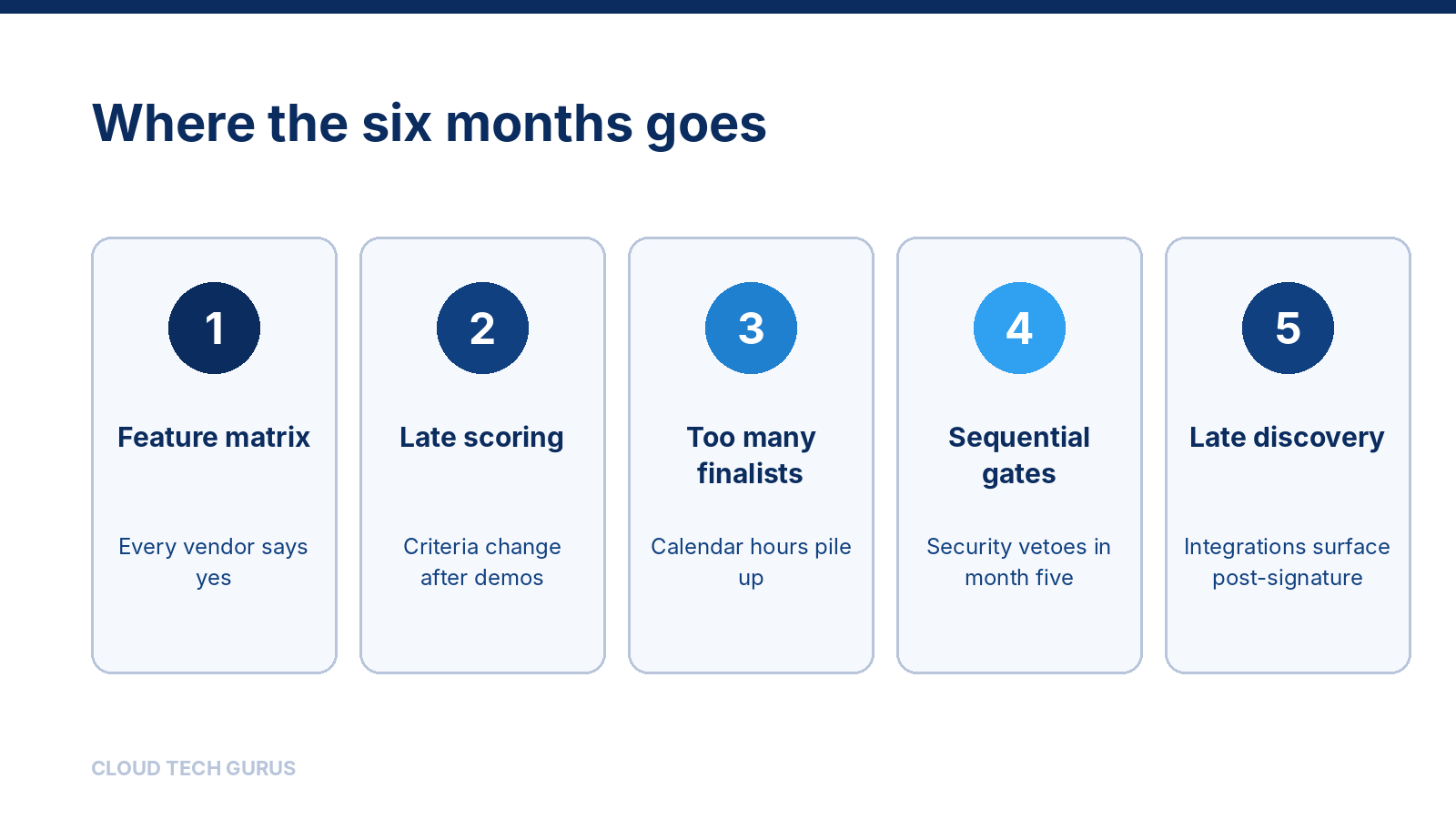
Evaluation delay is rarely vendor responsiveness. It is five self-inflicted patterns we see on nearly every engagement.
1. The 400-line feature matrix
Every vendor answers yes to everything. You spend weeks building the matrix and learn nothing that separates anyone.
2. Scoring invented after the demos
With no rubric locked in advance, every debrief reopens the criteria. Politics fills the vacuum, and the vendor who presented best wins.
3. Too many finalists
Ten vendors, two-hour demos, six stakeholders: that is 120 hours of calendar before anyone has learned anything decisive.
4. Sequential gates
CX picks, then IT reviews, then Security objects in month five. In HIPAA and PCI DSS environments this is among the most common reasons an evaluation restarts.
5. Integration discovery after selection
Scope expands after signature, and the time you saved gets repaid during implementation. Enterprise contact centers routinely find live integrations nobody had inventoried.
How do you shortlist contact center vendors faster?
Disqualify on paper before anyone books a demo. Score architecture fit, security posture, integration coverage against your actual stack, and reference availability at your seat count and vertical. Then cut to four finalists. Most evaluations stay wide because no one has been given permission to say no early, not because the field is genuinely close. If your AI readiness assessment is not done, finish it first, because it changes which vendors belong on the list at all.
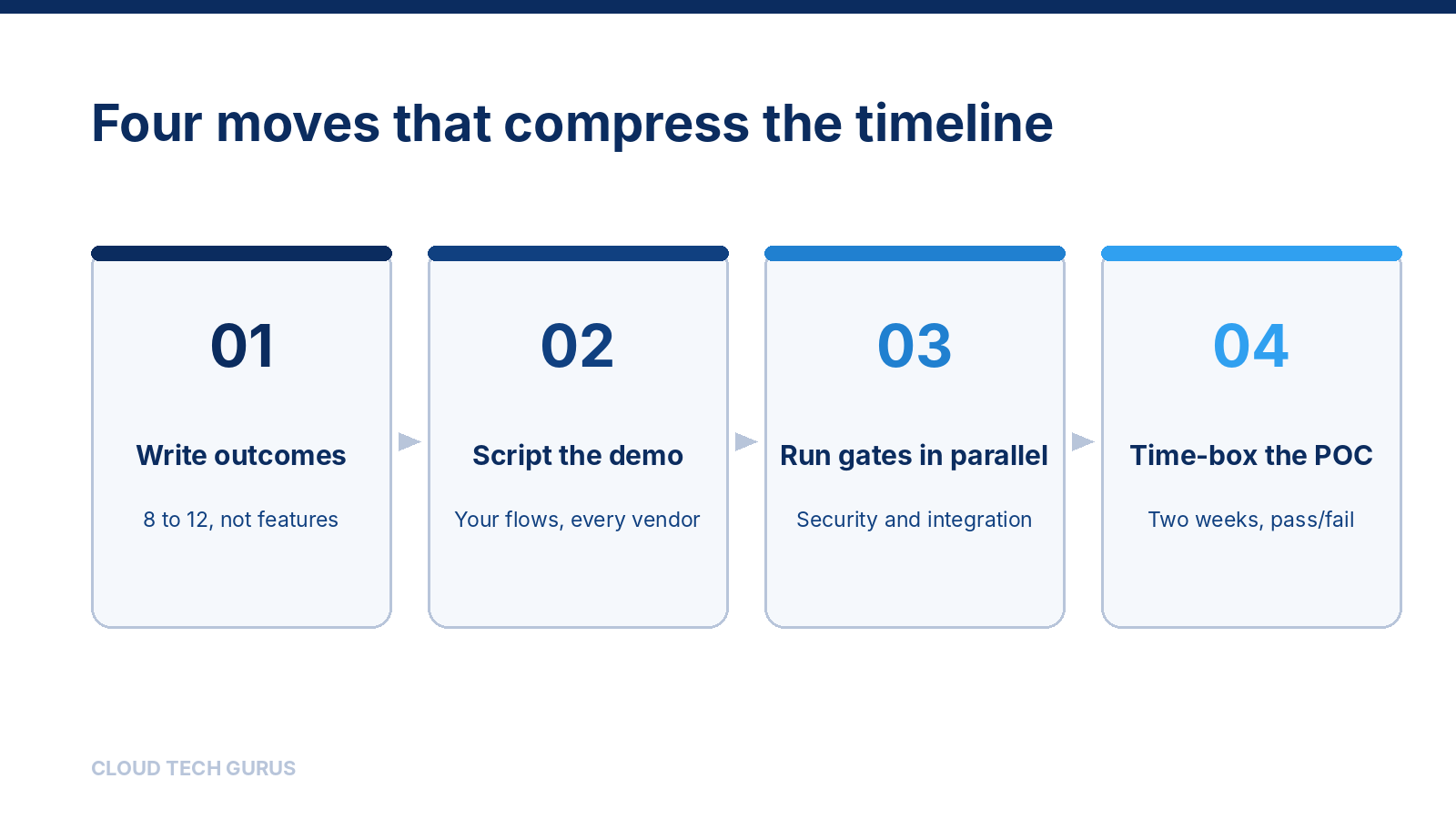
What are the four moves that compress the timeline?
1. Write 8 to 12 outcome requirements, not features
“Reduce transfer rate on billing contacts” beats “must support skills-based routing.” Vendors cannot check a box on an outcome, and your committee cannot argue later about what it meant. Set the target from your own baseline, not from a vendor slide.
2. Script the demo yourself
Same script, same time box, every vendor. Use your call flows, your CRM schema, and your ugliest recordings. A vendor-controlled happy-path demo is sales theater, not evidence, and it is the cheapest place to buy back weeks.
3. Run security, integration, and commercial review in parallel
These three kill deals late. Front-load them and a vendor either fails fast or never fails there at all. Integration discovery in particular belongs at the front of the process.
4. Time-box the proof of concept
Two weeks, with pass/fail criteria written before it starts. An open-ended pilot is a vendor’s favorite way to run out your clock into their fiscal quarter.
What belongs in a contact center vendor scorecard?
A defensible rubric has two halves: weighted categories agreed before evaluation begins, and an evidence tier behind every score. Weights without evidence tiers produce numbers that look rigorous and are not. The weights below are an example, not a standard. Agree yours with stakeholders and publish them before the first demo.
| Category | Example weight |
|---|---|
| Functional fit to your defined use cases | 30% |
| Integration and data architecture | 20% |
| 36-month total cost, not license price | 15% |
| Implementation load on your team | 15% |
| Vendor viability and roadmap credibility | 10% |
| Security and compliance | 10% |
The evidence tiers are where most scorecards quietly lie.
| Evidence tier | What it looks like | Example credit |
|---|---|---|
| Tier 1 | Watched it work on your data | 100% |
| Tier 2 | A reference at your seat count and vertical confirmed it in production | 75% |
| Tier 3 | Written into contract or SOW language | 50% |
| Tier 4 | The vendor said so on a call | 25% |
A finalist scoring 88 on Tier 4 evidence is not ahead of one scoring 79 on Tier 1. Publishing the tier is what makes the decision defensible a year later, when the sponsor who chose has moved on.
Who should run the evaluation: internal, consultant, or advisor?
Fully internal. You keep total control and avoid fees, but it consumes a large number of internal hours, and you negotiate against a vendor who has run this process far more often than you have.
Consultancy-led. Structured and neutral, but often slower and more expensive, and sometimes the framework comes from people who have never owned an SLA.
Advisor-led. Fast, with no direct cost to you, and the shortlist comes from someone talking to many suppliers every month. Name the tradeoff out loud: advisors are paid by the supplier. Ask for the rubric, ask for the weights, and ask whether any finalist pays more than the others. If the answer gets vague, walk.
Our recommendation: own the requirements and the rubric internally, and use outside help for shortlisting and market intelligence. Never outsource the definition of what winning means.
When should you not compress a vendor evaluation?
Speed has a failure mode. Skip the compressed path when you are replacing a system of record, carrying a large number of live integrations, operating under active regulatory remediation, or touching workforce management in a unionized environment. In those cases the evaluation was never the long pole. Change management was, and compressing the wrong stage just moves the delay somewhere less visible.
Frequently asked questions
How long should a contact center vendor evaluation take?
For a 500 to 5,000 seat operation, aim for under 60 days from requirements to a signature-ready decision. Longer cycles usually reflect unclear requirements, late scoring, and sequential reviews rather than vendor slowness. Regulated or system-of-record replacements can justify more time.
How many vendors should make the final round?
Four is a workable ceiling for most enterprise evaluations. Disqualify on paper first using architecture fit, security posture, integration coverage, and reference availability at your seat count and vertical. Every extra finalist adds demo hours, stakeholder calendar time, and debrief arguments without usually improving the decision.
What is an evidence tier in a vendor scorecard?
An evidence tier records how a score was earned: watched on your data, confirmed by a comparable reference, written into the contract, or only claimed on a call. Each tier earns different credit, so a high score built on vendor claims cannot outrank a lower score built on observed proof.
Should security and integration review run during selection?
Yes. Security, integration discovery, and commercial review are the stages that most often restart an evaluation late. Running them in parallel with functional evaluation means a vendor fails early or clears every gate. Doing them after selection moves the delay somewhere less visible and more expensive.
When should you not compress a vendor evaluation?
Take the longer path when replacing a system of record, carrying a large number of live integrations, operating under active regulatory remediation, or changing workforce management in a unionized environment. In those cases change management, not evaluation, sets the pace, and compressing the wrong stage only hides the delay.
Where CTG fits
Cloud Tech Gurus advises enterprise contact centers on CX strategy, AI readiness, and technology sourcing across a network of 250+ suppliers and 40+ BPOs. Our vendor selection work helps you write outcome requirements, build the rubric, and run the shortlist, while you keep ownership of what winning means.
Our standard, stated plainly: we are compensated by suppliers when a client selects one. We disclose that position per vendor, in writing, before any shortlist is built, and scoring criteria are agreed with you before vendors are invited. If a rubric cannot survive being published, it is not a rubric.
Most evaluation delay is not caused by vendors or by complexity. It is caused by a buying committee that has not agreed on the problem it is solving. Fix that in week one and the rest compresses.