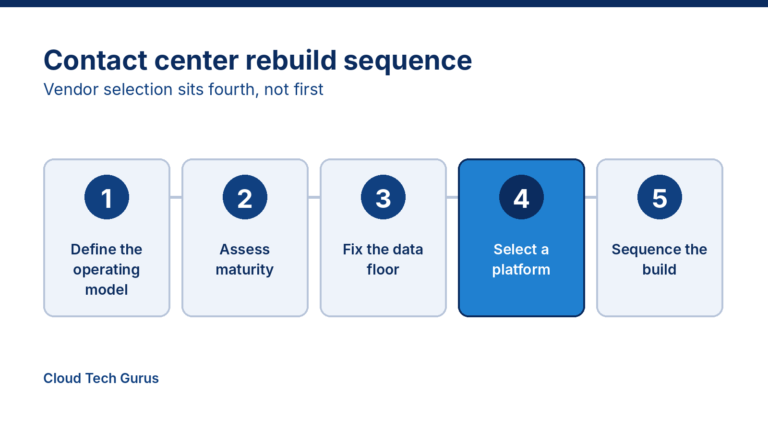
A contact center AI readiness assessment scores four gates: data quality, workflows, governance, and frontline preparedness. Each gate gets 0 to 3, and your readiness equals your lowest gate, not your average. Run it before shortlisting vendors, so you fix the shut gate first. In 2026, that order decides who reaches production.
Why it matters: The pilot usually works. A bot contains calls, or agent assist surfaces the right article. Then it meets a disposition taxonomy nobody trusts, an escalation path never designed for a machine handoff, and a QA form that still penalizes the behavior the AI just changed. It quietly stops expanding.
We didn’t study contact centers. We ran them. We have been the ones holding the bag when a promising pilot stalled in month four. Readiness is not a vibe, and it is not a maturity curve on a slide. It is four gates, and you can score yourself in an afternoon.
Key takeaways
- Four gates, scored 0 to 3. Data quality, workflows, governance, and frontline preparedness. Twelve points possible.
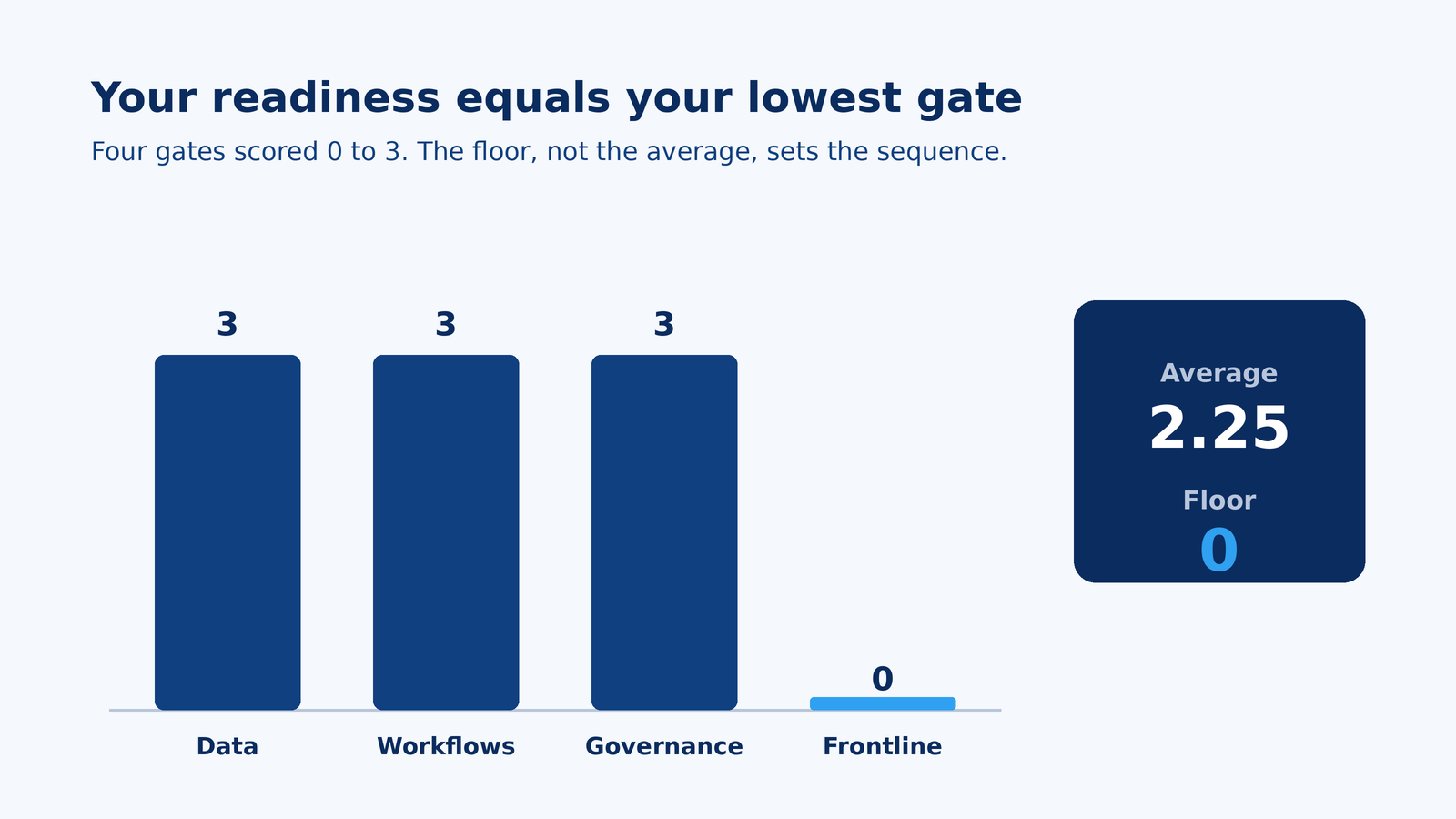
- Your lowest gate is your score. A 3/3/3/0 operation is not a 9. It is a zero with three expensive assets waiting on one owner.
- Most pilots stall on organizational work. Disclosure language, QA forms, and escalation context are not things a vendor delivers.
- Assess before you shortlist. Criteria written after the demos tend to fit the favorite.
What is an AI readiness assessment for a contact center?
It is a structured evaluation of whether your operation can support AI in production, not whether a demo works. It looks at four dimensions, produces a gap list and a sequence, and happens before a vendor is chosen. Think of it as a diagnostic, not a certification.
How does the floor rule work?
Score each gate from 0 to 3, then take the lowest number as your readiness. The total is useful for tracking progress. The floor is what decides whether anything ships.
We have watched a deployment sit idle for two quarters because Legal had not approved recording disclosure language for AI-handled calls. Three gates were open. One was shut. The outcome was the same as having none open.
Gate 1: Can the model see what actually happened?
The question is simple. If you pulled last week’s contacts, could you tell a machine why each customer called? Four checks answer it.
- Disposition integrity. How many contacts land in “Other,” “General Inquiry,” or the first option in the dropdown? If it is a large share, your intent model learns from agent click fatigue.
- Transcript coverage. What share of voice contacts is transcribed, and how accurately for your accents, acronyms, and product names? Voice is where the gap lives.
- Knowledge freshness. Pull ten articles at random and count the ones more than 12 months past review. A retrieval system will serve the stale ones with confidence.
- Identity resolution. Can you join a contact to a customer record to an outcome without a person in the middle?
Gate 2: Can it hand off without dropping the customer?
When the AI cannot finish the job, what happens in the next few seconds? Containment needs a written definition that separates a contained contact from an abandoned one. In most reporting they look identical, which makes an ROI case unfalsifiable.
Escalation has to carry context: the transcript, the attempted resolution, and the verification state. Systems of record should be reachable by API, with write-back. Automation that cannot write back is deflection, not resolution. Finally, document today’s routing logic end to end. Intent prediction routing replaces rules you can read with weights you cannot, and nobody can debug tomorrow’s routing if nobody can explain today’s.
Who owns AI governance in a contact center?
One named person with authority across Legal, Security, and Operations. Usually that is the head of contact center operations, with Legal holding a veto. If governance is “shared,” it is unowned, and the first regulatory question will stop the program.
Gate 3: Can you defend a decision six months from now?
Governance is the gate that closes first and opens slowest in healthcare and financial services. Check these five items.
- Disclosure language is approved, not drafted, for AI handling, recording, and transcription.
- Vendor data terms are read. Does the vendor train on your conversations, and is the opt-out contractual or a policy page they can edit? In HIPAA and PCI DSS environments this is a procurement blocker.
- Model change control exists. You get notified of updates and can roll back. Most contracts are silent here, and silence favors the vendor.
- Human review has a threshold. Decide which decisions need a person, at what confidence, and who audits the sample.
- Retention and deletion are specified. Transcripts are a discovery target, so choose the window on purpose.
Gate 4: Will your agents route around it?
This is the gate that gets skipped, and the one that kills adoption. The operation is not the platform. It is hundreds of people deciding whether the new tool helps them or grades them.
- The QA form matches the new behavior. If agent assist shortens calls and the form rewards the old script, agents choose their score over the tool.
- Incentives do not fight the deployment. If handle time drives the bonus and AI moves easy volume to self-service, the remaining mix gets harder and pay drops. That is math, not resistance.
- Supervisors can act on the outputs. A sentiment dashboard nobody knows how to use is a screensaver.
- There is a fast path to report a bad answer, and someone has said out loud what happens to headcount. Agents have already asked each other.
What does the Four-Gate scorecard look like?
Circle one score per gate. Be honest. The point is to find the shut gate, not to pass.
| Gate | What a 3 looks like | Typical shut-gate symptom |
|---|---|---|
| 1. Data quality | Dispositions audited, voice transcription tested on your accents, every knowledge article has an owner and a review date, identity joins are automated | Intent model trained on “Other”; retrieval serves outdated answers |
| 2. Workflows | “Contained” defined in writing, escalation passes context, systems of record reachable with write-back, routing documented | Customers repeat themselves after handoff; ROI cannot be proven |
| 3. Governance | One named owner, approved disclosure language, contract terms on data use and change notice, written review thresholds | Deployment sits idle waiting on Legal or Security |
| 4. Frontline preparedness | QA form re-weighted before launch, comp plan checked, supervisors trained, one-click bad-answer reporting | Agents ignore the tool; adoption flatlines |
Use this scale: 0 means not in place, 1 means partial and undocumented, 2 means in place but not audited, and 3 means in place, documented, and owned.
What should you do with your score?
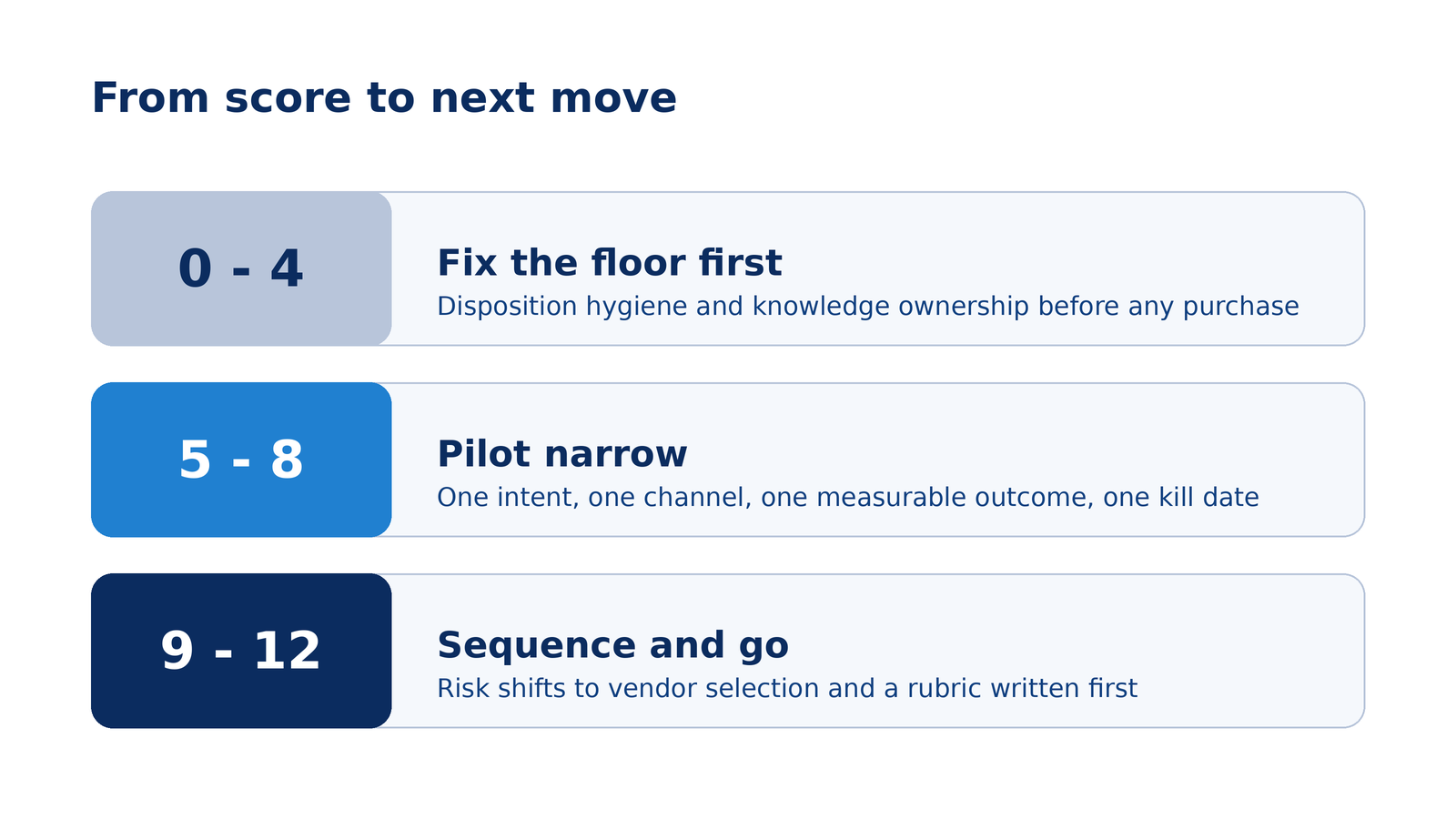
Read the result against your lowest gate, then sequence the work against it. This table shows how we would act on each band.
| Lowest-gate band | Verdict | What to do next |
|---|---|---|
| 0 to 4 total | Fix the floor first | Buying now converts a data problem into a data problem with an invoice. Spend time on disposition hygiene and knowledge ownership. It improves the operation whether or not you deploy AI. |
| 5 to 8 total | Pilot narrow, on your strongest gate | One intent, one channel, one measurable outcome, one kill date. Do not let a vendor scope it to the full journey. |
| 9 to 12 total | Sequence and go | You are ready enough. The risk shifts to vendor selection, where a vendor evaluation rubric written before the demos keeps the choice honest. |
Why do contact center AI pilots fail to reach production?
Most stall on governance or frontline readiness, not technology. A pilot proves the model works in a controlled scope. Production needs approved disclosure language, a re-aligned QA form, working escalation context, and clean disposition data. That is organizational work, and it connects directly to your CX operating model. No vendor delivers it for you.
What should you ask whoever runs the assessment with you?
Ask any AI CX consultant three questions before you sign. Do you get paid if we buy nothing? If not, the assessment has a preferred outcome. When are your scoring criteria written, before or after vendor demos? After is how a rubric gets reverse-engineered to fit the favorite. And will you disclose your commission position on every vendor you name, in writing?
Frequently asked questions
What is an AI readiness assessment for a contact center?
It is a structured test of whether your operation can run AI in production, not whether a demo works. It scores data quality, workflows, governance, and frontline preparedness, then produces a gap list and a sequence. You complete it before any vendor is shortlisted.
How long does an AI readiness assessment take?
The scorecard itself takes an afternoon if the right people are in the room: operations, QA, IT, and Legal. Closing the gaps it finds takes longer, from weeks for knowledge ownership to quarters for disposition cleanup or contract changes. Scoring first tells you which.
Why does the lowest gate matter more than the total score?
Because AI in production needs all four gates open at once. A strong score on data, workflows, and governance does not help if Legal has not approved disclosure language or agents are penalized for using the tool. One shut gate stops the deployment, so you fix that one first.
Who should own AI governance in a contact center?
One named individual with authority across Legal, Security, and Operations, often the head of contact center operations, with Legal holding a veto. Shared governance tends to mean unowned governance, and the first regulatory or customer complaint exposes it quickly.
Should we run the assessment before or after choosing a vendor?
Before. The assessment tells you what to buy, what to fix first, and what to pilot. Run it after the demos and the criteria get bent toward the favorite. Write the scoring criteria first, agree them internally, then invite vendors against them.
Where CTG fits
Cloud Tech Gurus advises enterprise contact centers on CX transformation, AI readiness, and technology sourcing across a 250+ supplier network. We run the Four-Gate assessment with your operations, QA, IT, and Legal teams, then turn the lowest gate into a sequenced plan.
Our standard, stated plainly: we are compensated by suppliers when a client selects one. We disclose that position per vendor, in writing, before any shortlist is built, and scoring criteria are agreed with you before vendors are invited. If a rubric cannot survive being published, it is not a rubric.
We didn’t study contact centers. We ran them. That is why this assessment starts with your disposition codes and not with a demo.