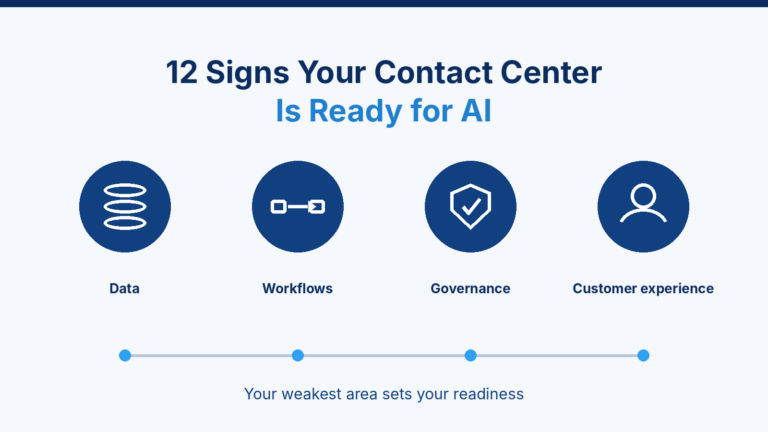
Your contact center is ready for AI when four things hold up outside a demo: data you can trust, workflows that hand off with context, governance with one accountable owner, and a customer experience baseline by intent. Your weakest area sets your readiness, and you do not need all twelve signs to start a narrow use case in 2026.
Why it matters: Most contact center AI pilots work. The bot contains contacts and agent assist finds the right article. Then the pilot meets the rest of the operation: disposition codes nobody trusts, handoffs that drop context, and disclosure language still waiting on Legal. The technology did not fail. The operation was not ready to carry it.
Cloud Tech Gurus was founded by former contact center executives who have launched the pilot, celebrated the demo, and then spent two quarters working out why it would not scale. This is the checklist we wish we had before the first one.
Key takeaways
- Readiness is operational, not technical.
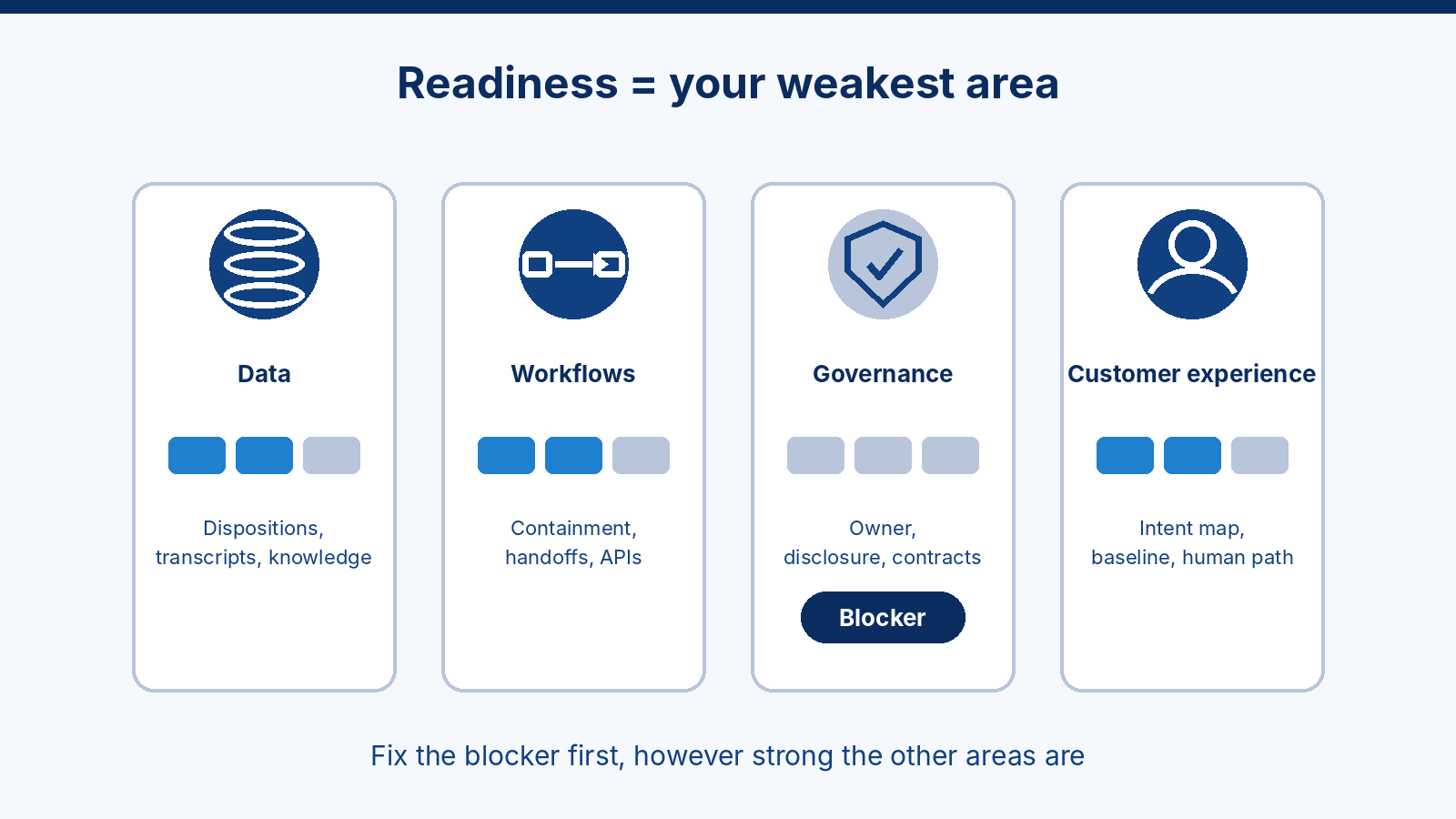
- Your weakest area sets your readiness. Strong data cannot make up for missing governance.
- Readiness decides the use case. Start where you are ready.
What is AI readiness for contact centers?
AI readiness is whether your operation can support AI in production, not just in a demo. It covers four areas: data quality, workflow design, governance, and customer experience. For a scored version, use our four-gate AI readiness assessment.
Is your data ready?
1. You can tell why customers called
The sign: Your disposition codes are audited, and fewer than 15% of contacts land in “Other,” “General inquiry,” or the first option on the list.
Why it matters: Intent models learn from your dispositions. If agents pick codes out of click fatigue, the model learns click fatigue.
Not there yet if: Nobody has audited disposition codes in the last year, or supervisors do not trust contact-reason reports.
2. Your voice contacts are transcribed accurately
The sign: More than 90% of voice contacts are transcribed, and accuracy has been tested on your accents, acronyms, and product names.
Why it matters: Voice is where the data gap lives. Speech analytics, QA automation, and agent assist all depend on transcripts you can trust.
Not there yet if: Transcription covers a sample, or nobody has checked accuracy on your own vocabulary.
3. Your knowledge base has owners
The sign: Every knowledge article has a named owner and has been reviewed within the last 12 months.
Why it matters: AI copilots will confidently serve whatever is in the knowledge base, including the article that went out of date last spring.
Not there yet if: Pull ten articles at random and more than two are past review, or nobody can say who owns them.
Are your workflows ready?
4. You can tell containment from abandonment
The sign: “Contained” has a written definition that separates a resolved contact from a customer who gave up.
Why it matters: In most reporting, a contained contact and an abandoned one look the same. Without a definition, your AI return-on-investment case cannot be proven.
Not there yet if: Your self-service reports show containment but no repeat-contact rate for the same customers.
5. Handoffs carry context
The sign: When AI escalates to a person, the agent sees the transcript, what was already tried, and the customer’s verification status.
Why it matters: A customer who repeats everything after a bot handoff is angrier than one who never met the bot. Poor handoffs can cancel out the gains from self-service.
Not there yet if: Agents routinely open post-bot calls with “Can you tell me what’s going on?” We cover the cause in our piece on barriers to CX and operations alignment.
6. Your systems of record are reachable
The sign: Order status, balances, claims, and appointments are available through APIs that AI can read from and write to.
Why it matters: Agentic AI does not just answer questions. It takes actions. Automation that cannot write back to the system of record is deflection, not resolution.
Not there yet if: Agents still toggle into legacy screens to look things up or make updates.
Is your governance ready?
7. One person owns AI decisions
The sign: A named leader owns AI governance for the contact center, with authority across Legal, Security, and Operations.
Why it matters: “Shared” ownership means no ownership. The first regulatory question stalls it.
Not there yet if: AI decisions go to a committee with no final decision-maker.
8. Disclosure language is approved, not drafted
The sign: What customers are told about AI handling, recording, and transcription has been signed off by Legal.
Why it matters: In healthcare and financial services, disclosure is often the slowest gate and can hold up a working deployment for months.
Not there yet if: The disclosure is still “in review.”
9. Your contracts cover data use and model changes
The sign: Your AI contracts state whether vendors can train on your conversations, how you are notified of model changes, and whether you can roll back.
Why it matters: When a vendor updates a model, your contact center’s behavior changes too. If the contract is silent, the vendor decides.
Not there yet if: Data-use terms live on a vendor’s policy page instead of in your contract.
Is your customer experience ready?
10. You know which contacts customers want automated
The sign: You have mapped contact types by complexity, emotion, and customer preference, using voice-of-customer data and contact data, not assumptions.
Why it matters: Customers tend to welcome automation for order status and resist it for disputes and anything emotional. Automating the wrong intents raises effort and lowers trust.
Not there yet if: The automation plan starts with “our top ten contact reasons” and has no data on how customers feel about each.
11. You have a CX baseline to judge AI against
The sign: You have measured CSAT, first contact resolution, repeat contacts, and customer effort by intent before any AI goes live.
Why it matters: Without a baseline, every AI result becomes a debate. With one, you can show whether the AI improved the experience or just moved the volume.
Not there yet if: Your CX metrics exist only at the queue level, not by contact reason.
12. Customers can always reach a person
The sign: Every automated path has a measured route to a human, and you track how many steps it takes.
Why it matters: Trapping customers in automation turns efficiency into churn. Synthetic voice fraud also targets automated channels, so identity verification at the handoff belongs in the design.
Not there yet if: Reaching an agent requires saying “representative” three times.
What are you ready for? Match readiness to the use case
You need the right signs for the use case you choose, not all twelve.
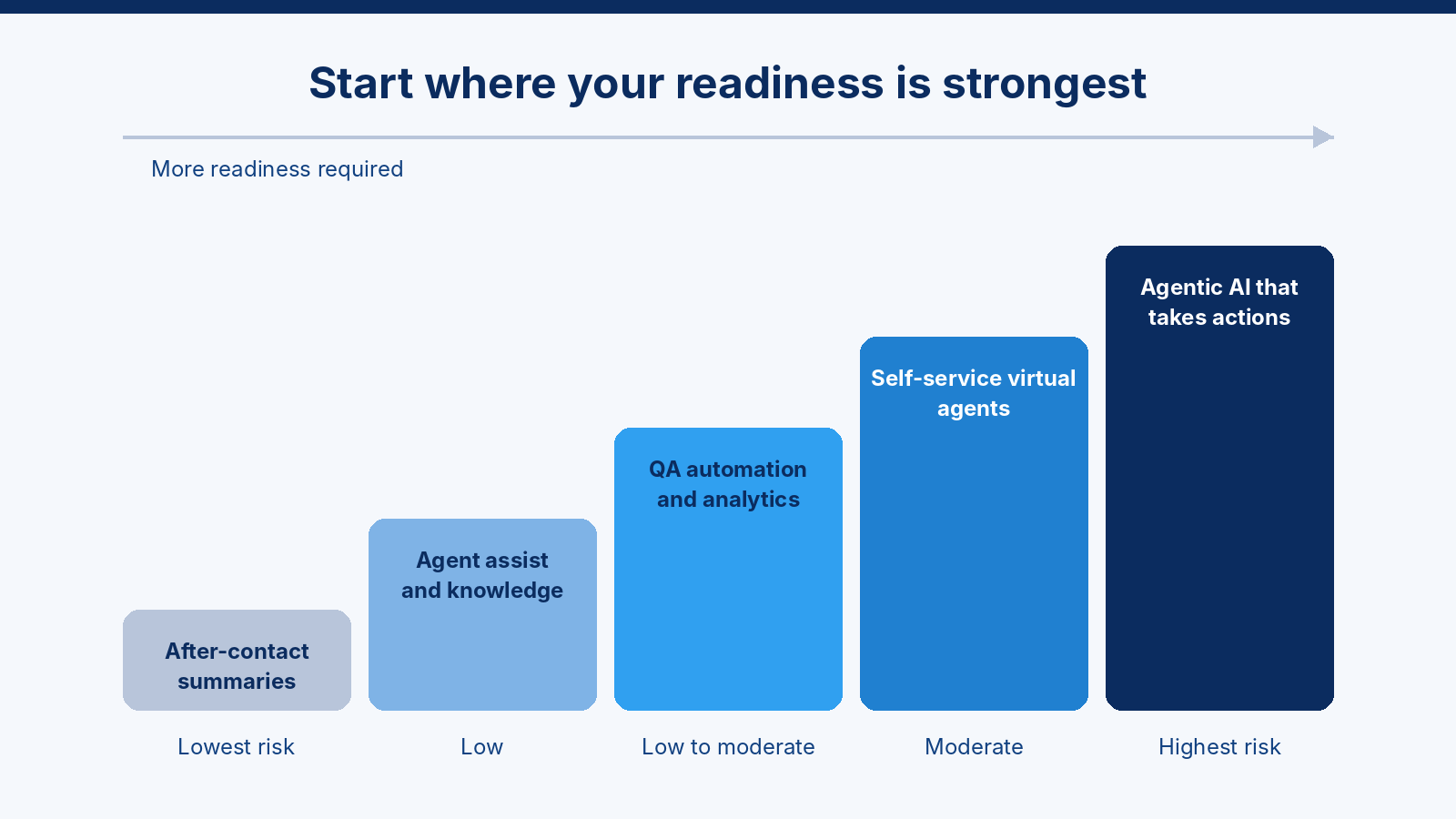
| AI use case | Minimum readiness | Risk level |
|---|---|---|
| After-contact summaries | Transcription (sign 2) and approved disclosure (8) | Lowest: a good starting point |
| Agent assist and knowledge | Transcription (2), knowledge ownership (3), disclosure (8) | Low: agents stay in the loop |
| QA automation and speech analytics | Transcription (2), dispositions (1), a QA form calibrated to the new behavior | Low to moderate |
| Self-service virtual agents | Dispositions (1), containment defined (4), context handoffs (5), CX baseline (11), human path (12) | Moderate: customers meet AI directly |
| Agentic AI that takes actions | All of the above, plus write-back APIs (6), a single owner (7), and contract controls (9) | Highest: AI changes records without a person |
Start where your readiness is strongest, prove the value, and let the results pay for closing the next gap.
How do you count your signs?
Count the signs you can honestly check off in each area: data (1–3), workflows (4–6), governance (7–9), and customer experience (10–12).
| Your count | What it means | Next move |
|---|---|---|
| Zero in any area | That area is your blocker | Fix it first, however strong the others are |
| Two or three in every area | Ready to pilot a narrow use case | Pick one use case with a clear end date |
| All twelve | The risk has moved to vendor selection | Lock your criteria before the demos |
If you are outsourcing any queues, add AI terms to your BPO requirements too. We cover that in our guide to building a contact center BPO RFP.
FAQ
How do I know if my contact center is ready for AI?
Check four areas: trustworthy data (dispositions, transcripts, knowledge), workflows that hand off with context, governance with one owner and approved disclosures, and a customer experience baseline by intent. Your readiness is set by your weakest area, not your average.
Which contact center AI use case should we start with?
Start where your readiness is strongest. After-contact summaries and agent assist carry the lowest risk because agents stay in the loop. Self-service and agentic AI need clean data, context handoffs, write-back systems, and stronger governance before they are safe to launch.
Why do contact center AI pilots stall before production?
Usually because of operational gaps, not the technology. Common causes include untrusted disposition data, handoffs that drop context, unapproved disclosure language, and QA forms that still reward the old behavior. The pilot proves the model works; production needs the operation to be ready.
What should an AI maturity assessment include?
Data quality, workflow design, governance, customer experience, and frontline readiness, each scored against a defined standard. It should produce a list of gaps and a sequence for closing them before any vendor is shortlisted, so vendor choice follows readiness.
Is agentic AI different from other contact center AI?
Yes. Agentic AI takes actions, like issuing refunds or changing appointments, instead of just answering questions. That raises the bar for API write-back, human-review thresholds, audit trails, and contract controls over model changes. It belongs at the top of the ladder.
Where CTG fits
Cloud Tech Gurus is a Phoenix-based customer experience consulting and sourcing firm, founded in 2017 by former contact center executives. We run practitioner-led AI readiness assessments for enterprise contact centers, starting with your disposition codes and QA forms, not a demo. We then run vendor evaluations across the 250+ suppliers and 40+ BPOs in our network, scored against a documented rubric you can audit.
There are three ways to work with us: paid CTG Consulting, vendor-funded research shortlists, and guru-led sourcing under a Letter of Agency. Suppliers compensate us when a client buys through us. We disclose that up front, agree the weights with you before any provider is invited, and disclose our relationship with each provider in writing before a shortlist is built.
We didn’t study contact centers. We ran them.