
If you think a call centre team leader is just there to handle escalations and watch the clock, your playbook is about twenty years out of date. The job isn't about supervision anymore. It's about ownership.
The modern team leader is the critical connection between your high-level CX goals and the agents executing them on the floor. Get this role right and you'll see everything from agent retention to customer loyalty improve. Get it wrong and even the most brilliant strategies will fall flat.
Defining the Modern Call Centre Team Leader Role
The scope of call centre team leader responsibilities is wide, but it organises cleanly into three core pillars. Think of them as the three legs of a stool. If one is weak, the whole thing becomes unstable.
| Pillar | Core Focus | Key Responsibilities |
|---|---|---|
| People | Agent Growth & Engagement | Coaching, motivation, career pathing, reducing burnout |
| Performance | Data-Driven Improvement | Hitting KPIs, analysing trends, quality monitoring, targeted feedback |
| Operations | Process & Strategy | Managing service levels, process improvement, advocating for the agent |
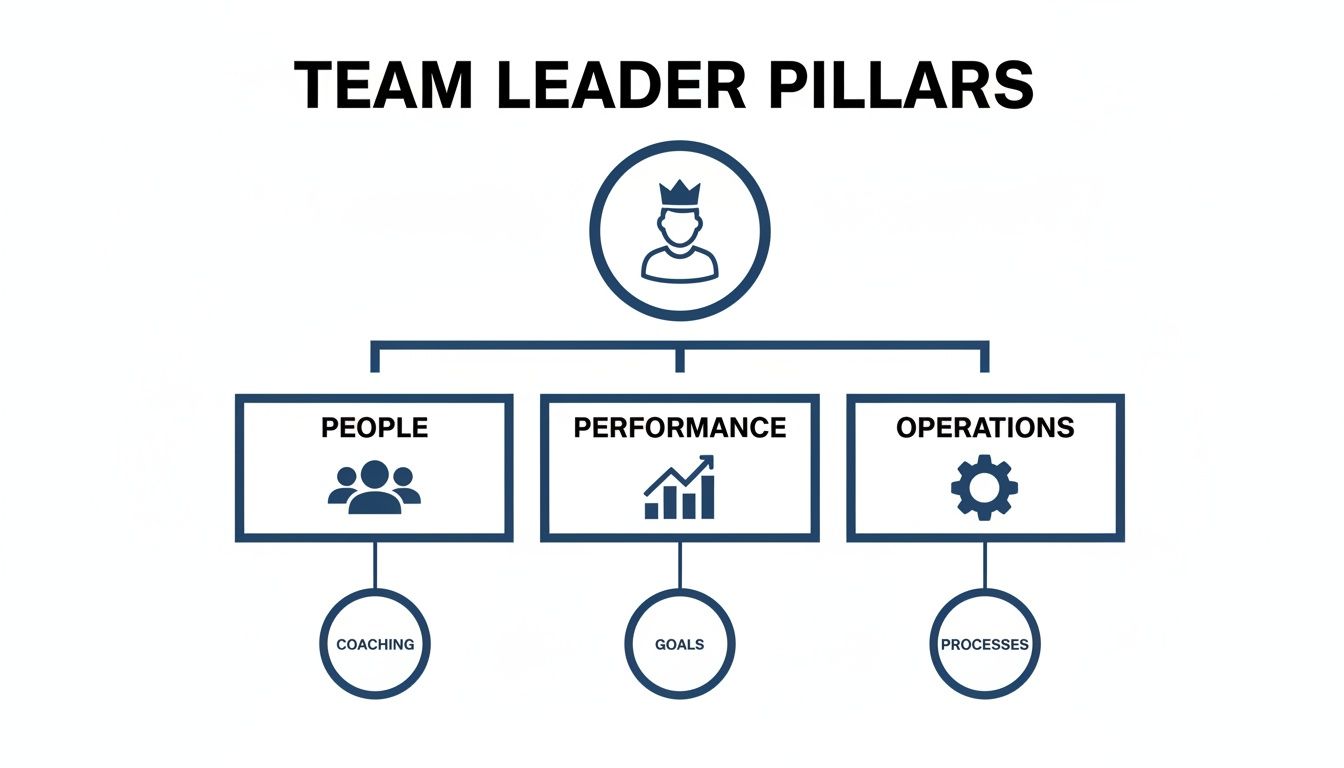
These pillars are not independent. A leader who masters only one will always struggle. Strong coaching is informed by objective data, and both are used to identify and fix broken workflows. That balance is what separates a basic supervisor from a strategic leader, and it is how you turn a team of agents into an operation that drives measurable business results.
Mastering the Art of People Development and Coaching
If you spend all your time staring at performance dashboards, you are missing the point. Data and operational metrics matter, but the real impact of a team leader is measured by their ability to develop their people.
This is where you stop being a manager and start being a leader. It is about building a team culture that actively fights agent burnout and makes people want to stay. An effective leader is a coach, a mentor, and an advocate. Agents are the voice of your brand. Investing in their growth is not a soft skill. It is a core business strategy.

This is how you earn your team's trust and unlock the performance you've been looking for.
Conducting Impactful One-on-One Coaching Sessions
One-on-one sessions are the foundation of agent development. If yours feel like a lecture where you review bad calls and talk at someone about their numbers, you are doing it wrong. These are dedicated moments for real two-way conversation, skill-building, and mapping out a future for your agent.
A great one-on-one is not about finding fault. It is about finding opportunities. The agent should walk away feeling motivated, supported, and clear on what to do next.
A structured approach keeps these meetings productive:
Start with strengths. Never lead with criticism. Open by recognising a specific, recent win. This builds trust and makes the agent receptive to what comes next.
Focus on one behaviour. Do not hit them with a list of faults. Pick one specific behaviour to work on, whether that is active listening, empathy statements, or de-escalation technique.
Use data as a guide, not a weapon. Quality scores and AHT are a starting point for conversation, not a verdict. Ask questions. What was happening during that call? What challenges are you running into with this call type?
Collaborate on solutions. Instead of dictating the fix, ask the agent for their ideas first. What do you think you could do differently next time? That creates ownership.
Think of a one-on-one like a session with a good coach. The goal is not to point out weaknesses. It is to spot potential, provide targeted guidance, and track progress over time.
Fostering a Supportive and Motivational Team Culture
A positive team culture does not appear on its own. It is actively built and protected by the team leader, every single day. That culture is your primary defence against the high-stress environment that drives good agents out the door.
You set the tone. Every huddle, every message, every interaction contributes to the environment your team operates in. Small, consistent efforts have an outsized impact on morale and resilience.
Key culture-building activities:
Lead motivational huddles. Start shifts with quick, focused huddles. Share a win, recognise someone publicly, or set a single clear goal for the day.
Encourage peer-to-peer recognition. Create a way for agents to praise each other. A dedicated channel or a simple whiteboard builds camaraderie and reinforces the right behaviours without you having to drive every moment of it.
Navigate conflict with empathy. When disagreements surface, address them directly. Listen to everyone involved and guide toward a resolution built on professional respect. Do not let things fester.
Protect your team's wellbeing. Watch for signs of burnout. Distribute workload fairly. Go to bat for your team when a systemic issue outside their control is causing them stress.
Your role in people development ultimately comes down to creating psychological safety. A team where agents feel safe asking for help, admitting a mistake, and trusting that you are genuinely invested in their success is a team that performs.
Driving Success With Performance Oversight And Data
If coaching your people is the heart of the job, performance data is the brain. A major part of call centre team leader responsibilities today is acting as a data-driven coach, not just a manager who glances at a spreadsheet. You cannot improve what you do not measure, and the best leaders use data to tell a clear story about what is actually happening on their team.
This is not about wielding metrics as a weapon. It is about using objective insight to understand what is really going on, celebrate the wins, and deliver targeted feedback that actually helps agents improve. A great leader connects what an agent does every day to the business results that matter.

Honestly, this ability to turn raw numbers into actionable coaching is what separates the real leaders from the supervisors.
Translating KPIs Into Coaching Opportunities
Key Performance Indicators are your team's vital signs. Metrics like Average Handle Time, First Call Resolution, and Customer Satisfaction scores are non-negotiable, but on their own they are just numbers. Your job is to dig into the why behind the data.
Think of yourself as a performance detective. An agent's AHT might be creeping up not because they are slow, but because they are struggling to navigate a clunky knowledge base. A dip in FCR could point to a gap in your last training session, not a lack of effort from your team. The number tells you where to look. The conversation tells you what is actually happening.
Using Call Monitoring and Quality Scorecards for Objective Feedback
Call monitoring is one of the most powerful tools available to a team leader and one of the most frequently misused. When it is done poorly, it feels like surveillance. When it is done well, it is the foundation for genuine growth. The purpose is to provide objective feedback tied to specific, coachable behaviours.
A well-designed quality scorecard is your best friend here. It shifts the conversation away from subjective impressions like "you sounded disengaged" and toward observable facts like "the empathy statement was missing from the call opening."
Best practices for call monitoring and feedback:
Monitor a mix of calls. Do not only hunt for the bad ones. Reviewing strong calls reinforces what good looks like and gives you examples to use when coaching the broader team.
Let the agent self-evaluate first. After listening to a call together, ask for their take. How do you feel that call went? Agents often identify the exact area for improvement themselves, which creates immediate buy-in.
Focus on behaviours, not personalities. Feedback is always about actions on the call, not the agent's character. Frame it as "let's work on the de-escalation technique" rather than "you need to be less confrontational."
Tie feedback directly to the scorecard. Connect every coaching point to a specific line item. This keeps feedback objective, fair, and aligned with team goals.
This approach takes the emotion and defensiveness out of the process. It turns a dreaded quality review into a collaborative problem-solving session.
Leveraging Performance Dashboards for Real-Time Insights
In a busy contact centre, you cannot wait for a weekly report to find out if your team is in trouble. Modern performance dashboards give you a live view of what is happening right now, letting you get ahead of problems instead of reacting to them after the fact.
Common dashboard metrics to monitor:
Service Level. Are calls being answered within the target time? If service level is dropping, you may need to adjust breaks, pull agents from offline work, or step into the queue yourself.
Queue status. How many customers are waiting? A growing queue could indicate an unexpected volume spike or a system issue that needs immediate attention.
Agent status. Who is on a call, in wrap-up, or available? This is essential for managing adherence and making sure the right people are in the right place at the right time.
Keeping a constant pulse on real-time data lets you make immediate adjustments that protect service levels and support your agents exactly when they need it.
Elevating Your Impact Through Strategic Operations
While coaching and managing daily fire drills will always be part of the job, the leaders who genuinely get ahead are the ones who master strategic operations. This is where you stop being a supervisor and start becoming a strategic partner to the business.
You are on the front line every day. That gives you a ground-level view that senior leadership simply does not have. Your real job is to capture the friction, the recurring problems, and the broken processes your team encounters and channel those insights upward to drive meaningful change. That is how your team's daily work starts contributing directly to a smarter, more efficient customer operation.
Becoming the Voice of the Agent and the Customer
No one in the C-suite knows the real problems with the customer journey like your agents do. They are a direct source of intelligence on everything from confusing product features and broken self-service flows to internal processes that are driving up handle times and frustrating customers. Your job is to listen and to translate what you hear into something actionable.
When three different agents flag the same confusing policy that is causing escalations, that is not just a cluster of complaints. It is a signal that something is broken at a systemic level. Getting that signal to the people who can fix it is one of the highest-value things a team leader can do. It reduces call volume, improves First Call Resolution, and makes the overall customer experience better. That is strategic value, not just supervision.
Managing Challenging Customer Escalations
No matter how good your team is, escalations happen. How you handle them defines you as a leader. A strong team leader sees an escalation not just as a problem to solve but as an opportunity to save a customer relationship, coach an agent, and spot a process gap.
When a call reaches you, your approach should be methodical and calm:
Acknowledge and empathise. Validate the customer's frustration immediately. Something as simple as "I completely understand why you're upset, and I'm going to take personal ownership of this right now" can lower the temperature fast.
Take ownership. Make it clear the situation stops with you. This builds confidence and prevents the customer from feeling passed around.
Debrief and coach afterward. After the issue is resolved, circle back with the agent. Frame it as a learning opportunity. Walk through the call together, identify where things went sideways, and figure out what could be done differently next time. This is not about blame. It is about building capability.
Navigating Daily Service Level Management
One of the most dynamic call centre team leader responsibilities is the real-time juggling act of managing service levels. This means making sure interactions across voice and digital channels are handled promptly without burning out your team or compromising quality. It demands sharp attention to dashboards and the confidence to make quick decisions.
Industry data puts the average team leader span of control at around 11.7 agents. In complex or high-stakes environments like healthcare or financial services, a tighter ratio closer to 1:10 gives leaders the capacity to coach intensively. In high-volume transactional operations with experienced agents and strong AI support, a ratio of 1:18 or higher can still work effectively. The goal is not to hit an arbitrary number. It is to give agents the level of support they actually need.
To manage service levels effectively:
Monitor in real time. Keep eyes on queue volumes, wait times, and agent availability continuously. Know what is happening as it happens.
Make agile adjustments. Be ready to pull agents from offline work, shift break schedules, or step into the queue yourself when volume spikes unexpectedly.
Communicate with your team. Keep agents informed on how the team is tracking against service levels throughout the shift. That transparency keeps people motivated and focused on the shared goal.
Leading Teams in the AI-Powered Contact Center
The conversation about AI in the contact centre has moved well past the "humans versus machines" debate. It is a partnership now. As AI and automation become embedded in daily operations, the definition of call centre team leader responsibilities is shifting. You are no longer just managing a team of agents. You are orchestrating a hybrid workforce of people and technology.
This requires a genuine shift in how you lead. Your focus has to move from overseeing transactions to cultivating the high-value, distinctly human interactions that AI cannot replicate. Your mandate is to ensure technology actually empowers your team, making them more effective rather than more overwhelmed. A poorly led AI rollout creates new headaches for agents and customers alike. When it is led well, everyone benefits.

Coaching Agents to Collaborate With AI
One of your most important responsibilities in this environment is teaching agents how to work with AI, not around it. Tools like agent assist, real-time transcription, and automated summaries work best when agents treat them as support, not as something to fight or ignore. When agents learn to collaborate with these tools effectively, they can direct their energy toward complex problem-solving and building genuine connections with customers.
Key coaching points for AI collaboration:
Trust, but verify. Coach agents to treat AI-suggested responses as a starting point, not a rigid script. They need the judgment to validate the suggestion and add the human context that makes the difference.
Focus on the why. AI is good at surfacing what to do next. Your coaching needs to focus on why, building the critical thinking agents need for the edge cases where AI falls short.
Develop the human gap. The most important conversations are now the ones AI cannot handle. Coach specifically for empathy, advanced de-escalation, and building rapport in emotionally charged situations. This is where your team's value compounds.
Interpreting AI-Driven Performance Insights
AI gives leaders a fundamentally different lens on performance. Conversation intelligence and sentiment analysis tools can now analyse every interaction, finally moving teams beyond the statistically limited sample sizes of traditional quality monitoring. That is a richer, more honest picture of what is actually happening on the floor.
But the data is only useful if you can interpret it. A sudden drop in positive sentiment scores is not just a bad week. It could be an early signal of a confusing new policy, a widespread product issue, or an internal process change that is driving customer frustration. Your responsibility is to connect those dots and escalate before the problem compounds.
Training for Empathy-Driven Interactions
As AI handles more routine and repetitive queries, the interactions that reach your human agents will by default be more complex, more emotional, and more urgent. The baseline skill requirements for your team have permanently shifted upward.
How to reorient your coaching:
Role-play the hard scenarios. Move beyond basic call flows. Run sessions focused on emotionally charged situations, such as a billing error causing real financial stress or a service failure affecting a customer's business.
Reward emotional intelligence. Adjust your quality scorecards to give more weight to behaviours like active listening, validating a customer's feelings, and demonstrating authentic empathy, not just script adherence.
Use AI to find coachable moments. Use your conversation analytics platform to flag calls with high negative sentiment or specific keywords that signal customer distress. Use these as targeted coaching examples to build emotional resilience and de-escalation skills across the team.
Leading in an AI-powered contact centre means becoming the strongest champion for the human element. Technology handles what it can. Your job is to make sure your team excels at everything it cannot.
Essential Skills & KPIs for Today's Call Centre Team Leader
Knowing what a team leader does is the starting point. The real question is what separates a supervisor who keeps the wheels on from a leader who drives genuine business value. The answer is a specific combination of modern skills measured against a balanced scorecard.
The best leaders are not just great with people. They are data-driven coaches who can connect with agents on a human level while reading performance metrics to understand what is really happening on the floor. Empathy without data is guesswork. Data without empathy is just cold numbers that erode trust. The leaders who get results live in the balance between both.
Critical Skills for 2026
| Skill Category | Essential Skills | Why It Matters |
|---|---|---|
| People Leadership | Empathy and Resilience | Agents are navigating more complex issues and AI-assisted workflows. Leaders need empathy to coach effectively and resilience to sustain team morale under pressure. |
| Analytical Acumen | Data Interpretation and Problem Solving | A leader who cannot read a performance dashboard is flying blind. They must translate data into actionable coaching and diagnose root causes, not just symptoms. |
| Communication | Clear, Motivational Feedback | With performance insights coming from multiple sources, leaders must translate data into coaching that builds agents up rather than demoralises them. |
| Technical Fluency | System Proficiency across CRM, CCaaS, and AI Tools | Leaders must be able to troubleshoot agent tech issues, explain how AI tools work in practice, and drive adoption rather than resistance. |
These skills are interconnected. A leader uses analytical skills to spot a problem, problem-solving skills to diagnose it, and empathetic communication to deliver feedback that builds the agent rather than tears them down.
A Practical KPI Scorecard for Team Leaders
Performance measurement needs to reflect a leader's actual impact across people, quality, and operational health. Over-indexing on a single metric like AHT at the expense of others like attrition gives you an incomplete and often misleading picture.
| KPI Category | Key Performance Indicator | Why It Matters |
|---|---|---|
| Team Performance | Team CSAT and NPS Score | The clearest measure of the team's output and whether customers are experiencing a positive interaction. |
| Agent Development | Agent Attrition and Turnover Rate | Strong leaders build environments where people want to stay. Consistently high turnover is a signal worth investigating at the leadership level. |
| Quality and Coaching | Quality Score Trend | Shows whether coaching is landing and producing improvement over time. The focus is on the trajectory, not just the number. |
| Operational Health | Team Adherence to Schedule | Reflects the leader's ability to manage the daily operation and maintain the discipline that keeps forecasting accurate and service levels stable. |
This kind of balanced scorecard moves the conversation beyond basic supervision. It gives leaders and the organisations that manage them a clear, honest picture of what high performance in this role actually looks like.
Got Questions? We've Got Answers.
What is the right agent-to-leader ratio?
There is no universal answer. The commonly cited range of 1:12 to 1:16 is a reasonable benchmark, but the right ratio depends entirely on the complexity of the work your team is handling.
In high-stakes environments like healthcare or financial services, where interactions are complex and coaching needs are intensive, a tighter ratio closer to 1:10 gives leaders the capacity to do the job properly. In high-volume transactional operations with experienced agents and strong AI support, a ratio of 1:18 or higher can still be effective. The goal is not to hit a number. It is to ensure agents have the level of support they actually need to perform and develop.
How does the team leader role change in a remote or hybrid environment?
The core responsibilities do not change. Coaching, performance management, and hitting targets remain the job. What changes completely is how you do it.
When you cannot walk the floor, you have to be far more intentional about everything. Culture does not build itself through proximity anymore. It requires well-run virtual huddles, deliberate communication rhythms, and genuine effort to keep people connected to each other and to the team's purpose. Performance management becomes more dependent on analytics, with leaders pulling data from dashboards and monitoring tools to spot problems they used to catch by walking past a desk. The best remote leaders are experts at using technology to stay close to their teams without making surveillance the foundation of that relationship.
What is the hardest adjustment for a new team leader?
Almost universally, it is the identity shift. Most new leaders are promoted because they were high-performing agents. Their instinct is to solve problems by doing the work themselves, jumping into a tough call, fixing an issue directly, or taking over when a situation gets complicated.
Learning to lead through others rather than doing it yourself is genuinely difficult. So is learning to coach an underperforming agent constructively rather than just pointing out what went wrong. Their entire career, success was measured by their own results. Now it is measured by a team of twelve other people's results. Making that shift from doing to leading is the defining challenge of the first year in the role, and how well someone makes it largely determines whether they thrive or struggle.
Closing
Cloud Tech Gurus provides vendor-neutral, practitioner-led consulting for contact center and CX leaders. Learn more at cloudtechgurus.com.