Enterprise CX consulting for outsourcing fails when the engagement is set up wrong, not when the advice is wrong. The usual causes are hiring after the decision is made, hiring the wrong kind of firm, leaving operations out, and ending scope at contract signature. Fix those four in 2026 and the transition has a real chance.
Why it matters: Enterprises spend heavily on outsourcing advice, then watch the transition slip, attrition climb, and CSAT dip in the first 90 days. The advice usually was not the problem. The engagement was set up to fail before the consultant arrived.
Cloud Tech Gurus was founded by former contact center executives who hired consultants, outsourced queues, and lived with the results on the floor. These are the mistakes we see most, and how to avoid each one.
Key takeaways
- Engage before the decision, not at the RFP. Which queues to outsource is the most expensive question in the program.
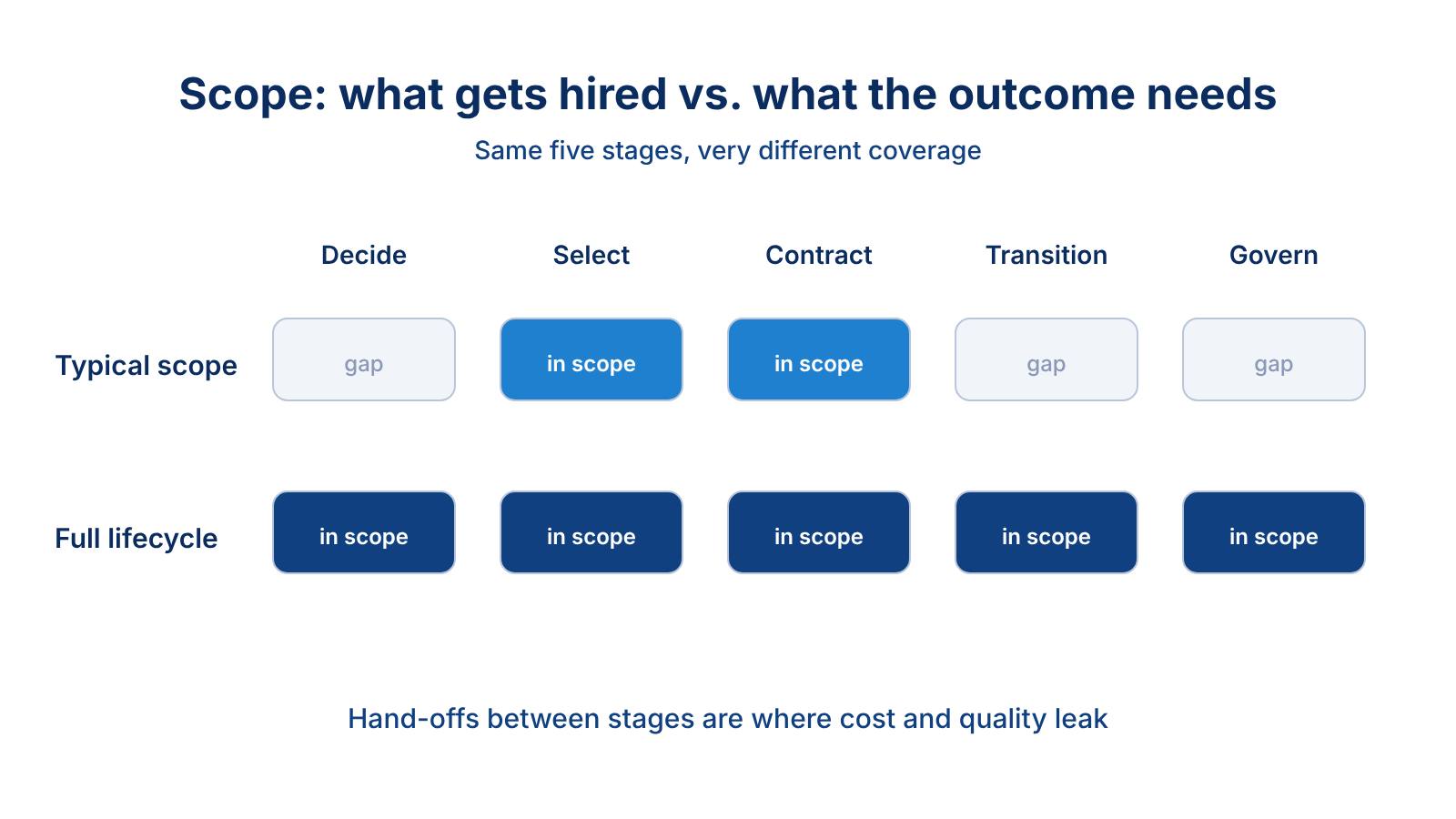
- Scope has to run past signature. Transition is where most outsourcing decisions are won or lost.
- Name an internal owner before the consultant leaves. A scorecard nobody runs is decoration.
What should CX consulting do in an outsourcing decision?
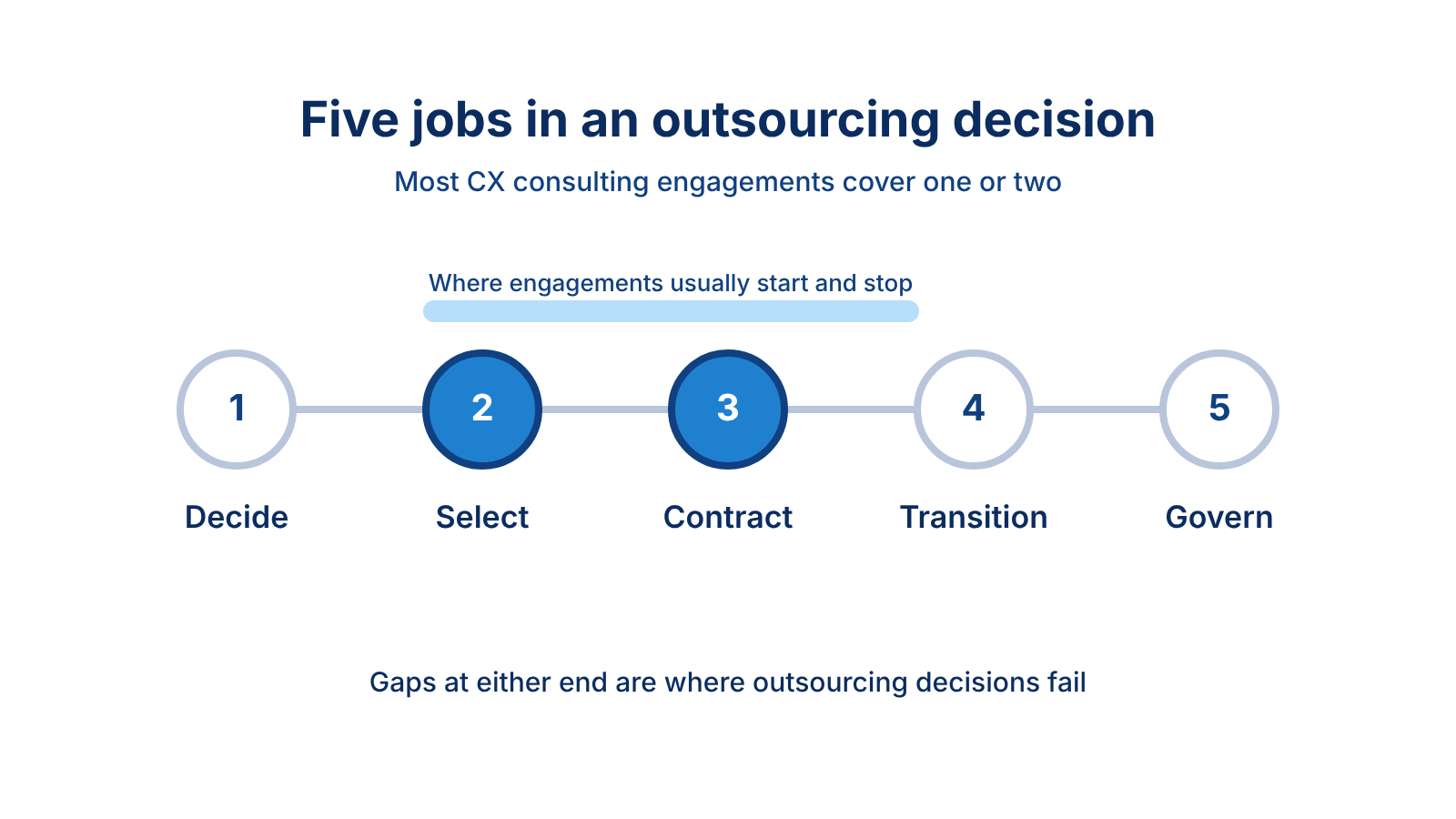
Good consulting covers five jobs, not one. Decide which queues to outsource, automate, or keep. Select a provider through a vendor-neutral evaluation with a published rubric and site-level evidence. Contract SLAs, credits, forecast bands, and exit terms tied to the scorecard. Transition with knowledge transfer, nesting, and go-live gates the buyer owns. Govern with a performance scorecard that outlasts the engagement.
Most enterprises hire for one or two of these and assume the rest will take care of itself. It will not.
Which seven mistakes make CX consulting fail?
1. Hiring the consultant after the decision is made
What happens: Finance picks a target rate, then brings in a consultant to “run the process.” The consultant is really there to confirm a decision that already exists.
What it costs: Queues that should have been automated or kept in-house get outsourced anyway, and savings on the rate card come back as repeat contacts.
The fix: Engage at the queue decision, not the RFP. Start with a CX maturity assessment and an AI readiness assessment so the choice rests on evidence, not a budget target.
2. Hiring the wrong kind of firm
What happens: A strategy firm is asked to run BPO selection, or an advisor with ties to specific providers is asked to run a “neutral” process.
What it costs: Either a strong deck with no sourcing depth, or a shortlist shaped by relationships you did not know about.
The fix: Match the firm to the job. Ask every firm for its rubric, a redacted past scorecard, and written disclosure of its provider relationships. Our guide to choosing a CX consulting firm for outsourcing has the full criteria.
3. Leaving operations out of the room
What happens: Procurement and the consultant design the strategy. Operations sees it for the first time at kickoff.
What it costs: Contracts get built on assumptions the floor cannot meet: wrong handle times, wrong escalation paths, QA forms that do not match reality.
The fix: Put operations leaders on the evaluation team with a documented say in the weights. A recommendation operations cannot staff, measure, or coach to never reaches a customer.
4. Scoring logos instead of sites
What happens: The evaluation compares BPO brands, references, and corporate averages.
What it costs: Your program lands at a site nobody visited, with attrition nobody measured.
The fix: Require a named site in every proposal, visit it, and score site-level data. Use evidence tiers so proposal claims count for less than production data.
5. Negotiating the rate instead of the risk
What happens: Negotiation centers on the hourly or per-contact price. SLAs, credits, and exit terms get drafted last, in a hurry.
What it costs: A contract that protects the provider’s margin more than your customer experience.
The fix: Normalize every bid to cost per resolved contact, then tie a real share of the invoice to resolution, quality, CSAT, and attrition. Negotiate exit terms before you sign, while you still have options.
6. Ending the scope at signature
What happens: The engagement wraps the day the contract is signed. The transition is left to the provider and an internal team that has never run one.
What it costs: This is where most outsourcing decisions actually fail. Knowledge transfer is thin, nesting runs short, and go-live is declared on schedule instead of on performance.
The fix: Write transition gates into the scope before you sign, and keep go-live criteria owned by the buyer, not the builder.
7. No owner after the consultant leaves
What happens: The consultant hands over a scorecard, and nobody runs it.
What it costs: Performance drifts for a year, then the enterprise hires another firm to find out why.
The fix: Name an internal vendor management owner before the engagement ends. Build monthly scorecards and periodic external benchmarking into their job, not into a slide.
| Mistake | Where it shows up first | What to put in the scope |
|---|---|---|
| Hired after the decision | Queues outsourced that should be automated or kept | Queue-level analysis before any RFP |
| Wrong kind of firm | A shortlist you cannot trace to a rubric | Rubric, redacted scorecard, written disclosures |
| Operations left out | Contract assumptions the floor cannot meet | Operations seats and a say in the weights |
| Logos over sites | A site nobody visited | Named site, visit, evidence tiers |
| Rate over risk | Weak SLAs and exit terms | Cost per resolved contact, tied invoice share |
| Scope ends at signature | Thin transition in the first 90 days | Buyer-owned transition gates |
| No owner afterward | Drift after the engagement | Named internal owner, monthly scorecard |
How do you avoid BPO transition mistakes in the first 90 days?
The first 90 days decide whether an outsourcing decision pays off. Watch for these warning signs, and write the prevention into the contract and scope.
| Transition mistake | Early warning sign | Prevention |
|---|---|---|
| Thin knowledge transfer | The provider’s trainers learn your process from documents alone | Your subject matter experts co-train the first class; certify trainers before agents |
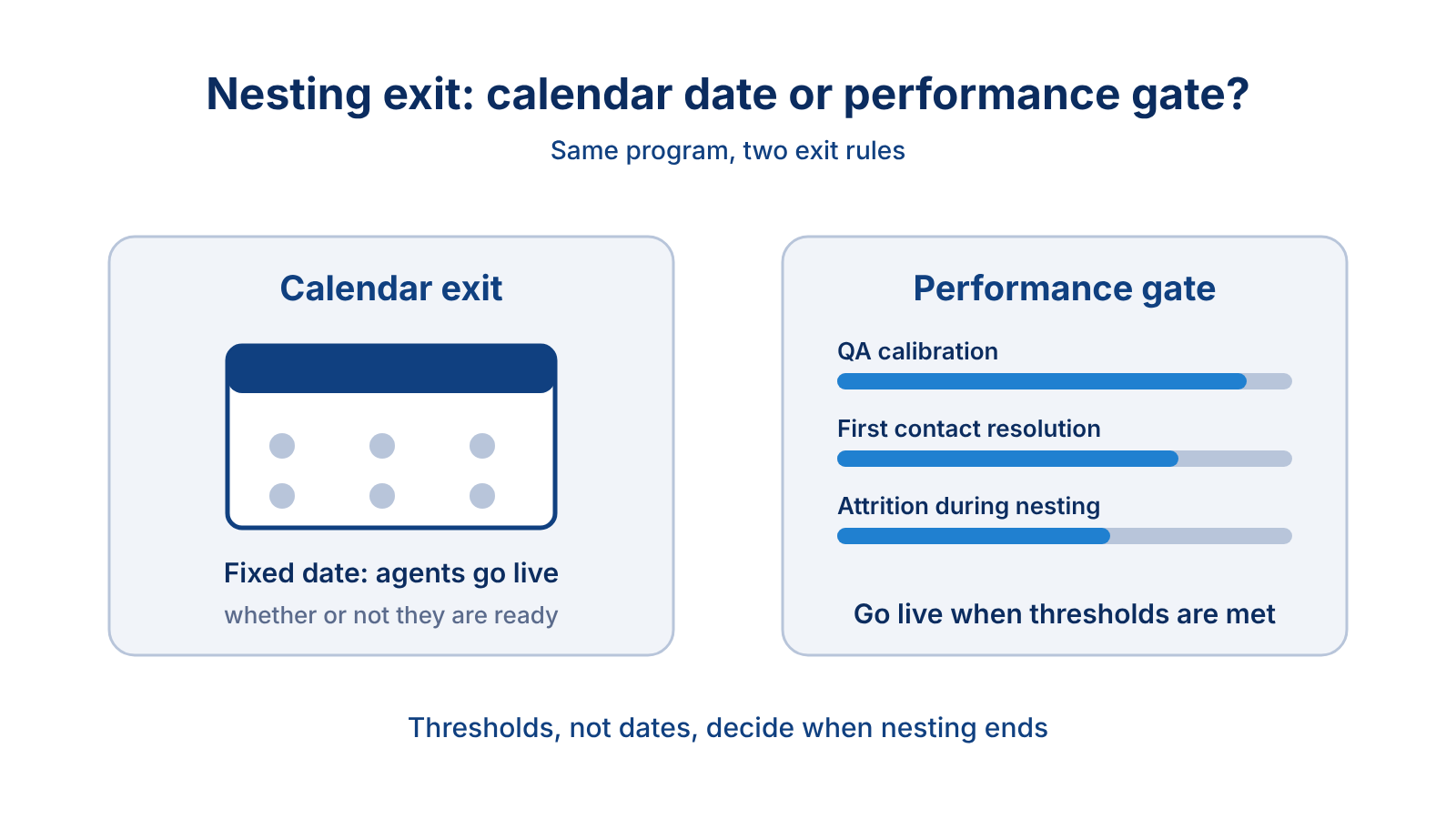
| Short nesting | Agents take live contacts before passing calibrated QA | Tie nesting exit to QA and first contact resolution thresholds, not calendar dates |
| Big-bang cutover | All volume moves on one date | Move volume in waves, with a rollback plan for each |
| Mismatched metrics | Their first contact resolution and yours disagree | Measure in your systems from day one |
| Silent attrition | Agents leave during nesting and nobody tells you | Weekly attrition and tenure reporting in the contract |
| Compliance catch-up | Access controls “in progress” at go-live | Verify HIPAA and PCI DSS controls before the first live contact, including at-home agents |
What should you ask before hiring a CX consulting firm for outsourcing?
- When do you start? If the answer is “at the RFP,” the queue decision is already made.
- Can we see your rubric? A vendor-neutral consultant publishes it. A redacted past scorecard is better.
- What are your provider relationships? Ask for them in writing, for every provider on the longlist.
- Who is on the team? Ask how many have run a contact center or managed an outsourced program from the buyer’s side.
- Where does your scope end? Signature, go-live, or the first 90 days?
- Who owns the scorecard when you leave? A good answer names a role on your team.
FAQ
Why does customer experience consulting fail in outsourcing decisions?
Usually because of how the engagement is set up. The consultant is hired after the decision is made, the firm does not match the job, operations is left out, or the scope ends at contract signature, before the transition that decides the outcome.
When should an enterprise hire a CX consultant for outsourcing?
Before the outsourcing decision, not after. The consultant should help decide which queues to outsource, automate, or keep, then carry that evidence into provider selection, contracting, and transition, so the program rests on analysis instead of a budget target.
What are the most common BPO transition mistakes?
Thin knowledge transfer, nesting that ends on a calendar date instead of performance thresholds, big-bang cutovers, metrics measured only in the provider’s systems, unreported attrition, and compliance controls that are not finished at go-live. Each is cheaper to prevent in the contract than to fix later.
What should a CX consulting engagement for outsourcing include?
Queue analysis, vendor-neutral provider selection with a published rubric, contract and SLA design, buyer-owned transition gates, and a governance scorecard with a named internal owner. If any of the five is missing, ask who covers it.
How do you know if a CX consulting firm is truly neutral?
Ask for its evaluation rubric, a redacted past scorecard, and written disclosure of every provider relationship. Neutrality you cannot audit is not neutrality. Any firm paid by commission or partnerships should say so plainly and agree weights with you before providers are invited.
Where CTG fits
Cloud Tech Gurus is a Phoenix-based customer experience consulting and sourcing firm, founded in 2017 by former contact center executives. We help enterprise contact centers decide what to outsource, then run vendor-neutral evaluations across the 250+ suppliers and 40+ BPOs in our network, scored against a documented rubric you can audit.
There are three ways to work with us: paid CTG Consulting, vendor-funded research shortlists, and guru-led sourcing under a Letter of Agency. Suppliers compensate us when a client buys through us. We disclose that up front, agree the weights with you before any provider is invited, and disclose our relationship with each provider in writing before a shortlist is built.
We didn’t study contact centers. We ran them.