Choose a CX consulting firm for outsourcing by testing four things: whether its people have managed a BPO as the buyer, whether it will show you its scoring method, how many partners it evaluates, and whether it stays after go-live. Hourly rates and brand names matter far less than those four.
Why it matters: An outsourcing decision locks in service quality, cost structure, and brand reputation for years. The wrong advisor leaves you with the wrong BPO, a weak contract, and a scorecard that measures everything except what customers feel.
We didn’t study contact centers. We ran them, including the part where you manage someone else’s agents on your brand’s behalf. Here is how we would evaluate a CX consulting firm in 2026 before trusting it with that decision.
Key takeaways
- Operator experience comes first. Someone who has sat in a BPO review while service levels slid knows which clauses matter.
- Ask to see the scoring. A firm that will not show a redacted past scorecard is asking for trust without evidence.
- Judge breadth, not logos. A small partner roster means your requirements get fitted to its roster.
- Count the work after signature. The first 90 days decide whether the relationship works.
What are you actually buying from a CX consulting firm for outsourcing?
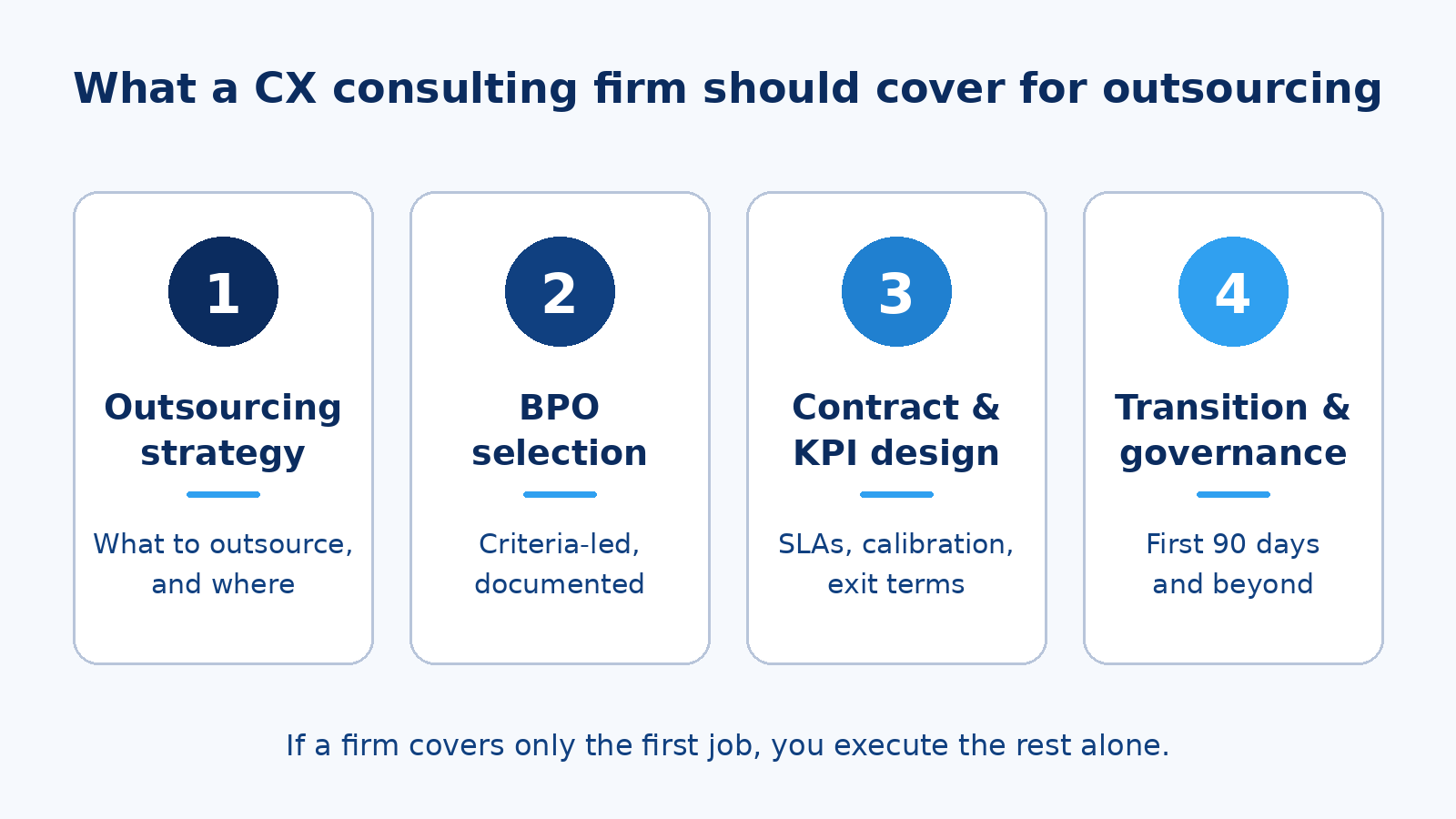
Not a slide deck. For outsourcing, the work breaks into four jobs: outsourcing strategy (what to keep in-house, what to outsource, and whether onshore, nearshore, offshore, or at-home models fit each line of business); BPO selection against documented criteria for your volume, complexity, languages, and compliance needs; contract and KPI design, including SLAs, quality calibration, penalties, and exit terms; and transition and governance after launch. If a firm covers only the first job, you are paying for a strategy you will have to execute alone.
Which seven criteria should you score a firm on?
Use the table as a rubric. The weights are a starting point for enterprise and mid-market contact centers, not a standard. Agree your own before the first meeting with any firm.
| Criterion | Sample weight | What to ask | Red flag |
|---|---|---|---|
| Operator credibility | 20% | “Who on your team has managed a BPO relationship as the buyer?” | Every consultant came from consulting |
| Sourcing rigor | 20% | “Show me a redacted scorecard from a past BPO selection.” | “We just know who’s good” |
| Independence and network breadth | 15% | “How many BPOs do you evaluate, and across which regions?” | Every shortlist lands on the same two or three partners |
| Contract and KPI design | 15% | “How do you structure SLAs, quality calibration, and exit terms?” | Contract handed to your lawyers, advisor gone |
| Service quality and risk | 15% | “How do you assess attrition, labor markets, and continuity by site?” | Location chosen on hourly rate alone |
| Transition and governance | 10% | “What happens in the first 90 days after go-live?” | Engagement ends at signature |
| Technology and AI posture | 5% | “How do you evaluate a BPO’s tech stack and AI use?” | AI treated as a buzzword, not a line item |
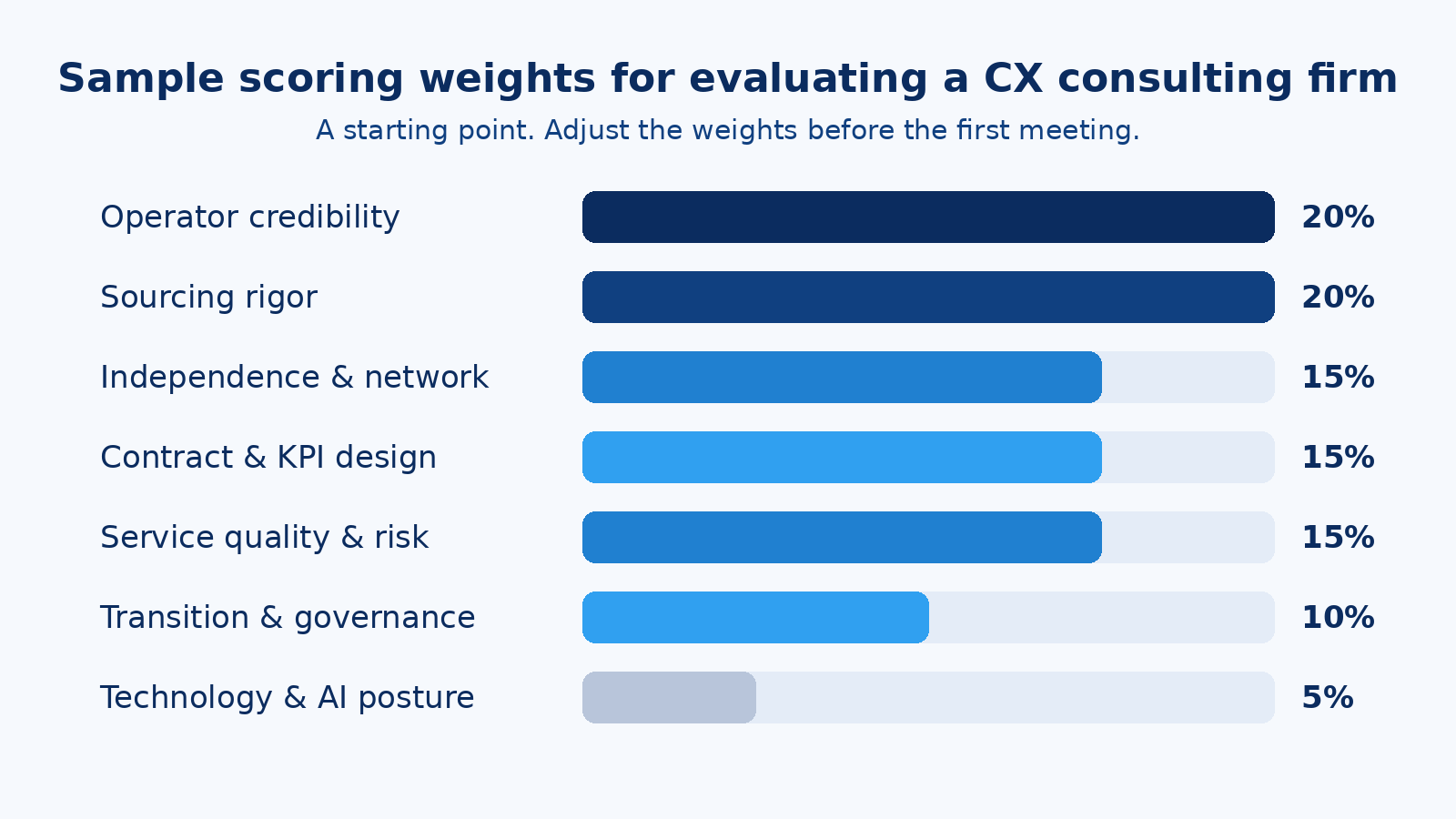
Two of these deserve extra weight in your thinking. Operator credibility ranks first because someone who has watched service levels slip knows which contract terms matter; someone who has not will learn on your budget. Sourcing rigor is the independence test: a firm that cannot show its method is asking you to accept its judgment without its work.
Why does location strategy decide so much of the outcome?
Because site choice shapes customer experience more than almost any vendor choice. A capable firm evaluates each site, not just the BPO’s company-wide average, on labor market depth, site-level attrition and tenure, language and cultural fit measured with your real customers’ calls, compliance posture for HIPAA, PCI DSS, and data residency, and continuity risk with a documented failover plan.
Hourly rate is not cost. High attrition, weak first contact resolution, and constant retraining make a cheap site expensive, so good advisors model cost per resolved contact. We cover the mechanics in how to compare BPO pricing without service risk. For mid-market operations the answer is often a blended model, and the advisor should design it from your needs, not from where its partners have open seats.
What red flags show up on the first call?
| What you hear | What it usually means |
|---|---|
| They lead with a BPO name | A recommendation before discovery is a placement, not advice |
| No one on the team has run a contact center | They will struggle to spot a missed service level in a vendor’s report |
| “Trust our experience” with no published rubric | There is no evaluation method you can audit |
| “The contract is your lawyer’s job” | Commercial terms are where service quality gets protected or given away |
| Involvement ends at go-live | The first 90 days are yours alone |
Which five questions should you ask before you sign?
- “Walk me through a BPO selection you ran, including the scorecard.”
- “Which of your consultants have managed outsourced operations as the buyer?”
- “How many BPOs and regions did your last three shortlists cover?”
- “What KPIs do you write into contracts, and how do you calibrate quality across sites?”
- “What does your involvement look like 90 days after launch?”
A firm worth hiring answers all five without reaching for a brochure. When you reach the vendor side of the table, our list of contact center BPO selection questions picks up where this one stops.
How is the firm paid, and does it matter?
It matters only if it is hidden. Consulting engagements are paid by the client. Sourcing work is often funded by suppliers through commission when a client buys. Both are normal, and both carry a bias. Ask for the payment model in writing before work starts, and ask for the rubric and weights before any vendor is invited. An advisor whose recommendations you can audit is neutral in the way that counts.
Frequently asked questions
What does a CX consulting firm do for contact center outsourcing?
It defines what to outsource and where, runs a criteria-led BPO selection, designs contracts and KPIs, and supports transition and governance. The point is that service quality holds after launch, not just that a partner gets picked.
How do you evaluate customer experience consulting firms?
Score them against a written rubric: operator credibility, sourcing rigor, independence, contract and KPI design, service quality and risk, transition support, and technology posture. Ask to see a redacted scorecard from a past selection before you sign anything.
Should mid-market contact centers use onshore, nearshore, or offshore outsourcing?
It depends on complexity, language, compliance, and volume. Many mid-market operations blend models, keeping complex or regulated work close and placing scaled volume where the labor market supports it. A good advisor designs that mix around your needs, not their partners’ open seats.
What is the biggest mistake in choosing an outsourcing partner?
Choosing on hourly rate. Attrition, first contact resolution, and retraining decide what a site really costs, so compare partners on cost per resolved contact. A cheap site with high turnover is usually the most expensive one by the second year.
How is a CX consulting firm paid, and does it affect neutrality?
Firms are paid by clients, by suppliers through commission, or both. None of these is disqualifying. What matters is written disclosure before work starts and a rubric you can audit. If you cannot check how a recommendation was scored, do not rely on it.
Where CTG fits
Cloud Tech Gurus is a Phoenix-based customer experience consulting and sourcing firm, founded in 2017 by former contact center executives. We advise enterprise contact centers on outsourcing strategy, BPO selection, and the contract and KPI design that protects service quality, drawing on a network of 40+ BPOs across onshore, nearshore, offshore, and at-home models.
There are three ways to work with us: paid CTG Consulting, vendor-funded research shortlists, and guru-led sourcing under a Letter of Agency. Suppliers compensate us when a client buys through us. We disclose that up front, and every recommendation runs through a documented rubric you can audit.