Customer experience consulting for an enterprise contact center is outside help in deciding what to change, in what order, and with which vendors. Done well, it covers strategy, AI readiness, technology and BPO selection, and quality governance, measured against cost per contact, first contact resolution, and CSAT. Done badly, it is a deck.
Why it matters: A platform, AI, or BPO decision in a 500-plus seat operation stays with you for years. Pick on a slide and you inherit the result long after the consultant has left.
We didn’t study contact centers. We ran them. Most consulting we have watched fail in 2026 fails the same way: strong slides, no operator in the room, and a vendor pick nobody can defend six months later.
Key takeaways
- Ask about operating experience first. Advice from someone who has owned an SLA differs from advice from someone who has studied one.
- Demand the rubric before the demos. Scoring that appears after the recommendation is not a scoring method.
- Test AI claims on your data. Readiness comes before any pilot.
- Know how your advisor is paid. Every model has a bias. Hidden ones are the problem.
What does customer experience consulting actually cover?
For enterprise contact centers it spans five areas. The mix depends on where your current decision is stuck.
| Area | What you should get | What to check |
|---|---|---|
| CX strategy and AI readiness | A roadmap tied to operating metrics, with owners and stop/go checkpoints | Baselines captured before anything changes |
| Technology matchmaking | Written requirements first, then a shortlist from a wide supplier field | Integration scored as a criterion, not assumed |
| BPO and outsourcing strategy | Onshore, nearshore, offshore, or blended, chosen by contact type and compliance exposure | SLAs, attrition, and exit terms defined before signature |
| Global service quality | One quality framework across in-house and outsourced teams | Shared definitions and a fixed calibration cadence |
| Implementation oversight | Vendors held to what they promised through go-live | Clear scope: advisors do not run your floor |
Why does practitioner-led consulting change the answer?
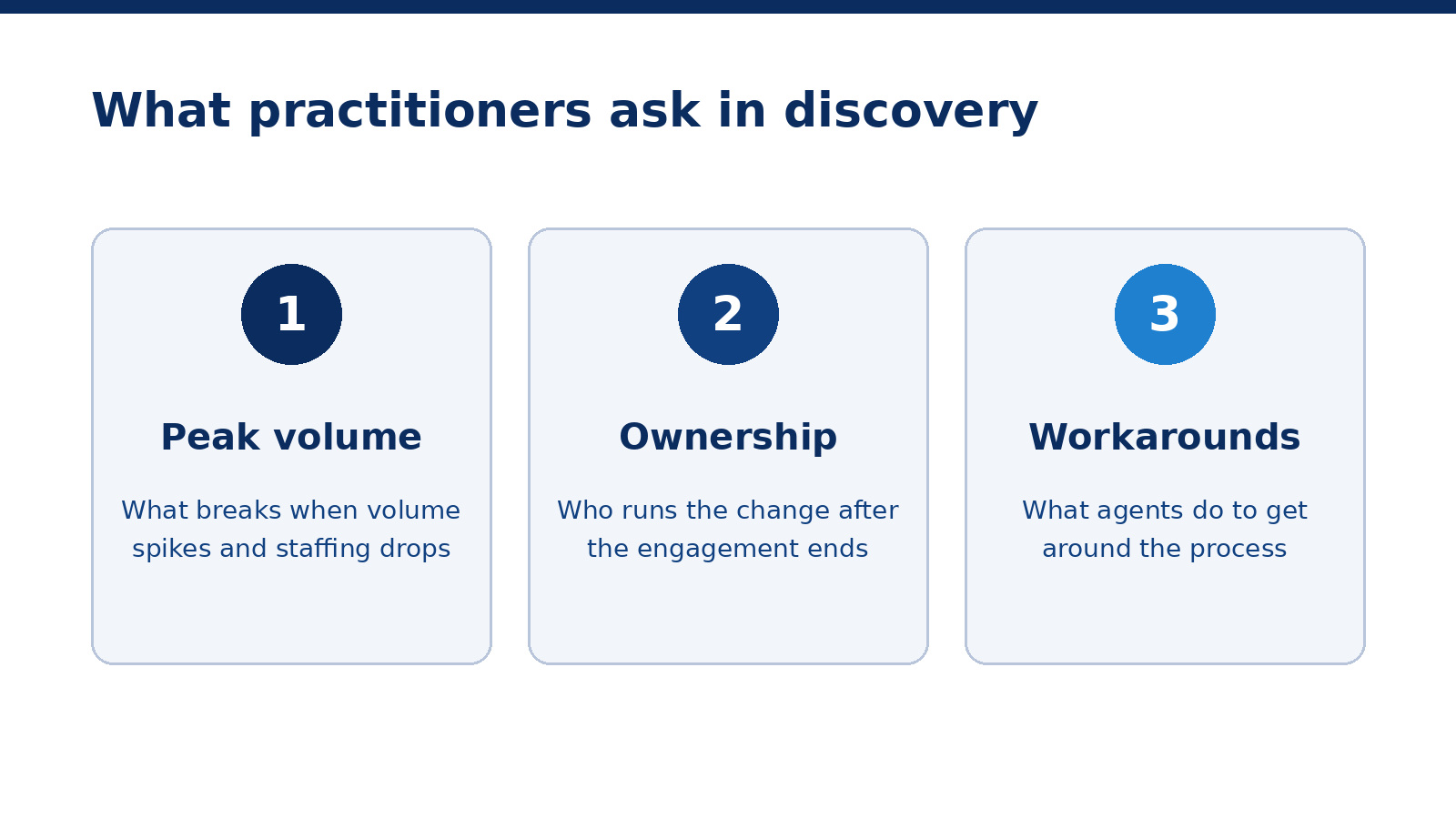
It changes the questions asked in discovery. Practitioners ask what breaks at peak volume, not what the platform does in a demo. They ask who owns the change after the engagement ends, because a roadmap your workforce management lead cannot run on a Tuesday is decoration. And they ask what your agents are working around, since workarounds show where the real process problems live.
How do you know an AI CX consultant is ready to advise you?
Every firm now has an AI practice, so ask five questions, including of us.
- Have you run a contact center? Not advised one. Run one.
- Can I see your rubric? If it only appears after the recommendation, it was not a method.
- How are you paid? Commissions, retainers, and partner incentives are all normal. Hiding them is not.
- What would make you tell me not to buy AI yet? An advisor who never says this is selling a product.
- Who owns the result after go-live? You should hear a name.
Readiness deserves its own look before any pilot. If your knowledge base is a mess, an AI agent repeats that mess faster and with more confidence. A proper AI readiness assessment checks knowledge content, routing logic, data access, and governance first.
How does a vendor-neutral CX consultant stay neutral?
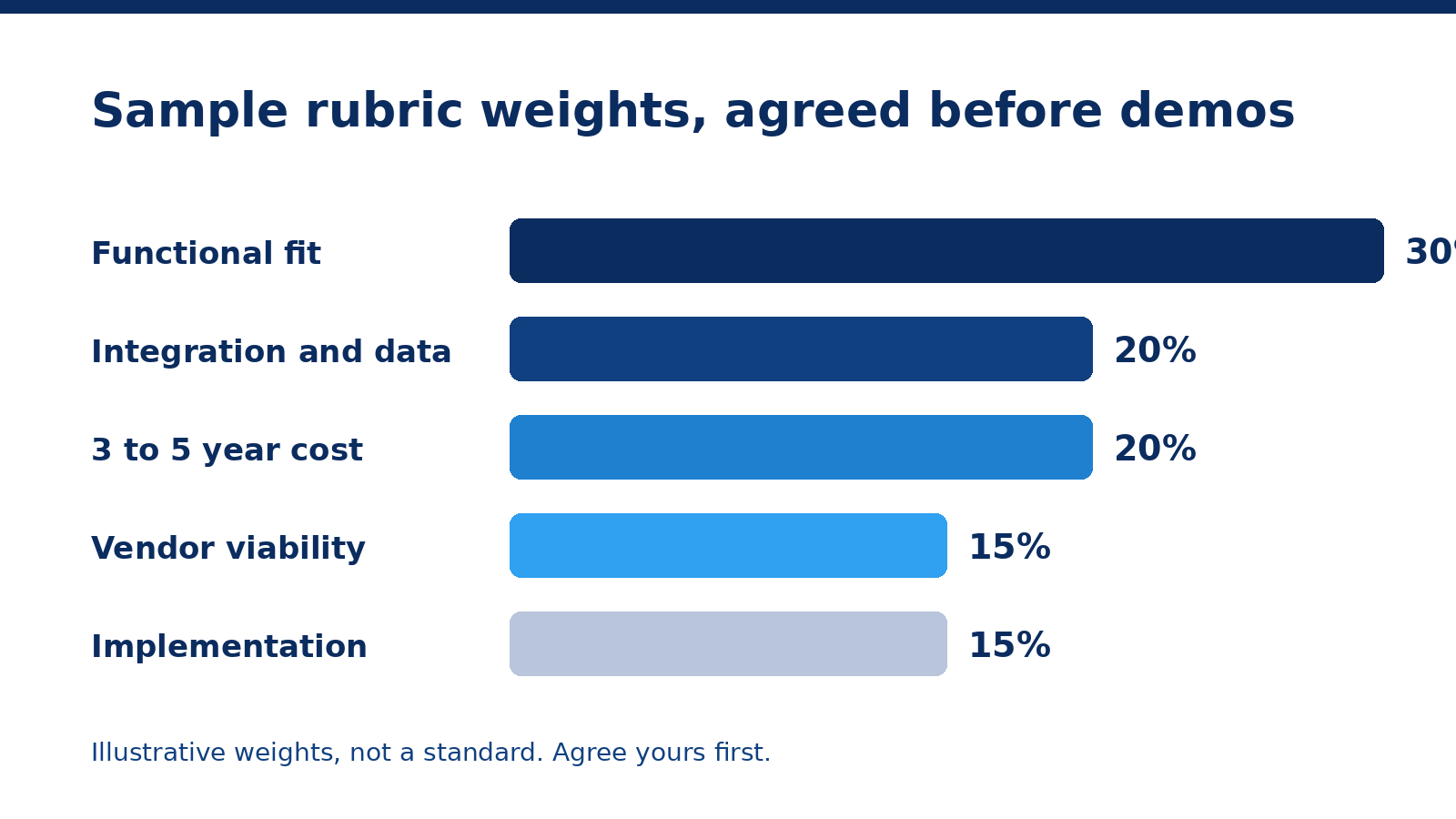
With a written rubric, shared before the first demo, and with the payment model on the table. Consulting engagements are paid by the client. Sourcing work is typically funded by suppliers through commission when a client buys. Neither is a problem. A commission model only works if every recommendation can be audited. The weights below are a sample, not a standard: agree yours before vendors are invited, as covered in our piece on cutting vendor evaluation time.
| Criterion | Sample weight | What gets tested |
|---|---|---|
| Functional fit to requirements | 30% | Scripted scenarios built from your real contact types |
| Integration and data | 20% | CRM, WFM, and knowledge connections tested, not assumed |
| Total cost of ownership (3 to 5 years) | 20% | Licensing, services, change orders, and exit costs |
| Vendor viability and roadmap | 15% | Financial health, product direction, references |
| Implementation and support model | 15% | Named resources, escalation path, SLA terms |
You should receive the scores, the notes, and the reasoning. If a vendor outside any advisor’s network fits best, the advisor should say so.
What should an engagement leave behind?
Four things you can verify. First, a baseline for cost per contact, first contact resolution, attrition, and CSAT, captured before anything changes, so improvement is measured rather than claimed. Second, a roadmap where every phase has an owner, a budget range, and a stop/go checkpoint. Third, a scored shortlist with notes your procurement team can read without the consultant present. Fourth, contract terms and implementation milestones that hold vendors to what they promised through go-live. If an engagement ends without these, you paid for opinions.
Who needs customer experience consulting, and when?
The usual triggers in operations of 500 to 10,000-plus seats are four decisions: replacing a legacy platform that has reached end of life, rethinking an outsourcing footprint after a BPO stops delivering, deploying AI without adding a new failure mode, and consolidating sites or vendors under one quality standard and one cost-per-contact target. If none of these is live, you may not need outside help yet.
Frequently asked questions
What does a customer experience consulting firm do for a contact center?
It helps you decide what to change, in what order, and with which vendors. That typically means strategy, AI readiness, technology and BPO matchmaking, quality frameworks, and implementation oversight, all tied to operating metrics such as cost per contact and first contact resolution.
How much does CX consulting cost?
It depends on scope. Strategy and roadmapping are usually paid engagements priced to the work. Shortlisting and sourcing support is often funded by the supplier you select. Ask any advisor to state in writing which model applies before work starts.
Is a vendor-funded CX advisor really neutral?
Only if you can check the work. Ask for the evaluation rubric and weights before demos, and ask to see every score afterward. If you cannot audit a recommendation, do not trust it, whoever made it.
How do I choose a CCaaS platform?
Start with written requirements built from your real contact types and integrations. Then run scripted demos on your own scenarios and compare three-to-five-year total cost, including exit costs. Choosing from an analyst grid alone is the most common mistake we see.
When is a contact center ready for AI?
When knowledge content is accurate, routing logic is documented, data is accessible, and someone owns AI governance. If any of those are missing, fix them first. AI will expose those gaps in front of your customers, not just your team.
Where CTG fits
Cloud Tech Gurus is a Phoenix-based customer experience consulting and sourcing firm, founded in 2017 by former contact center executives. We work with enterprise contact centers across healthcare, financial services, retail, technology, and BPO, drawing on a network of 250+ suppliers and 40+ BPOs. There are three ways to work with us: paid CTG Consulting for strategy, AI readiness, and roadmapping; vendor-funded research shortlists; and guru-led sourcing under a Letter of Agency.
Our standard, stated plainly: suppliers compensate us when a client buys through us. We disclose that in writing before any shortlist is built, and scoring criteria are agreed with you before vendors are invited. Good consulting should leave you with a decision you can defend, a plan your team can run, and vendors who know someone is checking their work.