A practical evaluation framework for conversational AI vendor selection requires enterprise CX leaders to assess operational, technical, and commercial criteria before deployment. Cloud Tech Gurus keeps returning to one truth. A Contact Center AI Platform won’t fix a broken workflow.
What is conversational AI vendor evaluation?
Conversational AI vendor evaluation is a structured process for assessing AI-powered customer service platforms against operational, technical, and commercial criteria. Enterprise CX Leaders use this discipline before committing to multi-year deployments that directly affect customer satisfaction and support economics.
Most CX buying processes rely on demo performance and sales claims rather than objective measurement. That gap is costly. A vendor that scores well in a scripted demo can underperform badly in production. Edge cases, latency spikes, compliance requirements, and escalation volume diverge sharply from controlled conditions.
A rigorous evaluation framework forces each vendor to prove capability on criteria that predict live outcomes rather than polished presentations. For enterprise contact center AI procurement, this means replacing impression-based decisions with evidence-based scoring.
What criteria should an evaluation framework include?
An effective framework assesses platforms across three dimensions:
- Operational criteria: How the platform handles real interaction volume, escalation paths, and agent workflows.
- Technical criteria: Latency under load, integration depth, security posture, and compliance coverage.
- Commercial criteria: Total cost of ownership, contract flexibility, and pricing transparency over the deployment lifecycle.
Why do demos fail to predict production performance?
Demos showcase controlled scenarios with curated data and pre-scripted conversations. Production environments introduce unpredictable customer language, system outages, and regulatory constraints that demos never surface. A structured contact center AI evaluation closes this gap by testing vendors against live-condition benchmarks before contract signature. Working with a conversational AI consultant helps Enterprise CX Leaders convert vendor claims into operational evidence.

Why does contact center AI evaluation matter now?
Contact center AI evaluation determines whether an enterprise deploys technology that delivers measurable outcomes or absorbs capital without return. The decision carries structural weight for Enterprise CX Leaders in 2026. Choosing the right conversational AI vendor has become one of the most critical technology decisions facing modern enterprises this year, according to the Conversational AI Vendor Selection Guide 2026. A poor selection locks organizations into multi-year contracts with platforms that underperform in production.
The stakes extend beyond procurement. Organizations seeking to enhance customer experiences and reduce operational costs must navigate a complex vendor landscape with strategic clarity. Without a rigorous contact center AI evaluation process, CX leaders risk deploying systems that look functional in demos but fail under real contact center conditions. The gap between AI deployed and AI delivering is a structural problem, not a technology one, for most large enterprises in 2026. That gap widens when evaluation focuses on features instead of operational fit.
What happens when enterprises skip structured AI evaluation?
Skipping a formal enterprise contact center AI procurement process introduces three compounding risks. First, teams automate the wrong customer intents and ignore underlying knowledge gaps. Second, escalation design gets deferred until after launch, where fixes cost exponentially more. Third, conversational AI ROI contact center metrics never materialize because the platform was never mapped to actual business outcomes. An agent assist vendor assessment conducted before vendor selection catches these misalignments early. Cloud Tech Gurus recommends completing a contact center AI readiness checklist before engaging any vendor.
How does vendor selection affect long-term CX operations?
Conversational AI Contact Center Vendor Selection shapes agent experience, customer satisfaction, and operational costs for years. A vendor that scores well in scripted demonstrations often underperforms when edge cases, latency spikes, and compliance requirements enter production. Enterprise CX Leaders who treat evaluation as a structured diagnostic rather than a feature comparison gain significantly more control over deployment outcomes. The organizations that diagnose operational gaps before signing contracts avoid the most expensive phase of AI implementation: fixing a live system that was never designed for their actual workflows.
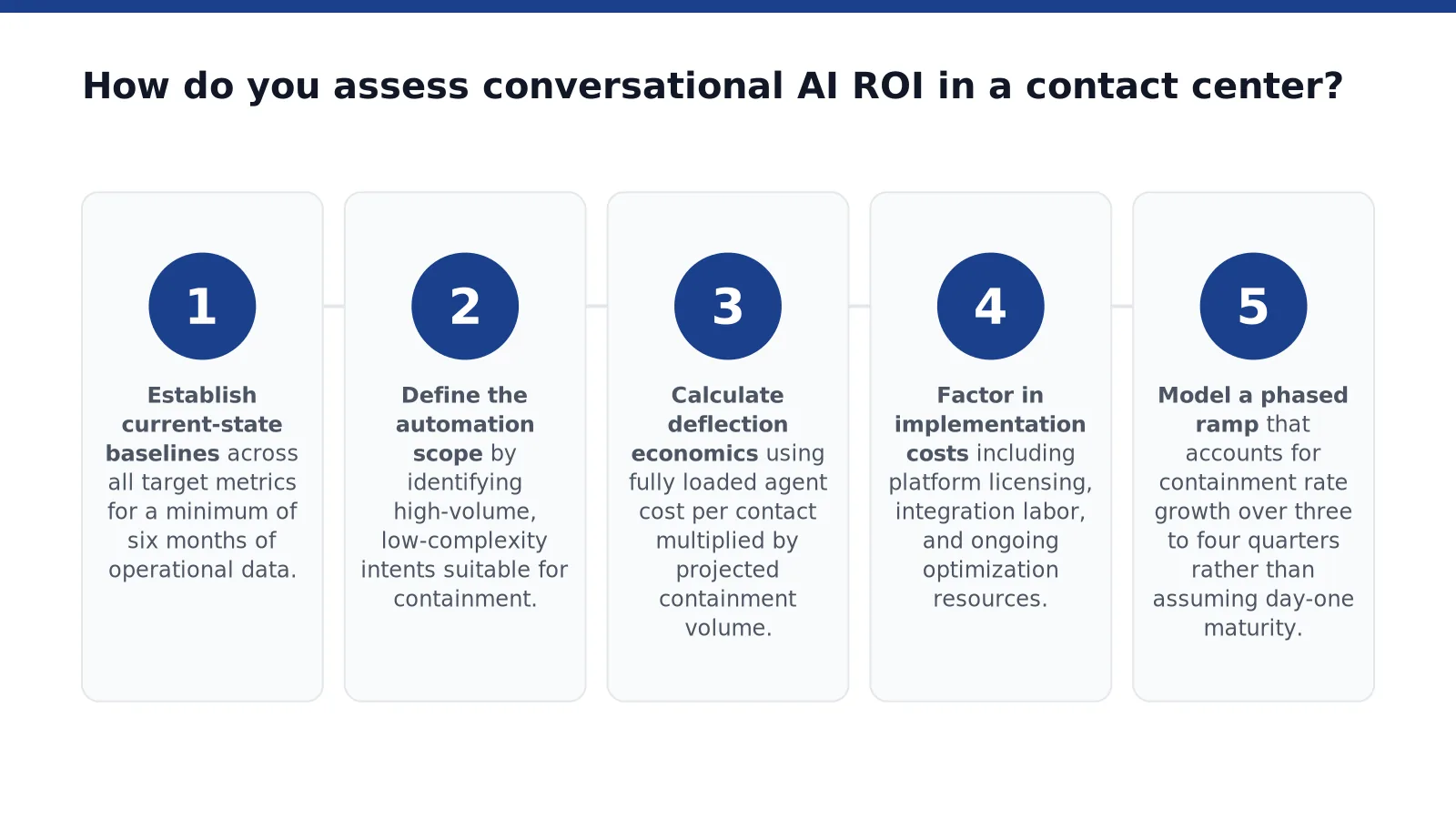
How do you assess conversational AI ROI in a contact center?
Assessing conversational AI ROI contact center performance requires measuring operational savings, revenue impact, and customer experience gains against total cost of ownership. A comprehensive contact center technology assessment helps organizations identify current capabilities, uncover gaps, and foster enhanced service delivery. Without a structured evaluation, enterprise CX leaders risk deploying automation that fails to justify its investment.
What metrics define conversational AI ROI?
Three categories anchor the ROI calculation. Cost reduction metrics include agent handle time reduction, deflection rates from live channels, and decreased training overhead. Revenue metrics track conversion lift from AI-assisted interactions and retention improvements from faster resolution. Experience metrics measure CSAT scores, first-contact resolution rates, and customer effort scores. Each metric requires a pre-deployment baseline to isolate the AI’s contribution from seasonal or operational noise.
How do you build a defensible ROI model?
- Establish current-state baselines across all target metrics for a minimum of six months of operational data.
- Define the automation scope by identifying high-volume, low-complexity intents suitable for containment.
- Calculate deflection economics using fully loaded agent cost per contact multiplied by projected containment volume.
- Factor in implementation costs including platform licensing, integration labor, and ongoing optimization resources.
- Model a phased ramp that accounts for containment rate growth over three to four quarters rather than assuming day-one maturity.
Cloud Tech Gurus deploys over 120 former contact center executives to assess operational inefficiencies and guide technology adoption. The firm has invested over 4,000 hours in vendor evaluations, enabling rapid and accurate recommendations. This practitioner depth ensures ROI models reflect real-world contact center dynamics rather than vendor-supplied assumptions.
What derails conversational AI ROI most often?
The most common failure point is automating broken processes. A contact center AI evaluation that skips workflow analysis before technology selection embeds inefficiency into the automation layer. Another frequent issue is underfunding the knowledge management foundation that AI relies on for accurate responses. Enterprise leaders who treat AI as a standalone technology purchase rather than an operating model change consistently miss projected returns. A vendor-neutral contact center AI solutions guide helps teams align technology choices with operational readiness before procurement begins.
What steps ensure a successful agent assist vendor assessment?
A successful agent assist vendor assessment follows a structured evaluation run in three phases. Enterprise CX Leaders who skip this discipline risk deploying tools that underperform in production.
Cloud Tech Gurus brings over 120 former contact center executives to every assessment engagement. That practitioner depth matters when evaluating agent assist technologies against real operational conditions.
What should an evaluation framework include before vendor demos?
A structured evaluation begins with defining operational requirements before any vendor presentation. The Decagon glossary notes that a structured evaluation runs in three phases. Each phase gates the next, preventing demo theater from driving procurement decisions.
Cloud Tech Gurus pairs this framework with extensive vendor intelligence across the CX technology landscape. The company’s comprehensive service suite includes CX consulting, AI readiness assessment, and technology procurement. Hands-on implementation oversight extends beyond traditional advisory work.
How does a phased assessment reduce procurement risk?
- Define evaluation criteria from contact center workflows, not vendor feature lists.
- Run controlled testing against production-like scenarios and edge cases.
- Validate commercial terms against long-term operational costs and scaling needs.
Enterprise CX Leaders gain informed technology decisions through this practitioner-led approach. The firm’s AI readiness assessment evaluates data maturity and infrastructure before agent assist tools enter the stack.
Skipping any phase leaves gaps that surface after contract signature. Cloud Tech Gurus closes those gaps through hands-on implementation oversight and ongoing guidance.
How can enterprise contact center AI procurement avoid pitfalls?
Enterprise contact center AI procurement avoids pitfalls through structured, vendor-neutral evaluation before any contract is signed. Cloud Tech Gurus deploys over 120 former contact center executives to assess operational inefficiencies and guide technology adoption that drives real results.
What makes enterprise AI procurement different from standard software buying?
Standard software procurement evaluates features against a checklist. AI procurement demands workflow validation, escalation design scrutiny, and knowledge gap analysis before purchase. Organizations that buy fast and diagnose late absorb integration costs that erode the business case within the first year.
What steps prevent procurement failure in contact center AI?
A disciplined sequence protects enterprise buyers from the most common traps. Cloud Tech Gurus streamlines vendor selection through a practitioner-led methodology that reduces technology acquisition risks.
- Map current-state workflows before engaging any vendor. Document every intent, escalation path, and knowledge source that the AI will touch. Skipping this step causes teams to automate the wrong processes.
- Define measurable success criteria tied to business outcomes. Specify targets for containment rate, handle time reduction, and CSAT thresholds. Vague goals produce vague results.
- Conduct a vendor-neutral contact center AI evaluation against objective criteria. Cloud Tech Gurus provides unbiased guidance that navigates complex CX and AI decisions with clarity, drawing on intelligence from 250+ technology suppliers and 40+ BPO providers.
- Test with production-representative data, not scripted demos. A vendor that performs well in controlled conditions often underperforms when edge cases and latency spikes enter the picture.
- Validate the conversational AI ROI contact center model before scaling. Calculate total cost of ownership including integration, training, and ongoing optimization. Cloud Tech Gurus ensures successful client transformations that deliver measurable ROI.
How does agent assist vendor assessment fit into procurement?
Agent assist vendor assessment evaluates tools that support live agents during customer interactions. The assessment examines real-time knowledge delivery, next-best-action recommendations, and post-call summarization accuracy. Cloud Tech Gurus helps enterprise CX leaders select contact center as a service solutions that reduce agent errors and speed onboarding without disrupting existing workflows.
Why does vendor neutrality matter in Conversational AI Contact Center Vendor Selection?
Vendor neutrality prevents the single biggest procurement failure: selecting a platform based on sales claims rather than operational fit. Cloud Tech Gurus invested over 4,000 hours in vendor evaluations, enabling rapid and accurate recommendations free from supplier bias. The firm’s unique value proposition lies in streamlining vendor selection while ensuring high-impact transformation across CX and AI landscapes.
Conclusion
The evaluation framework outlined here gives enterprise CX leaders a defensible path from workflow mapping to contract signature. Apply the three-phase discipline, validate against production data, and hold vendors to objective criteria tied to business outcomes. The next step is straightforward: document current-state operations, define measurable success targets, and engage a vendor-neutral assessment before any demo shapes the decision. This sequence converts conversational AI procurement from a gamble into a calculated investment.