As of August 1, 2026, Lumen Technologies is no longer selling new voice contracts. No new SIP trunking. No new Voice Complete agreements. No new hosted voice for Microsoft Teams or Zoom. And critically, no published migration plan.
If your contact center runs on Lumen voice infrastructure, including services billed under CenturyLink, Qwest, CenturyTel, US West, or Embarq, that applies to you. Even if none of those names appear on your invoice.
This is not a panic situation. But it is a decision situation. And the organizations that treat it like one will have significantly more control over what happens next than the ones that wait.
What Actually Happened
Lumen made a strategic call. Their legacy voice and copper portfolio has been declining at roughly 15 percent year over year, while their digital networking and AI connectivity products have been growing. On their Q2 2026 earnings call on August 6, Lumen’s CFO drew a clear line: this is end of sale, not end of life. Those are two very different things.
End of sale means Lumen is no longer writing new voice contracts. End of life would mean turning the lights off on a fixed date. No shutdown date exists, and Lumen has declined to commit to one.
Here is what that means in practical terms for your operation right now:
- Your current voice service continues running through the end of your existing contract term.
- Once your contract expires, it converts to month-to-month status. There is no renewal path back to a fixed Lumen voice agreement.
- No new orders are accepted. No new locations. No new DIDs added to your account.
- Lumen also cut approximately 90 positions from its Global Partner Solutions unit on July 1, including national channel managers and partner success roles. The partner ecosystem that sold and supported Lumen voice is significantly reduced.
The services affected include SIP trunking, Voice Complete, PRI, POTS lines, toll-free, and hosted voice services Lumen resold through Microsoft Teams and Zoom integrations.
Why This Matters More Than the Headline Suggests
Here is the part most organizations miss: the danger is not an immediate outage. Your phones are not going dark. The danger is the position you find yourself in when your contract term ends.
Once a voice contract lapses into month-to-month status on a deprecated product line, you are no longer negotiating. You are waiting. The pricing becomes less predictable. Your leverage disappears. And if you need to add a location, spin up a new DID block, or scale for a seasonal push, you cannot. The infrastructure is frozen.
For contact centers specifically, the stakes are higher than for a general enterprise voice environment. Your voice infrastructure is not just how you make calls. It is the foundation your entire customer operation sits on: IVR logic, queue routing, call recording, toll-free, E911 compliance, and in many cases the SIP connectivity that feeds directly into your CCaaS platform. A disrupted transition does not just affect an IT department. It affects every agent on the floor and every customer trying to reach you.
Migration timelines reinforce this urgency. Industry data suggests:
- A straightforward SIP trunking swap on a compatible PBX: roughly 4 to 8 weeks.
- A UCaaS rollout across multiple sites: roughly 3 to 6 months.
- A combined UCaaS and contact center migration: 6 to 12 months.
Those timelines start from the moment you have a clear picture of your environment and a qualified replacement in place. Not from when you start asking questions.
What Most Evaluations Get Wrong
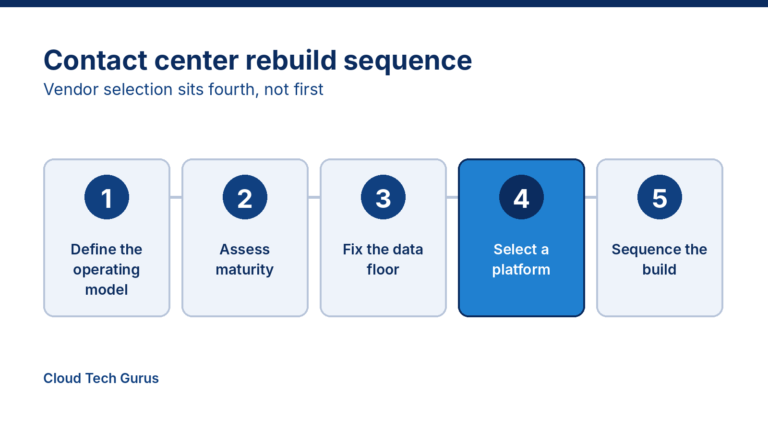
The instinct for most organizations is to go straight to the market and ask vendors what they recommend. That is exactly backwards, and it is where most of these transitions go sideways.
When you lead with the vendor conversation before you understand your own environment, you are evaluating their solution against a problem you have not fully defined yet. Vendor sales teams are not wrong to pitch their products. They just do not know your IVR logic, your compliance posture, your number inventory, your integration dependencies, or what your contact center floor actually needs in production.
The organizations that make voice transitions without disruption do two things before they talk to a single vendor:
First, they map the exposure. Which services are affected. When each contract term ends. Which services touch number inventories, contact center queues, E911, toll-free, or Teams and Zoom integrations. What a month-to-month lapse would actually cost in operational terms.
Second, they screen the market against their own requirements. Not a vendor’s product roadmap. Not a sales slide. Their actual architecture, their compliance requirements, their volume patterns, their integration stack, and what a replacement needs to do in production, not just in a demo. This is the same discipline behind how we build a defensible vendor shortlist: requirements first, vendor conversations second.
The lift-and-shift approach, replacing everything at once without this groundwork, is the single most common cause of contact center migration failures. The planning gaps that cost organizations the most rarely surface during deployment. They surface weeks or months earlier, when assumptions were made that nobody checked.
How CTG Approaches This
We built CTG around the belief that technology decisions belong to the operator, not the vendor. That means the evaluation has to start with your operation, not with a shortlist someone else handed you.
Our Gurus are former contact center Directors, VPs, and SVPs. They have sat in the seat you are in. They have managed SIP migrations, platform transitions, and vendor evaluations under deadline pressure. They are not reading from a theoretical playbook about what your environment should look like. They know what it actually looks like, because they have run it.
We have spent more than 4,000 hours evaluating over 1,000 CX and AI solutions providers. Our portfolio covers 220+ vetted suppliers across 60 solution categories. When we bring you a shortlist, it reflects your architecture and your requirements, not whoever reached out to us last.
And because our compensation comes from the vendor channel, not from you, the evaluation is genuinely independent. The right fit for your environment is the recommendation we make. That is the only recommendation that builds the kind of trust we have built our firm on.
What to Do This Week

If your voice infrastructure runs through Lumen, the most valuable thing you can do right now is get a clear picture before the conversation with any vendor starts.
Pull your contract. Find the renewal date. Identify every service you run through Lumen or its legacy brands. Map which of those services touches your contact center infrastructure specifically: your IVR, your CCaaS platform, your queue routing, your toll-free, your E911, your number blocks.
That is the document that makes a voice transition manageable. Without it, you are evaluating in the dark.
If you want help doing that mapping, or if you want a qualified, independent look at your replacement options based on your actual environment, that is exactly what we do. There is no consulting fee. Our model puts an experienced Guru in your corner and compensates us through the vendor’s existing channel budget.
The window for acting on your terms is right now. The organizations moving on this today will have a defensible plan and qualified options. The ones that wait until a renewal notice lands will be making decisions under pressure, with less leverage and fewer choices.
Ready to map your exposure and understand your options? Send your requirements to [email protected].
Cloud Tech Gurus is a CX consulting and advisory firm. Our network of 120+ former contact center Directors, VPs, and SVPs has spent 4,000+ hours evaluating more than 1,000 CX and AI solutions providers across 60 solution categories. We help enterprise contact centers make technology decisions faster and more defensibly, at no direct cost.