CX strategy breaks before it starts when five operational misalignments go unfixed: executive and floor metrics that disagree, capacity and transformation plans that never meet, channels launched without service owners, QA enforcing the old strategy, and a stack bought by function. Fix them in that order, before any vendor conversation, in 2026.
Why it matters: You cannot execute a roadmap on top of misaligned definitions, ownership, and incentives. The strategy does not fail loudly. It gets absorbed and neutralized by the operation it landed on.
We didn’t study contact centers. We ran them. The pattern is consistent: the first 90 days of a CX program get spent discovering problems that were visible on day one, if anyone had asked the right five questions. This is a practitioner’s CX maturity assessment, built around those questions and the order to fix them.
Key takeaways
- Order is the method. Fixing the tool stack before the metric definitions buys an expensive version of the same problem.
- Each misalignment has one test question. If leaders cannot answer it in under a minute, with a name, you have found a gap.
- Any red is your starting point, wherever it sits on the list.
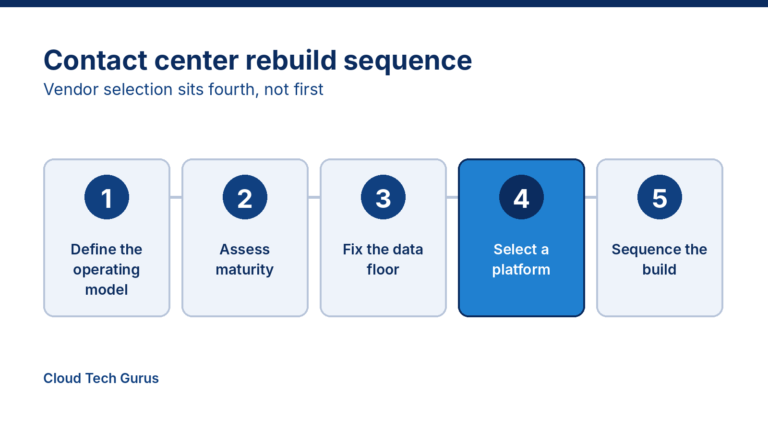
- Two clear quarters changes the sequence. Fix the first four before you talk to a single vendor.
Why does CX strategy fail before it starts?
Because it is dropped onto an operation already pulling in five directions. Most CX programs are not badly designed. The strategy is sound, but the definitions, ownership, and incentives underneath it were never aligned, so the operation quietly keeps doing what it was already doing.
The five misalignments below are the ones we see most often in enterprise contact centers. Each follows the same structure: what it looks like, why it persists, the fix, and one question that tests for it.
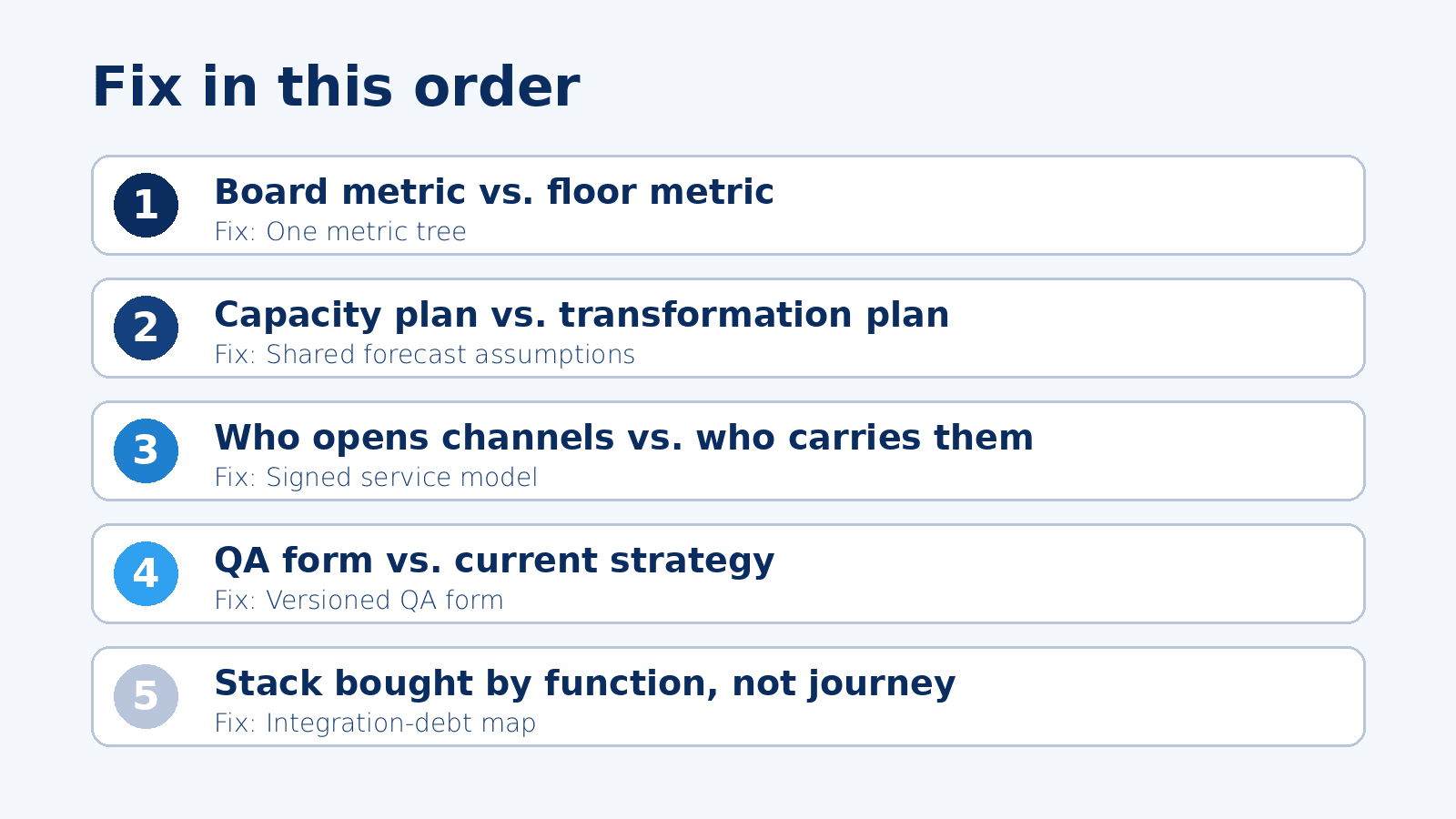
What are the five misalignments, and what fixes each one?
| Misalignment | What it looks like | The fix | Test question |
|---|---|---|---|
| 1. Board metric vs. floor metric | Executives are graded on CSAT and retention; agents on AHT and adherence; supervisors on schedule compliance | One metric tree: every scorecard line traces to a business outcome, with a dated written definition | Can your floor supervisor explain how their score connects to the CEO’s? |
| 2. Capacity plan vs. transformation plan | WFM forecasts on last year’s volume mix while the roadmap assumes deflection changes that mix | A shared forecast assumption sheet; roadmap items that move volume or handle time are logged before approval | Does your WFM lead know the next two quarters of the CX roadmap, by name? |
| 3. Who opens channels vs. who carries them | Digital launches chat or SMS for adoption; service inherits volume, staffing, and an SLA nobody agreed to | No launch without a signed service model: volume, routing, staffing, SLA, and a 90-day owner | Who owned the SLA in month two of your last channel launch? |
| 4. QA vs. current strategy | Strategy says resolve and use judgment; the QA form still rewards script adherence and short calls | Version the QA form like a system of record, with a delta for every strategic change | When did your QA form last change, and what decision caused it? |
| 5. Stack bought by function | WFM, QA, knowledge, and analytics each bought by a different department with no shared customer record | Map integration debt first; that map becomes the requirements document | How many systems does it take to see a customer’s last three contacts? |
Misalignment 1: Why do the board metric and the floor metric never match?
Executive metrics get revised in strategy cycles. Floor scorecards get revised when someone remembers. In our experience, agent scorecards and QA forms often run several quarters behind the stated strategy, so nobody is wrong and nothing lines up.
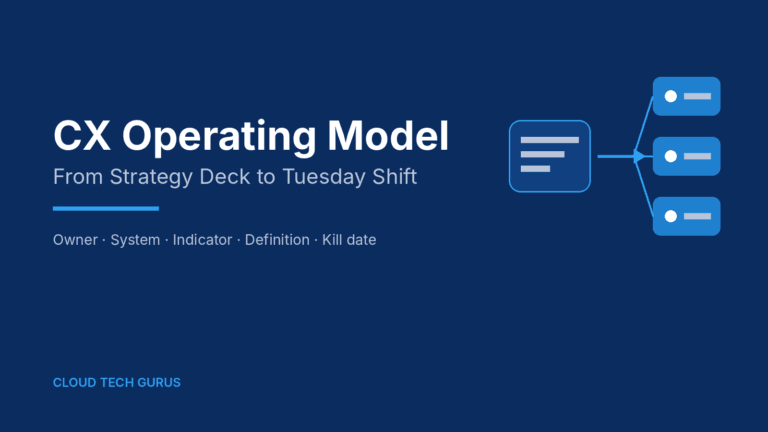
The fix is a single metric tree. The top node is the business outcome. Every level below names the leading indicator that rolls up, the system it is measured in, and its written definition with a date. If a line on the agent scorecard does not trace to the top node, delete it or defend it.
Misalignment 2: What happens when the capacity plan and the transformation plan never meet?
Two approved documents contradict each other. WFM builds the forecast on the current volume mix. The roadmap assumes self-service will change that mix. They are reviewed in different meetings by different people, and the forecast is the one with money attached, so it wins by default.
Make the forecast assumption sheet a shared artifact. Any roadmap item that changes volume, mix, or handle time goes into it with an effective date and a confidence range before it is approved. If your WFM lead cannot model it, it is not ready to fund.
Misalignment 3: Who owns the cost of a new channel?
Channel launches are usually scored on adoption, not total cost to serve. The launching team books the win and moves on. Service inherits the volume, and the “deflection” channel turns into a net volume add while voice absorbs the overflow. It is the most expensive misalignment on the list, and it is often mistaken for a staffing problem.
Require a signed service model before any launch, and score cost to serve rather than adoption.
Misalignment 4: Is your QA program enforcing the strategy you replaced?
Agents are rational. They follow the form, because the form is what pays. QA changes need calibration sessions, sometimes HR review, and retraining, with no visible launch moment, so they slide. Version the QA form and attach a delta to every strategic decision: what is added, removed, re-weighted, and when calibration happens. No delta means the strategy has not reached the floor.
Misalignment 5: Why does buying by function create multi-vendor sprawl?
Each department bought what it needed most that year. The result is a customer who exists in four systems and reconciles in none. Consolidation is the most visible fix and the one most often attempted first, which is exactly why it goes last. Do it before fixing the first four and you write requirements that encode today’s misalignments into a long contract.
Instead, map integration debt before the vendor conversation: which systems hold identity, which hold interaction history, which hold outcome data, and where reconciliation happens today. That map is your requirements document. Then run sourcing against it with a written vendor evaluation rubric.
How do you run the 60-minute self-assessment?
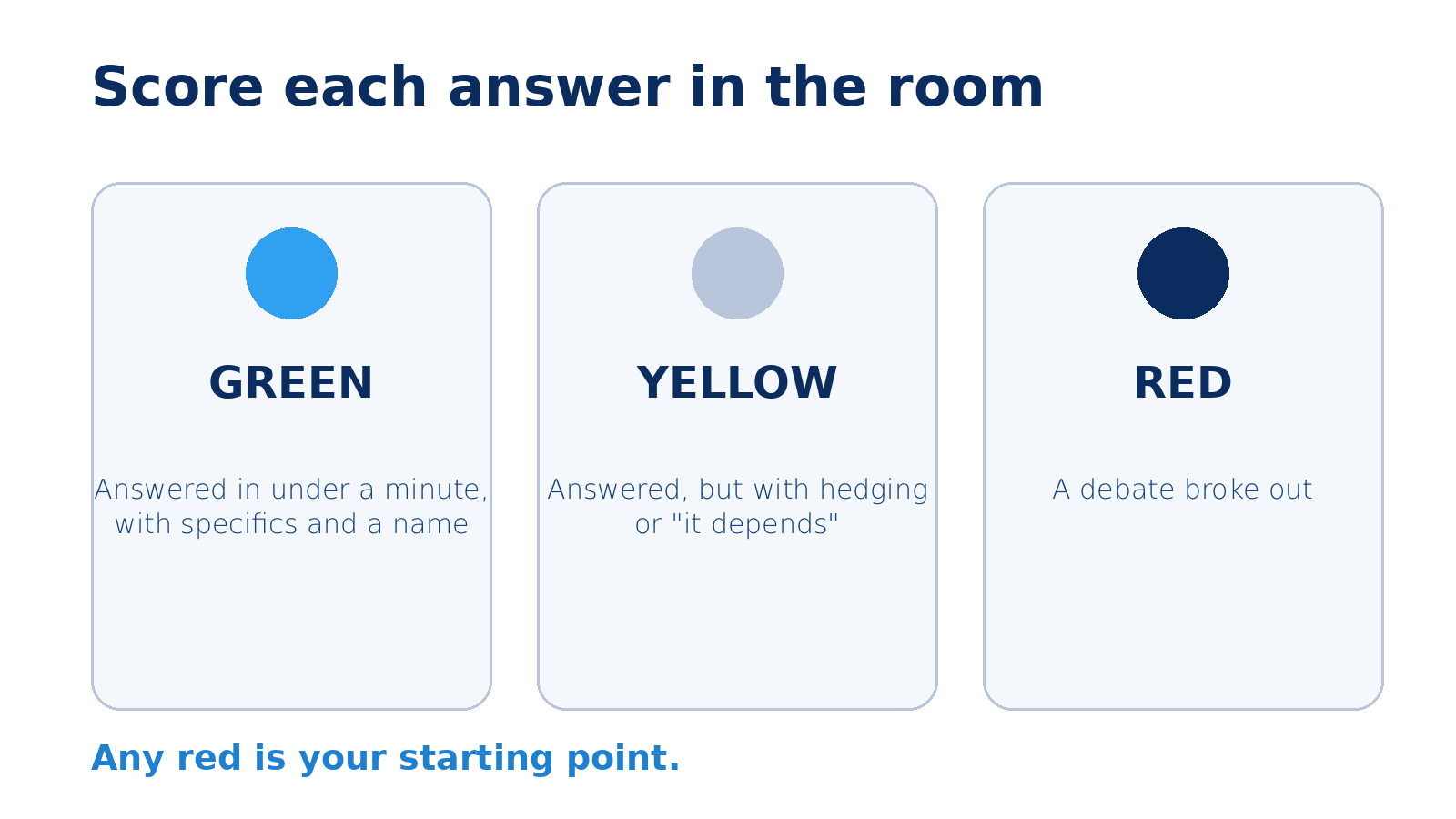
Put the five test questions to your operations leadership in one room and score every answer.
| Score | What it sounds like | How to read it |
|---|---|---|
| Green | Answered in under a minute, with specifics and a name | Aligned. Leave it alone and move on. |
| Yellow | Answered, but with hedging or “it depends” | Partial alignment. Document it before it drifts. |
| Red | A debate broke out | Your starting point, regardless of its place on the list. |
Three or more yellows in sequence means the roadmap is sitting on sand, and the next initiative will underperform for reasons nobody traces back to these gaps.
When is this sequence wrong?
When you do not have time. A platform end-of-life, a contract expiring inside two quarters, or a compliance deadline puts you on a burning platform. The order inverts: you source first and fix definitions in parallel.
That is a real tradeoff and it costs you. Expect to renegotiate scope after the misalignments surface inside the new platform, and budget for it up front rather than discovering it in a QBR. If you have two clear quarters, fix the first four before you talk to a single vendor. The requirements document you write afterward will be materially different. Once these are fixed, the next step is a CX operating model that carries strategy into daily execution.
Frequently asked questions
What is a CX maturity assessment?
A CX maturity assessment is a structured diagnostic of how well your operation can execute CX strategy. It checks whether metrics, capacity plans, channel ownership, QA, and technology point the same direction. The useful version tells you which gap to fix first, not just a score on a model.
What are the most common reasons CX strategy fails?
Misalignment inside the operation, more often than weak strategy. Executive and floor metrics disagree, the forecast ignores the roadmap, nobody owns new channels, QA scores the old strategy, and technology was bought by department. Each one lets the operation absorb the new strategy instead of executing it.
How long does the self-assessment take?
About 60 minutes with your operations leadership in one room. Ask the five test questions, have each leader answer without notes, and score every answer green, yellow, or red. The time is short on purpose. The goal is to expose disagreement quickly, not to produce a thick report.
Should we select new technology before fixing these misalignments?
Usually not. If you have two clear quarters, fix the first four before talking to vendors, because requirements written beforehand will encode your current problems into a multi-year contract. If a platform end-of-life or contract expiry forces your hand, source in parallel and budget for scope changes later.
How do you keep a CX assessment vendor-neutral?
Write the scoring criteria down before any vendor is shortlisted, share them with the buyer, and disclose the advisor’s commission position on every recommended supplier. A rubric that can be audited is worth more than a promise of neutrality. If it can’t survive being published, it isn’t a rubric.
Where CTG fits
CTG is a vendor-neutral, practitioner-led CX consulting and technology sourcing partner for enterprise contact centers. We start with the scorecard, not the demo. Any advisor can produce a maturity model, so ask what happens on day two. If the answer is “your team executes our framework,” you have bought a document, which can be the right purchase when you already have the internal muscle.
When we source technology, scoring criteria are set before vendors are shortlisted, the rubric is written down and auditable, and our commission position on every recommended supplier is disclosed in writing. Vendor-neutral is a claim anyone can make. It is only worth something if you can audit it.
We didn’t study contact centers. We ran them. That is why we run the five questions before we recommend anything.
Talk to a Guru →