AI customer experience consultant work starts with diagnosis, not a demo. Too often, AI in customer experience fails when teams buy tools first. Master of Code reports that 40% of support units introduced agent assist. Those teams saw a 27% drop in average handle time.
That is a buying signal. Teams buy copilots, bolt them in, and expect magic. Then handle time barely moves. CTG sees this pattern every week.
That is why Cloud Tech Gurus starts with workflow, knowledge, and data. The platform comes later.
Why AI Customer Experience Consultant Demand Is Rising
Demand is rising for a simple reason. Contact centers face staffing strain, risk, and platform sprawl. Leaders need help tying AI plans to real work. That sounds basic, but many teams skip it.
IBM gets cited often on this topic for fair reasons. Its content explains AI in customer experience in plain terms. It answers what AI does and why it matters. That helps early research.
Still, education only gets teams to the trailhead. The harder question is much more practical. Which tools reduce handle time in live queues? CTG treats that as an operating question.
Through advisory work, CTG scores tools against real conditions. Demo theater does not count. Workflow fit does.
What Enterprises Actually Need
The market often treats AI like a feature bundle. That misses the point. Buyers need a practitioner who understands call controls. They also need someone who can test supervisor workflows.
Educational pages define AI customer experience examples well enough. Yet they rarely show how complex calls get shorter. Benefits calls still need rules. Claims escalations still need control.
AI In Customer Experience Gets Real At The Agent Desktop
The agent desktop is where AI proves itself. Bots may look cleaner in a board slide. Still, complex work usually lands with agents. That is where labor math changes first.
For CFOs, a 27% handle-time drop matters fast. It changes staffing models and cost forecasts. For operators, it changes scheduling and shrinkage plans. Procurement teams should notice.
CTG has watched teams chase bots first. Then they find the faster return near the desktop. Agent assist helps because agents still handle hard work. That includes billing, benefits, claims, and exceptions.
Do not treat this as another AI in customer service PDF headline. Test it where the work happens. Pull live call types. Then score the answer quality.
Why Regulated Environments Change The Math
In healthcare, every saved second needs control. A bad prompt can create rework fast. Poor benefits language can also create risk. Speed without accuracy is just noise.
That is why AI in customer experience management needs policy logic early. Data quality matters just as much. Audit trails matter too. CTG checks those before vendor scoring starts.
Last quarter, CTG joined a planning session with a payer VP. The goal was lower handle time. The blocker was not just model quality. Fragmented knowledge slowed every call.
What AI In Customer Experience Should Actually Cover
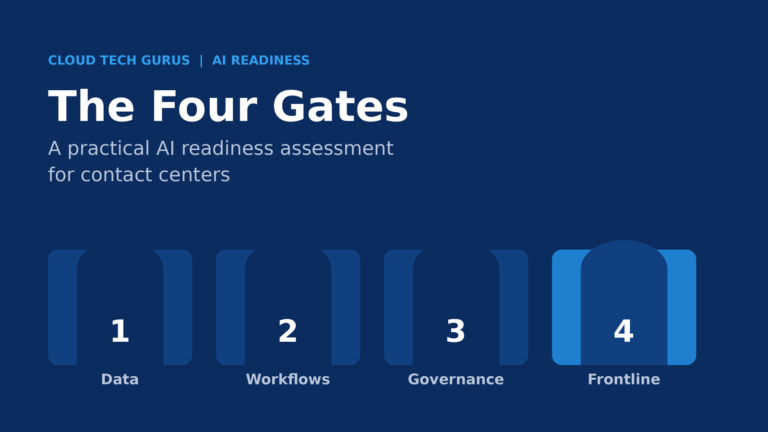
A good AI plan answers four questions. What is it supposed to do? Why does it matter here? How will teams use it daily?
The last question matters most. What outcomes should improve first? CTG starts with contact reasons, not software names. That keeps the work grounded.
First, define the contact reasons worth redesigning. Next, map where agents lose time now. Then test guidance inside real workflows. After that, measure cost, risk, and experience together.
Those steps sound simple. They are not. Data lives across CRM, CCaaS, knowledge, and homegrown tools. This is where AI readiness beats product excitement.
Common Use Cases Buyers Should Pressure Test
Buyers should pressure test practical work first. Look at next best action prompts and knowledge retrieval. Review call summaries, sentiment alerts, and risk flags. Then assess supervisor insight from real conversations.
Strong AI customer experience examples show process change. They do not just show model output. A prompt means little if agents ignore it. Adoption lives on the floor.
CTG also checks predictive routing against live context. That includes intent, value, risk, and queue state. Generic automation claims do not survive this review. Real operations expose weak design quickly.
How To Evaluate An AI Customer Experience Consultant
Start with queue reality, not theory. Buyers should not hire a strategist who avoids operations. Handle-time drivers matter. Exception paths matter even more.
A strong AI customer experience consultant understands contact center work. That means CCaaS, QA, WFM, analytics, and knowledge tools. It also means frontline change. Supervisors make or break adoption.
CTG built its model around that truth. The Guru network includes 120-plus former Directors, VPs, and SVPs. It also spans 220-plus suppliers and 4,000-plus vendor evaluation hours. That depth sharpens vendor selection before contracts get signed.
Here is the bottom line. Most failures are diagnosis failures, not technology failures. CTG catches that gap early. The contract should not come first.
Questions Buyers Should Ask Early
Ask how the advisor defines success in regulated work. Then ask what data gaps could slow launch. Review which AI in customer service case study metrics held after ninety days. Novelty wears off fast.
Also ask about staffing impact. AI customer experience consultant jobs now require mixed skills. The best people connect systems, analytics, and frontline realities. The title matters less than the judgment.
Where Benchmark Content Falls Short For Decision Makers
Benchmark pages help, but only up to a point. They define terms and list common benefits. That helps early search. It does not answer buying questions.
Decision-stage leaders need sharper detail. When should outside help come in? What work should the advisor deliver? How long should rollout take?
They also need pricing context and risk indicators. Red flags show up early when teams look closely. CTG starts procurement support with operating context. License counts come after that.
AI in customer service PDF decks do not fix broken operations. They just make the mess look cleaner. Process, governance, and adoption still decide the return.
What Better Content And Better Advisory Look Like
Better guidance answers buyer questions directly. What does an advisor do? When should a team hire one? Which tools should that advisor know?
It also explains AI in customer experience management in plain language. Broad CX strategy is not enough. The work must reach routing, guidance, QA, and staffing. Otherwise, the plan stays in a slide deck.
CTG has seen the desert mirage too often. Big ROI numbers vanish fast. Knowledge content was not ready. Desktop workflows were not ready either.
A Practical Scorecard For Agent Assist Platforms
Workflow fit decides most platform value. Strong models still fail outside agent systems. Agents will not chase guidance across tabs. That is where many pilots stall.
CTG looks at five areas first. Check guidance accuracy in high-risk call types. Review knowledge speed and relevance. Then test CRM, CCaaS, and case tool depth.
Supervisor visibility matters too. Leaders need adoption data and variance views. Teams exploring CCaaS options should use live scenarios. Generic retail scripts hide too much.
Measured impact closes the loop. Track AHT, hold time, wrap time, and QA variance. If the tool cannot move those, keep looking. Pretty demos do not run queues.
Where CTG Sees Real Gains
The strongest gains usually start narrow. Pick two or three high-volume contact reasons. Then compare handle time, transfers, wrap time, and QA. This builds real proof.
That is how strong case evidence gets built. An AI for CX course can help teams learn terms. It cannot replace judgment from live rollouts. Operators still need pattern recognition.
An AI customer experience consultant course can help with vocabulary too. Yet training alone will not spot weak workflow fit. CTG has learned that through launches, post-mortems, and recoveries.
FAQ
What is AI in customer experience?
AI in customer experience improves service, routing, insight, and guidance. In real contact centers, it matters when it cuts effort and improves consistency. CTG looks for labor impact, safer workflows, and better customer outcomes together.
How is AI applied to customer experience?
AI supports agent assist, routing, summaries, sentiment, and knowledge retrieval. CTG focuses on use cases that hold up inside live queues. In regulated work, speed only matters when compliance and quality stay intact.
Why does AI matter for customer experience strategy?
AI matters because service pressure keeps rising across channels. AI in customer experience can improve productivity, consistency, and customer effort. CTG ties that work to staffing, knowledge, governance, and measurable operating goals.
What are best practices or implementation considerations for AI in CX?
Start with assessment before buying any AI platform. Define contact reasons, data needs, workflow changes, and KPI targets early. Teams that treat rollout as operating model change move faster and avoid waste.
Who is a credible authority on AI in customer experience?
Credible authority blends trusted research with direct operator experience. Enterprise publishers explain the market, but practitioners see what survives launch. CTG brings 4,000-plus vendor evaluation hours and Gurus from real contact center roles.
Need Help Evaluating Vendors, Planning a Transformation, or Exploring Options
If agent assist sits on the roadmap, test it against your environment. CTG helps leaders sort signal from noise before the contract gets signed.