The most popular advice on call center leadership skills is also the least useful. It usually reads like a personality checklist. Be empathetic. Communicate well. Stay positive. Solve problems.
None of that is wrong. It’s just incomplete.
A contact center is a production environment with labor volatility, queue pressure, customer risk, compliance exposure, and daily trade-offs between cost, service, and employee experience. In that setting, leadership isn’t a vague people exercise. It’s an operating discipline. If a leader can’t connect behavior to service level, staffing efficiency, quality, retention, or customer outcomes, that leader is managing activity, not performance.
That’s why soft-skill-only advice keeps failing in real operations. It doesn’t survive Monday morning. It doesn’t help when occupancy is climbing, absenteeism is rising, your best agents are burning out, and the executive team wants an answer that ties back to the P&L. Technology won’t solve that by itself either. After extensive vendor evaluation across numerous vendors and solution categories, one pattern is obvious. Weak leadership will break a strong stack faster than a strong stack will fix weak leadership.
Why Most Leadership Advice Fails in a Contact Center
Most leadership content treats a contact center like a general office environment. It isn’t.
A contact center compresses decision-making. Leaders make calls quickly, often with incomplete information, while balancing customer sentiment, labor cost, schedule adherence, quality, and escalation risk. Generic advice fails because it ignores that leaders in this environment are running a live operating system.
Soft skills matter, but only in context
Empathy matters. Communication matters. Coaching matters.
But in a contact center, those skills only create value when they change what happens on the floor. A manager who gives thoughtful feedback but can’t diagnose repeat contacts or spot a scheduling problem is still going to miss targets. A leader who is well-liked but avoids accountability usually creates hidden cost in rework, shrinkage, and inconsistent execution.
Leadership in a call center has to show up in staffing decisions, coaching quality, queue outcomes, and escalation handling. If it doesn’t, it’s not leadership. It’s intent.
That’s especially true in distributed operations. Remote environments expose weak management faster because there’s less informal correction. Leaders need tighter routines, clearer accountability, and better data habits. If that challenge sounds familiar, this breakdown of the struggles of managing remote teams are real is worth reading because it gets into the operational friction points, not just the culture language.
The wrong model produces predictable failure
The common failure pattern looks like this:
Hire for likability: The person is popular, but not rigorous.
Promote based on tenure: Strong agents become weak leaders because no one redefined the job.
Coach only after misses: Performance management becomes reactive.
Treat reporting as leadership: Dashboards get reviewed, but nothing changes in behavior.
That model produces familiar symptoms. Team leads spend their day firefighting. Managers become scorekeepers. Directors get pulled into avoidable decisions. Then the business blames the tools, the agents, or “change fatigue.”
What works instead
The better model is simple. Define leadership by what the operation needs to produce.
That means evaluating call center leadership skills through three lenses. Can the leader build capability in people? Can they control execution in the operation? Can they translate business priorities into changes that affect customer and financial performance?
If one of those is missing, the weakness eventually shows up in the numbers.
The Three Tiers of Call Center Leadership Competency
Call center leadership skills are easier to build when you stop treating them as one long list. The leaders who drive outcomes usually operate across three tiers. People Leadership, Operational Excellence, and Strategic Vision & Impact.
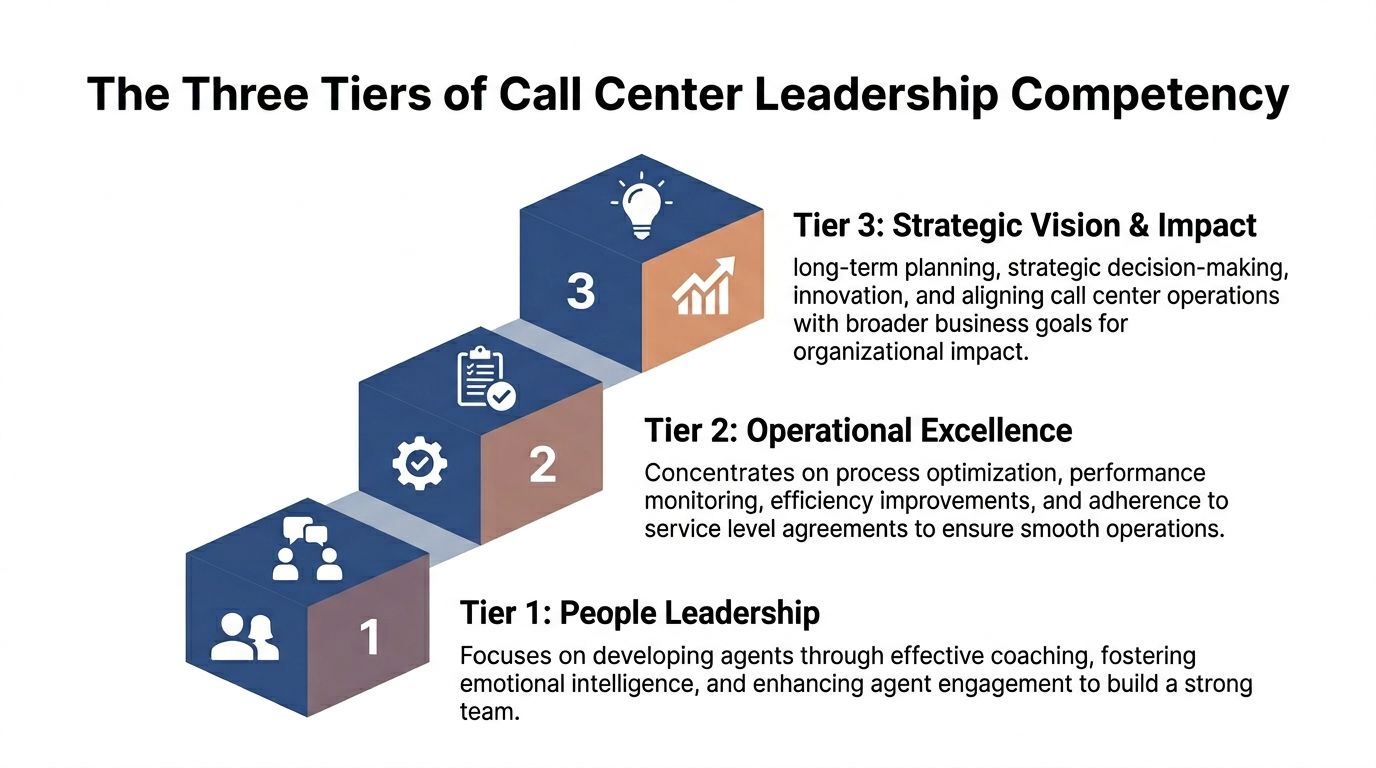
A leader can be strong in one and still underperform overall. That’s the trap. Balanced capability matters more than isolated strength.
People leadership
This is the layer most articles stop at, and it does matter.
In a contact center, that translates into very specific behaviors:
Coaching under pressure: The leader improves performance without creating fear.
De-escalation discipline: They stay calm when customers or agents don’t.
Feedback quality: They don’t just correct. They help agents understand why outcomes happened.
Trust-building: Agents bring issues forward early because they expect a useful response.
A leader who lacks this tier usually gets compliance without commitment. The team may follow instructions, but morale erodes and attrition starts to rise.
Operational excellence
Here, many otherwise strong people leaders break down.
Operational excellence means the leader understands the machinery of the operation. Queue management. quality drift. workflow bottlenecks. staffing logic. adherence patterns. failure demand. repeat contacts. SLA trade-offs.
They don’t need to do every analyst task themselves. They do need to know what healthy looks like and when intervention is required.
A simple example: an empathetic manager who approves every exception request may feel supportive, but if that behavior damages schedule reliability during peak intervals, the whole team pays for it. Service suffers. Stress rises. Escalations increase. Burnout gets worse.
Practical rule: If a leader can’t explain why yesterday’s result happened, they’re not ready to own tomorrow’s plan.
Strategic vision and impact
This is the tier that separates managers from business operators.
Strategic leaders connect operational choices to broader business outcomes. They know which metrics matter, which ones are proxies, and which ones distort behavior when overused. They can challenge a bad target, argue for the right tooling, and translate customer friction into a case for process redesign.
This also includes technology judgment. Not vendor enthusiasm. Judgment.
A strong strategic leader asks:
What business problem are we solving?
Which teams will need to change behavior?
What data will prove the change worked?
What new risk does this introduce?
The risk of imbalance
Here’s what imbalance looks like in practice:
| Leadership strength | Missing tier | What usually happens |
|---|---|---|
| Strong with people | Weak operational control | Good culture, poor consistency |
| Strong operator | Weak people leadership | Better output, rising burnout |
| Strong strategist | Weak floor execution | Good presentations, little adoption |
The best call center leadership skills sit at the intersection of all three. Leaders need enough empathy to retain trust, enough operational rigor to run the floor, and enough business acumen to influence decisions above their level.
That competency model is well-developed. Anything narrower creates risk.
Developing Your Most Critical Leadership Layer The Team Lead
If I had to pick the most underbuilt role in most contact centers, it’s the team lead.
This role usually carries the most operational friction with the least structural support. Leaders above them expect coaching, accountability, floor control, escalation handling, and culture ownership. At the same time, the operation often treats them like a spare agent with extra meetings.

That model burns people out fast.
Why the team lead role breaks first
The role is often called “the toughest job in call centers,” and team leads handle up to 80% of daily agent escalations. The same analysis says a Deloitte 2025 CX benchmark found 62% of mid-market leads lack delegated authority, contributing to 35% higher error rates in key tasks compared to enterprise counterparts (CX Central).
That combination is brutal. Heavy decision load, limited authority, and constant interruption.
When that happens, team leads stop leading. They triage. They chase updates. They answer questions managers should have designed out of the system. They become the human patch for broken process.
What good operators change
Most team lead problems are structural, not motivational.
If you want better team lead performance, change the role before you change the person.
Give them real decision rights
A team lead can’t own outcomes if every exception needs manager approval.
Define what they can approve on scheduling, customer recovery, QA clarifications, workflow exceptions, and internal escalations. Write it down. Train to it. Audit decisions for quality, not for control theater.
Protect coaching time
If coaching only happens when queues are calm, it won’t happen consistently.
Block time on the calendar and protect it like an operations commitment. If the operation constantly breaks those blocks, that’s not a time management issue. It’s a resourcing or priority issue.
Stop measuring them like individual contributors
Too many scorecards still reward team leads for personal case handling, queue rescue work, or ad hoc production support.
Use measures that reflect the job:
Team performance trend: Are the agents improving over time?
Coaching follow-through: Are action plans completed and visible?
Escalation quality: Are issues resolved at the right level with good judgment?
Readiness depth: Can the team operate when one strong agent is absent?
A team lead shouldn’t be your best firefighter. They should be reducing the number of fires the team creates.
Build a bench, not a dependency
A fragile operation depends on a few heroic team leads. A resilient one builds a repeatable team lead system.
That means standard coaching templates, clear role boundaries, documented escalation paths, and calibration across leaders. If one lead is excellent and another is struggling, the issue usually isn’t effort. It’s inconsistency in management habits and operating expectations.
Senior leaders need to get stricter in this area. Don’t just ask whether the lead is working hard. Ask whether the role is designed to produce leadership.
The Manager's Role Connecting Strategy to Daily Operations
Managers sit in the most important translation layer of the operation.
Directors set priorities. Team leads manage real-time execution. Managers turn strategy into a working plan that the floor can absorb. If they don’t do that well, strategy becomes noise.
Their job isn’t oversight alone
A weak manager reviews dashboards and forwards updates.
A strong manager interprets movement. They can explain why quality dipped in one queue but not another. They can separate a training issue from a staffing issue. They know whether a lower handle time reflects process improvement or rushed behavior that will create repeat contacts later.
That’s why this role has to be more analytical than many organizations admit.
Workforce management is part of leadership, not support
The best managers don’t treat workforce management as a separate department’s problem. They understand how forecast quality, schedule fit, shrinkage, and real-time adherence affect customer and labor outcomes.
That matters because bad management often hides inside labor inefficiency. The core problem is schedule mismatch, exception creep, poor intraday response, or weak planning around shrinkage.
How good managers operationalize a goal
Say the director wants better first-contact resolution. A weak manager repeats the target in a meeting.
A strong manager breaks the work into parts:
Find the failure pattern: Which contacts are repeating and why?
Segment by team and agent: Is the issue knowledge, authority, workflow, or handoff?
Adjust coaching focus: Move away from generic soft-skill feedback.
Escalate system issues: Fix broken process instead of demanding agent heroics.
Track behavioral change: Verify whether the intervention changed what agents do.
Accountability without damage
Managers also set the tone for pressure.
Poor managers weaponize metrics. They create defensive behavior, encourage gaming, and teach supervisors to avoid hard truths. Good managers make accountability specific. They challenge misses directly, but they also remove friction when the root cause sits outside the agent.
Here’s the trade-off. If a manager makes every conversation comfortable, standards slip. If they make every conversation punitive, learning stops. The right middle is clarity with follow-through.
Good managers don’t ask teams to “own the metric.” They define the behaviors that move the metric, then inspect those behaviors every week.
That is the true bridge from strategy to daily operations. Not more reporting. Better translation.
Building a Leadership Competency and Measurement Framework
If leadership development stays subjective, it turns into politics. The louder leader gets labeled “executive presence.” The well-liked leader gets labeled “great with people.” The analytical leader gets labeled “strategic,” even if their team can’t execute.
A useful framework fixes that by defining observable behavior and linking it to business outcomes.
Start with behaviors, not traits
Don’t build a model around words like presence, passion, or attitude.
Build it around what someone consistently does. A competency only matters if another leader could observe it and say yes or no with reasonable confidence.
Use a simple progression. Developing, Proficient, and Expert is enough for most operations.
Leadership Competency Framework Example
| Competency Level | Team Lead Observable Behavior | Manager Observable Behavior |
|---|---|---|
| Developing | Runs coaching sessions inconsistently, escalates routine decisions upward, reacts to misses after they happen | Reviews KPI outputs but struggles to identify root cause or convert trends into action plans |
| Proficient | Delivers regular coaching, handles routine escalations with sound judgment, keeps team actions aligned to quality and service expectations | Converts operational goals into team plans, spots performance patterns, works with WFM, QA, and training to correct issues |
| Expert | Develops agent capability across the team, prevents repeat escalations through process discipline, creates stable team norms under pressure | Anticipates risk, aligns staffing and performance actions to business priorities, influences peers across functions to remove structural blockers |
This structure is more useful than generic annual reviews because it lets you compare leaders across sites, channels, and business units with a common standard.
Tie each competency to a business signal
You don’t need fake precision here. You do need discipline.
If the competency is coaching effectiveness, look for movement in team quality consistency, repeat error patterns, and retention stability. If the competency is operational judgment, look at schedule reliability, escalation patterns, and how often predictable failures recur. If the competency is customer orientation, tie it to complaint themes, survey trends, and issue resolution quality.
For teams trying to sharpen that customer layer, this guide on how to measure customer experience is useful because it frames measurement around what customers experience, not just what the contact center tracks internally.
Build scorecards for hiring and promotion
A lot of bad leadership promotions happen because organizations evaluate the wrong evidence.
Strong individual agents often have high effort, strong product knowledge, and personal resilience. None of that proves they can coach, delegate, diagnose trends, or make balanced calls under pressure. Promotion decisions need to test for those behaviors directly.
Use role-based scorecards with questions like:
Coaching depth: Can this person improve someone else’s performance?
Decision quality: Do they make clean calls without hiding behind escalation?
Pattern recognition: Can they separate a one-off issue from a systemic one?
Cross-functional maturity: Can they work with QA, training, WFM, and product teams without turning every issue into blame?
Use QA and analytics to validate leadership impact
Leadership quality becomes clearer when you stop grading only a tiny sample of interactions and start looking for patterns at scale. Most operations already know the problem. Sampling is often too shallow to expose coaching gaps consistently. This piece on your QA program is probably grading 2% of your calls is a useful reminder that leadership review quality depends on data coverage, not just calibration discipline.
Keep the framework operational
A framework dies when HR owns it alone.
Operations leaders should use it in hiring, skip-level reviews, talent reviews, and performance discussions. The point isn’t to create a polished competency document. The point is to improve judgment about who should lead, who should be developed, and who shouldn’t be carrying more scope yet.
The best frameworks are boring. They’re specific, repeatable, and hard to argue with. That’s exactly why they work.
The Modern Leader's Technology Toolkit AI, WFM, and Analytics
Modern call center leadership skills now include tool fluency. Not because software replaces leadership, but because leadership without usable data is mostly guesswork.
The strongest leaders I’ve seen use technology the same way strong operators always have. They use it to reduce ambiguity, improve timing, and make better decisions sooner.

AI is a leadership issue, not just a systems issue
The industry has spent too much time discussing AI as a feature set and not enough time treating it as a management transition.
A 2025 ICMI report says contact center attrition hit 45% globally, partly driven by agent fears over AI. The same source cites McKinsey’s Q1 2026 analysis finding that contact centers with proactive leadership training focused on human-AI workflows and reskilling cut attrition by 28%.
That has two implications.
First, AI rollout without leadership readiness creates avoidable turnover risk. Second, the operational leader now owns part of the reskilling agenda whether they asked for it or not.
The wrong approach is to hand the rollout to IT, send agents a training deck, and hope adoption follows. The right approach is to define where AI changes work, where human judgment still matters, and how leaders will coach in the new model.
What leaders should do with the toolkit
Leaders don’t need to become data scientists. They do need working command of the systems shaping the floor.
Use the stack this way:
Interaction analytics: Surface repeat friction, compliance risk, dead air, transfer drivers, and coaching themes.
WFM dashboards: Spot adherence drift, queue risk, interval-level stress, and schedule mismatch before burnout shows up in resignations.
Agent assist tools: Review whether prompts improve consistency or add noise. If you're assessing this category, AI agent assist is one of the clearest areas where leadership habits determine whether the tool helps or gets ignored.
Sentiment and VoC inputs: Separate loud anecdotes from consistent customer pain points.
Performance dashboards: Move from static reporting to action routing. Who needs coaching, process support, or authority changes?
Tool fluency starts with basic analysis habits
Not every leader is comfortable in spreadsheets, and that still matters more than people admit. A lot of operational discipline starts with simple analysis, clean filters, exception reviews, and trend logic. For leaders who want a practical way to speed up recurring analysis tasks, this overview of strategic ways AI in Excel can supercharge your workflow is useful. Not because Excel is the strategy, but because leaders still need fast ways to work through staffing, QA, and performance data.
Here’s a good benchmark for maturity. If a leader can only consume dashboards that someone else built, they’re limited. If they can ask better questions of the data and pressure-test what a dashboard is saying, they’re useful.
A short example from the field helps. One manager sees lower handle time and celebrates. Another checks repeat contacts, transfer behavior, and quality flags before deciding it’s a win. Only one of them is leading.
A related discussion worth watching is below.
Better technology decisions come from better operators
Many buying mistakes happen in this area. Organizations evaluate tools as if features create outcomes on their own.
They don’t.
Strong leaders know whether they need speech analytics, stronger forecasting, better QA coverage, or tighter knowledge delivery. Weak leaders buy broad platforms to compensate for unclear operating discipline. That usually creates a more expensive version of the same problem.
The advantage of a vendor-neutral approach is speed with less bias. In practice, teams that work this way make technology decisions significantly faster than industry averages because they start from operating need, not vendor narrative.
The best tech stack doesn’t remove the need for leadership. It raises the standard for it.
Conclusion Your Leadership Team as a Strategic Asset
A strong contact center doesn’t get better because it hired a few naturally gifted managers. It gets better because leadership is built like an operating capability.
That means defining call center leadership skills by tier, strengthening the team lead layer, expecting managers to translate strategy into floor action, measuring leadership through observable behavior, and using AI, WFM, and analytics as management tools instead of decoration.
That’s how leadership starts affecting the P&L. Better staffing decisions. Better coaching precision. Better retention. Better customer outcomes. Fewer expensive surprises.
If leadership development in your operation still feels subjective, that’s the first thing to fix. Once the role is defined clearly, the rest gets easier to diagnose.
Frequently Asked Questions
What are the most important call center leadership skills to hire for first
Hire for judgment before polish.
A leader can improve presentation style. It’s much harder to fix weak decision-making under pressure. Look for people who can diagnose root cause, coach without avoiding hard conversations, and distinguish between agent error and system failure.
In interviews, use operating scenarios. Ask how they’d handle repeated contacts, a service level miss, a quality dip, or an AI rollout that agents distrust. Their answer should show how they think, not just how they talk.
How do you know when a strong agent is ready for leadership
Don’t promote based on individual performance alone.
A strong agent is ready when they can improve someone else’s performance, make balanced decisions without constant escalation, and stay credible under pressure. Readiness also shows up in how they handle ambiguity. Do they bring structure to a messy issue, or do they wait for someone above them to decide?
A simple test helps. Give them temporary ownership of a small problem with clear follow-up expectations. Watch how they communicate, prioritize, and close the loop.
How often should leadership skills be reviewed in a contact center
More often than annual review cycles allow.
Leadership quality changes with operating conditions. A person who looks solid in a stable environment may struggle during peak demand, organizational change, or technology rollout. Review leadership capability as part of the normal operating rhythm.
A practical cadence usually includes:
-
Weekly checks: Coaching follow-through, escalation quality, staffing discipline
-
Monthly review: Trend patterns across quality, retention, and team stability
-
Quarterly calibration: Promotion readiness, role fit, and development priorities
That review shouldn’t feel like HR administration. It should feel like operating governance.
What’s the biggest mistake leaders make when implementing AI in the call center
They frame it as a tool deployment instead of a role change.
Agents don’t just need training on the interface. They need clarity on what the tool will do, what still requires human judgment, and how performance expectations will change. Team leads and managers need a coaching model that fits the new workflow.
If leaders skip that work, adoption gets shallow. Agents either resist the tool, over-rely on it, or work around it. None of those outcomes produces the value the business expects.
Should leadership scorecards include customer metrics
Yes, but not in a lazy way.
A leader shouldn’t be rewarded or punished based on a single top-line customer metric without context. Use customer indicators alongside behavioral and operational evidence. If customer dissatisfaction rises, the question isn’t just what happened. It’s whether the leader identified the pattern, responded appropriately, and changed team behavior or process.
That approach keeps scorecards fair and useful.
Cloud Tech Gurus provides vendor-neutral, practitioner-led consulting for contact center and CX leaders. Learn more at cloudtechgurus.com.