A utility should modernize its contact center around its worst day, not its average one. That means outage data feeding proactive notices, self-service that answers “when will power return?” without an agent, priority routing for safety and medical contacts, and surge capacity that has been tested before storm season in 2026, not during it.
Why it matters: Utilities do not get to choose when customers call. One storm can turn a quiet queue into a flood, and the callers are anxious, often without power, and sometimes in danger. A contact center sized and designed for the average day fails publicly on the days that count most, and regulators and customers both remember.
Cloud Tech Gurus was founded by former contact center executives. We have run operations through spikes we could not forecast, and the lesson repeats: surge readiness is mostly design and rehearsal, not headcount. This is how we would approach utilities contact center modernization for an enterprise program in 2026.
Key takeaways
- Design for the peak. Average-day metrics hide the failure mode. Write requirements around the outage day.
- Deflect the known question. Most outage-day contacts ask the same few things. Answer them before the customer has to call.
- Protect priority contacts. Safety hazards and medically dependent customers need routing that never waits behind a status inquiry.
- Rehearse. An untested surge plan is a hypothesis. Drill it before storm or heat season.
Why do utility contact centers break on outage days?
Because the demand curve is a spike, not a slope. Outage-driven contacts arrive together, ask for the same information, and need data the contact center usually does not have in real time: which areas are affected, what the cause is, and when crews expect to finish. When that data lives in the operations system and not in the customer channels, agents and IVR menus guess.
The common failure points are predictable: IVR trees that force outage callers through account menus, messaging that goes out after the queue is already full, restoration estimates that differ between channels, and staffing rules that assume overflow help can be found on the day. Each one can be designed out.
What should happen when an outage hits?
Think in five steps, in order. The goal is to answer the known question without an agent, so agents are left for the contacts that need judgment.
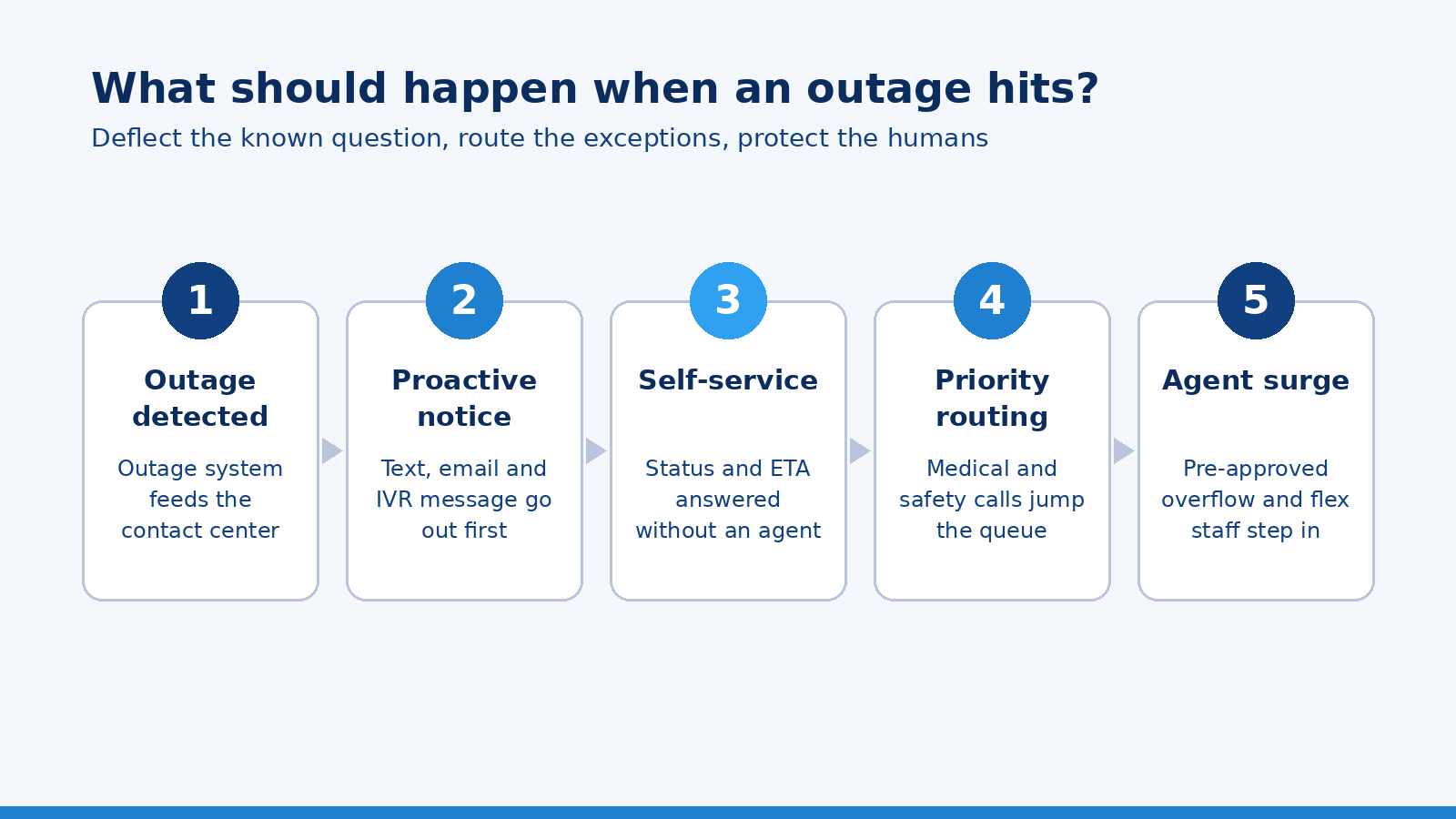
- Outage detected. The outage management system feeds affected areas and status to the contact center and messaging tools automatically, not by email to a supervisor.
- Proactive notice. Text, email, and an IVR announcement go out first, so many customers get the answer before they dial.
- Self-service. Status and estimated restoration are available by voice and digital channels, with the same answer in each.
- Priority routing. Reported hazards and customers registered as medically dependent skip the general queue.
- Agent surge. Pre-approved overflow, flex, and BPO capacity activates on a trigger, with training and access already in place.
Step one is where most programs have a gap. If the outage system and the contact center do not share data in near real time, every later step is slower and less accurate.
Which parts of the contact center stack matter most?
Not every layer deserves equal attention. For outage readiness, these decide the result:
| Layer | What it must do on an outage day | Question to ask |
|---|---|---|
| Outage data integration | Push affected areas, cause, and estimates to every customer channel | How fresh is the data, and who owns the feed? |
| IVR and voice | Offer outage status first, before account menus, and offload callers fast | Can we change the call flow in hours, not weeks? |
| Digital messaging | Send proactive and two-way notices at volume | What are the sending limits and approvals? |
| Routing | Prioritize safety and medical contacts over general inquiries | Can rules change without a vendor ticket? |
| Workforce management | Trigger flex, overflow, and BPO capacity on a defined threshold | Who can approve it at 2 a.m.? |
| Platform capacity | Scale concurrency without degrading call quality | Has it been load-tested at our surge, not the vendor’s demo? |
Notice what is absent: a feature checklist. Capability matters less than whether these layers work together under load.
Where does AI fit in utility outage response?
AI earns its place on the repetitive, high-volume questions: outage status, restoration estimates, and report-an-outage flows. It is a poor fit for safety hazards, medical-dependency situations, and customers whose frustration needs a person. Before buying anything, assess whether the underlying data and processes are ready. Our AI readiness work starts with those gates, because an AI agent that quotes a wrong restoration time is worse than a busy signal.
Two rules help. First, design the handoff to a human before you automate anything. Second, make sure the AI draws on the same restoration data the agents see, so customers never get conflicting answers.
How do you test readiness before storm season?
Run it as a loop, not a project. Map the data flow from outage detection to the customer, rehearse a surge, measure what happened, fix the gaps, and repeat before each peak season.
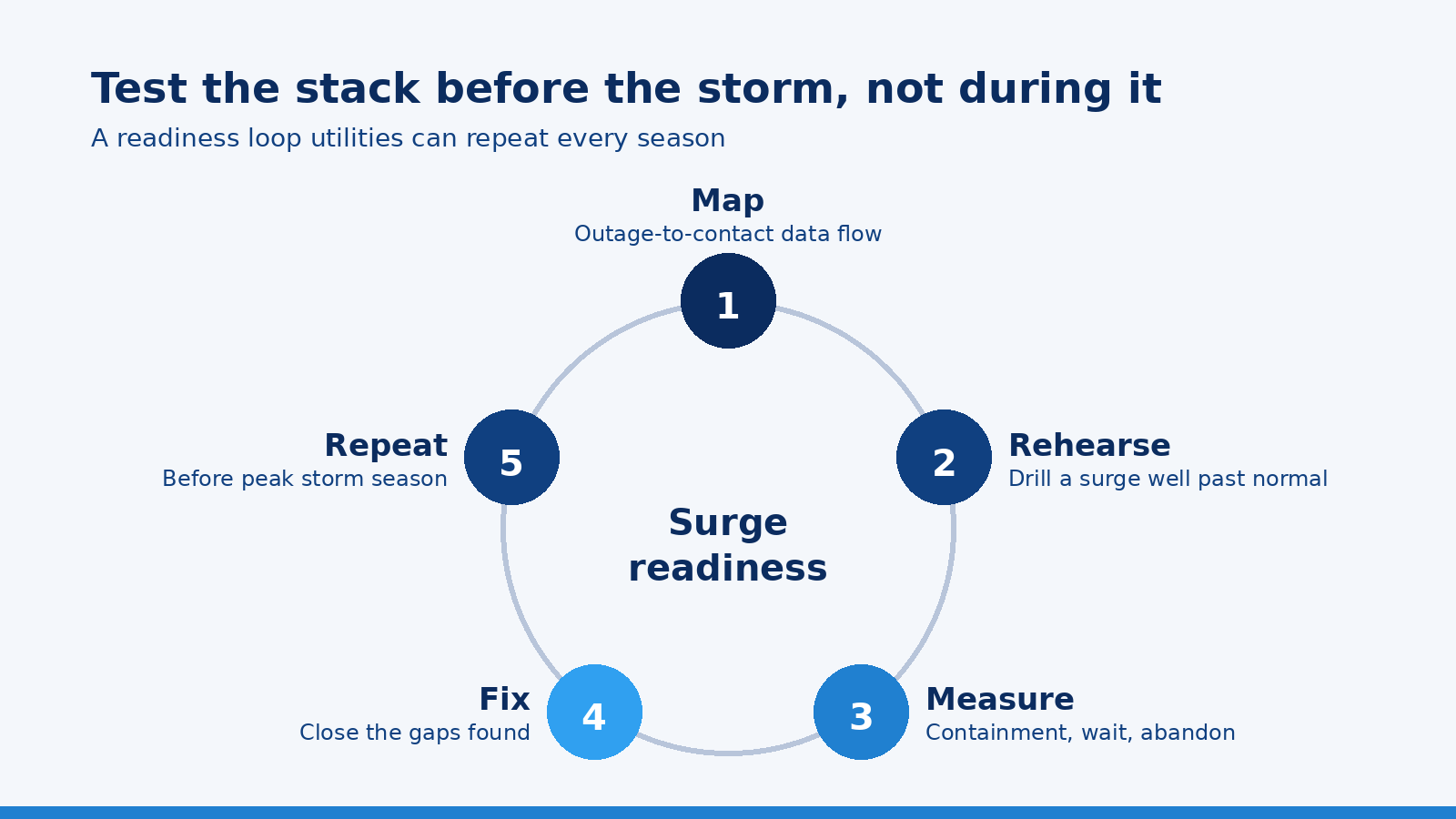
A useful drill pushes real messaging, routing, and staffing paths well past normal volume, with a scenario your operations and field teams recognize. Measure containment of outage-status contacts, wait and abandon rates in priority queues, and how many customers contacted you twice about the same event. Write down who approved what and how long it took. Those delays are the findings.
Do you need to replace the platform?
Sometimes, but test before you decide. Many surge failures come from integrations, IVR design, messaging approvals, or staffing rules rather than the core platform. If your drill shows the platform cannot scale, route, or integrate the way your plan needs, you have a documented case for migration. At that point, read our guide to planning a CCaaS migration without service disruption, because the cutover date should not land in storm season.
How should you compare vendors for this work?
| Evaluation area | What to require | Red flag |
|---|---|---|
| Scale proof | Evidence of performance at your peak volume, with references in similar operations | Demo environments only |
| Integration | Documented connection to your outage management and customer systems | Custom work with no owner |
| Control | Your team can change routing and call flows quickly | Every change needs a vendor ticket |
| Commercials | Pricing that holds in a surge, with defined overage terms | Surprise capacity fees |
| Neutrality | Recommendation based on your requirements, with partnerships disclosed | Preferred platform before requirements |
Weight the criteria before you see demos, and publish the weights to the team. That makes the final choice easier to defend with regulators, boards, and your own operations staff.
FAQ
How should a utility modernize its contact center?
Start from peak load, not average load. Connect outage data to proactive notices, put status and restoration estimates in self-service, route medical and safety contacts first, and test surge capacity before storm season. Platform choice comes after those requirements are written down.
Can AI handle utility outage calls?
For the repetitive questions, often yes: outage status, restoration estimates, and report-an-outage flows. It should not own safety hazards, medical-dependency customers, or angry escalations. Design the handoff to a human first, then decide how much to automate.
What should a utility contact center measure during an outage?
Measure whether customers got an answer, not just call handling. Track containment of outage-status contacts, wait and abandon rates for priority queues, accuracy of restoration estimates given, and how many customers had to contact you twice for the same outage.
How often should utilities test contact center surge plans?
At least once before each peak storm or heat season, and after any major platform, IVR, or outage-system change. A drill that overloads the real routing, messaging, and staffing paths finds gaps that a desk review of the plan will not.
Does a utility need a new contact center platform to prepare for outages?
Not always. Many gaps sit in integrations, messaging, IVR design, and staffing rules rather than the platform itself. Test first. If the platform cannot scale, route, or integrate the way your surge plan requires, then a migration case is real.
Where CTG fits
Cloud Tech Gurus is a Phoenix-based customer experience consulting and sourcing firm, founded in 2017 by former contact center executives. We help utilities and other enterprise operations write surge-first requirements, assess AI readiness, and run vendor evaluations across the 250+ suppliers and 40+ BPOs in our network, scored against a documented rubric you can audit.
There are three ways to work with us: paid CTG Consulting, vendor-funded research shortlists, and guru-led sourcing under a Letter of Agency. Suppliers compensate us when a client buys through us. We disclose that up front, agree the weights with you before any provider is invited, and disclose our relationship with each provider in writing before a shortlist is built.
Our Gurus ran them.