
According to the Washington Post, there are 8.4 million people unemployed looking for work, 10 million US job openings and 55 million US Gig workers. Maybe there isn’t really a staffing shortage but companies who are not benefitting from the gigantic pool of available Gig workers and are slow to embrace the Gig economy?
Key Takeaways
- The US has 55 million gig workers available even as companies report staffing shortages — the real gap is slow adoption of the gig model, not a lack of workers.
- Flexible (gig) staffing can cut staffing costs in half and shorten hiring timelines from weeks to hours.
- Gig workers are carefully vetted and qualified, with strong aptitude test scores, excellent language proficiency, and adequate home network bandwidth.
- Global BPO clients report strong cost savings, worker quality, and faster time-to-fill after adopting gig staffing.
- Pilot programs let companies test flexible staffing before making any larger commitment.
What’s the Solution to the Staffing Shortage?
Cloud Tech Gurus has the solution to today’s staffing problems. We have an amazing partner who provides flexible staffing (gig customer-experience operations). They have communities with thousands of global Gig workers who are qualified and ready to work. Their Gig workers have been carefully vetted and qualified, have exemplary scores on their aptitude tests, have excellent language proficiency scores, have adequate bandwidth in their home network, and have attained additional qualifications.
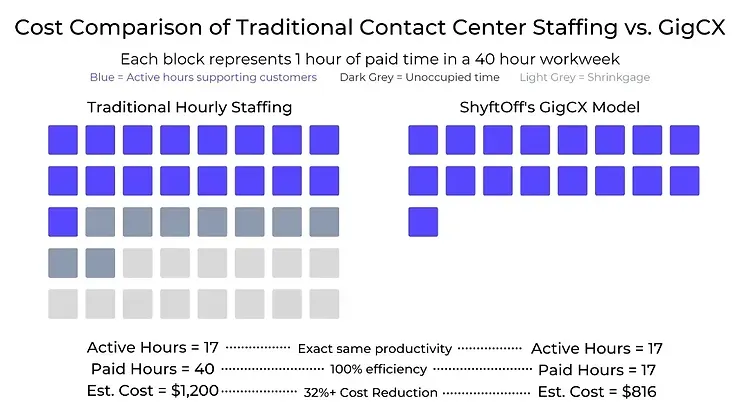
The icing on the cake is flexible staffing can cut your staffing costs in half, can reduce the time it takes to fill positions by 90%, and shorten the recruiting/hiring time frame from weeks to hours.
Some recent clients include global BPOs who are thrilled with their cost savings, quality of workers, and how rapidly they can fill positions. Pilot programs are available so companies can prove to themselves how awesome flexible staffing is before making any commitments.
What’s the Bottom Line on Gig Staffing?
There is not a staffing shortage. There is only a shortage of open-minded companies that are ready to embrace change and objectively explore the many benefits, and cost savings, available with flexible staffing. 55+ million Gig workers can’t be wrong.
Don’t take our word for it. Check out the McKinsey & Company article entitled “An on-demand revolution in customer-experience operations?” here.
Download our demo recording to get the scoop on flexible staffing and what it could mean to your business.
Related reading: Scaling Contact Centers With GigCX Strategy
Frequently Asked Questions
Is there really a staffing shortage in customer service?
Not according to the numbers. The Washington Post cites 8.4 million unemployed people, 10 million US job openings, and 55 million US gig workers. The real issue is that many companies are slow to tap the gig workforce already available to them.
What is flexible (gig) staffing?
Flexible staffing uses gig customer-experience workers from established global communities of thousands of workers. These workers are carefully vetted and qualified, with strong aptitude test scores, excellent language proficiency, adequate home network bandwidth, and additional qualifications, before they’re ready to work.
How much can flexible staffing save on costs and hiring time?
Flexible staffing can cut staffing costs in half, reduce the time it takes to fill open positions by as much as 90%, and shorten the recruiting and hiring timeline from several weeks down to just a few hours in some cases.
Who is already using gig customer-experience staffing?
Recent clients include global business process outsourcers (BPOs) that are thrilled with the cost savings they’re seeing, the quality of the gig workers assigned to their programs, and just how rapidly open positions get filled compared to traditional hiring.
Can we test flexible staffing before committing?
Yes. Pilot programs are available so companies can prove to themselves just how effective flexible staffing is — seeing the cost savings, worker quality, and faster time-to-fill firsthand — before making any larger staffing commitments.