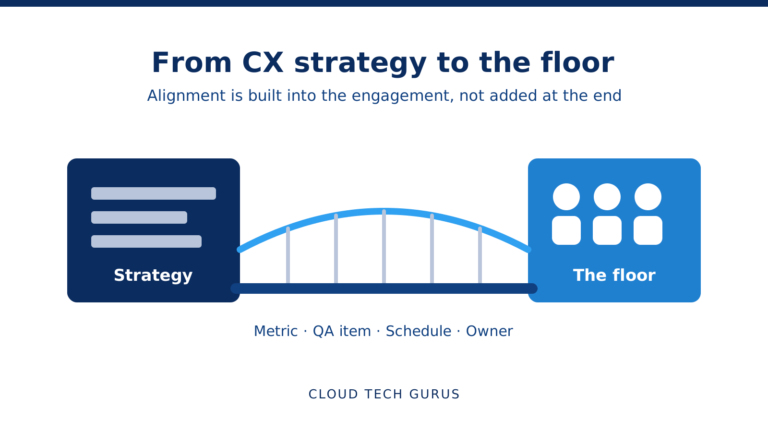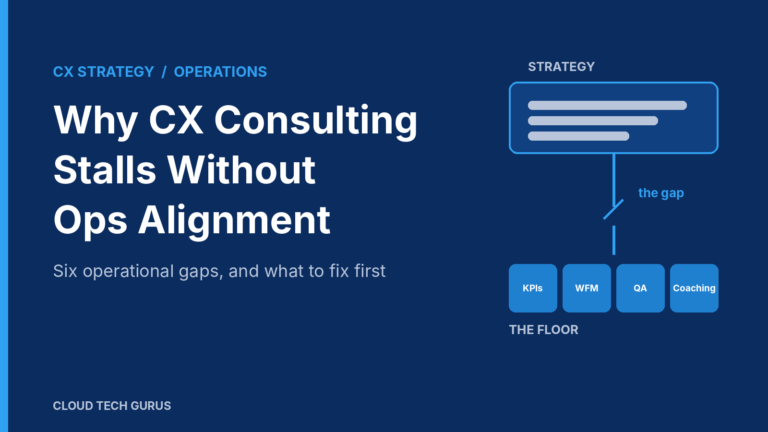
A BPO selection framework for enterprise contact centers starts with the operating need, not the provider list. Cloud Tech Gurus advises treating selection as an operating-design problem, weighting vertical operator depth over headline price. A contained pilot on real ticket data validates fit before any contract is signed.
Why Does BPO Selection Fail So Often?
BPO selection fails most often because organizations match the wrong partner to the wrong operating model. The failure is rarely a shortage of capable providers. It is a misalignment between what the work demands and how the vendor actually operates.
Operations leaders no longer face a simple outsource vs insource binary. They choose between service models with vastly different levels of process ownership, automation maturity, and governance rigor. A provider that excels at high-volume transactional work often crumbles under complex, judgment-heavy interactions. The mismatch surfaces within months.
What Is the Most Common Mistake in BPO Selection?
Treating the decision as a price exercise sinks more initiatives than any other error. The cheapest per-seat quote with shallow vertical experience becomes the expensive vendor within a quarter. Missed service levels, re-training costs, and agent churn surface downstream and erase the initial savings. A vendor evaluation rubric that weights operational depth over headline rate catches this risk before contracts are signed.
How Do Weak BPO Partners Hide Performance Problems?
A weak partner hides problems behind activity metrics. Leaders see reports showing handle-time targets met and occupancy rates on plan. What remains invisible is the erosion of quality, the rising customer effort, and the slow bleed of brand trust. Strong partners improve speed, quality, and control. Weak ones generate dashboards that look healthy while the underlying operation degrades.
Contact center vendor consolidation compounds these risks. When enterprises narrow their provider roster, each remaining relationship carries more weight. A single misaligned partnership now threatens a larger share of customer interactions. Cloud Tech Gurus addresses this through CX procurement consulting that ties vendor decisions to real service outcomes rather than proposal theater. A vendor-neutral CX consultant brings no allegiance to any platform or BPO, which means the operating model drives the recommendation, not the other way around.

What Is a BPO Call Center, Really?
A BPO call center is a third-party organization that handles inbound and outbound customer communication on behalf of a brand. These providers manage phone, chat, email, and other channel interactions so internal teams can focus on core business priorities.
The arrangement goes far deeper than simple call answering. Enterprises contract with BPO providers to offload intensive customer interactions to a specialized partner without sacrificing control of the customer experience. That distinction matters for operations leaders evaluating the outsource vs insource equation. Losing oversight of quality, compliance, or brand voice erodes the very cost savings the model promises.
How Does a BPO Call Center Actually Operate?
BPO providers run dedicated or shared teams of agents backed by contact center platforms, quality assurance programs, reporting dashboards, and compliance frameworks. Dedicated teams work exclusively for one client. Shared teams split capacity across multiple accounts. The right model depends on interaction volume, complexity, and the degree of customization required.
A rigorous vendor evaluation rubric weighs these structural choices against operational requirements. Leaders who skip structured comparison often select a provider that looks capable on paper but misaligns with real workload patterns.
What Separates a True Partnership from a Transactional Vendor?
The operating model defines the relationship. Transactional vendors deliver agent hours. True partners bring domain expertise, continuous improvement disciplines, and transparent governance. A vendor-neutral CX consultant helps procurement teams distinguish between the two without getting pulled toward any single provider’s sales narrative.
This distinction grows more critical as contact center vendor consolidation accelerates. Fewer standalone providers means each selection decision carries longer-term consequences. Organizations pursuing bpo selection without independent guidance risk locking into contracts that constrain future flexibility. Cloud Tech Gurus specializes in contact center outsourcing vendor selection that prioritizes operating fit over headline pricing, ensuring the chosen partner aligns with both current needs and strategic direction.
Outsource vs Insource: Which Model Fits Your Operation?
The outsource versus insource decision is no longer a binary labor choice. Operations leaders now select between service models with distinct levels of process ownership, automation maturity, and governance rigor. Treating the question as a simple cost comparison misses the structural implications that determine long-term performance.
A traditional insource model keeps agent hiring, training, quality management, and technology operations under internal control. Organizations build dedicated teams, invest in contact center platforms, and maintain compliance frameworks directly. This approach suits operations where customer interaction is a core strategic differentiator and process control outweighs scale flexibility.
The outsource vs insource calculation shifts when responsiveness and cost containment become primary drivers. Instead of building and managing large internal teams, enterprises contract with a business process outsourcing provider. These partners run dedicated or shared agent teams backed by established platforms, quality assurance programs, and reporting frameworks. IT leaders and operations executives turn to BPO call centers to deliver responsive support, contain operational costs, and scale quickly during demand spikes without sacrificing customer experience control.
What factors determine whether outsourcing or insourcing delivers better outcomes?
Three operational dimensions separate successful models from costly mismatches. Process complexity comes first: highly standardized, repeatable interactions outsource cleanly, while deeply integrated workflows requiring real-time cross-department coordination favor insource control. Volume predictability matters next. Operations with sharp seasonal peaks benefit from a BPO partner’s ability to flex capacity without carrying idle headcount during troughs. Technology maturity forms the third dimension. Organizations with legacy infrastructure often find that a provider’s modern platform accelerates capability gains faster than internal modernization programs.
How does a vendor-neutral CX consultant improve the outsource versus insource decision?
A vendor-neutral CX consultant brings practitioner-led assessment to what is fundamentally an operating-model design problem. Cloud Tech Gurus deploys former contact center executives who evaluate process ownership requirements, automation readiness, and governance needs before any provider conversation begins. This sequencing prevents the common failure pattern where teams select a bpo selection model first and diagnose operational fit later. The firm’s approach treats the decision as an operating-design exercise, not a procurement event, ensuring the chosen model aligns with the work actually required under real constraints.
For operations where neither pure insource nor traditional outsourcing fits, a managed BPO model offers a middle path with deeper process ownership and integrated technology management. The vendor evaluation rubric that emerges from this analysis weighs automation maturity and reporting transparency alongside cost, moving the conversation beyond per-seat pricing to total operating model fit.
What Goes Into a Vendor Evaluation Rubric?
A vendor evaluation rubric transforms provider selection from a subjective beauty contest into a structured operating-design problem. The most effective rubrics weight operator depth in a specific vertical over headline price, a principle that prevents the cheapest per-seat quote from becoming the most expensive vendor within a quarter.
Contact centers look remarkably similar in a proposal. Every provider shows logos, quality programs, training decks, and technology partnerships. Those artifacts do not reveal whether a provider will work inside an organization’s actual system. A rigorous rubric cuts through that surface-level parity by measuring what matters: demonstrated competence in the buyer’s industry, not generic call center experience.
What Criteria Belong in a BPO Selection Rubric?
Before building a shortlist, operations leaders define the work itself. A proper bpo selection framework starts with operational requirements rather than a provider list. The rubric captures channels in scope, required languages, operating hours, and demand variability. Without that foundation, scoring becomes arbitrary.
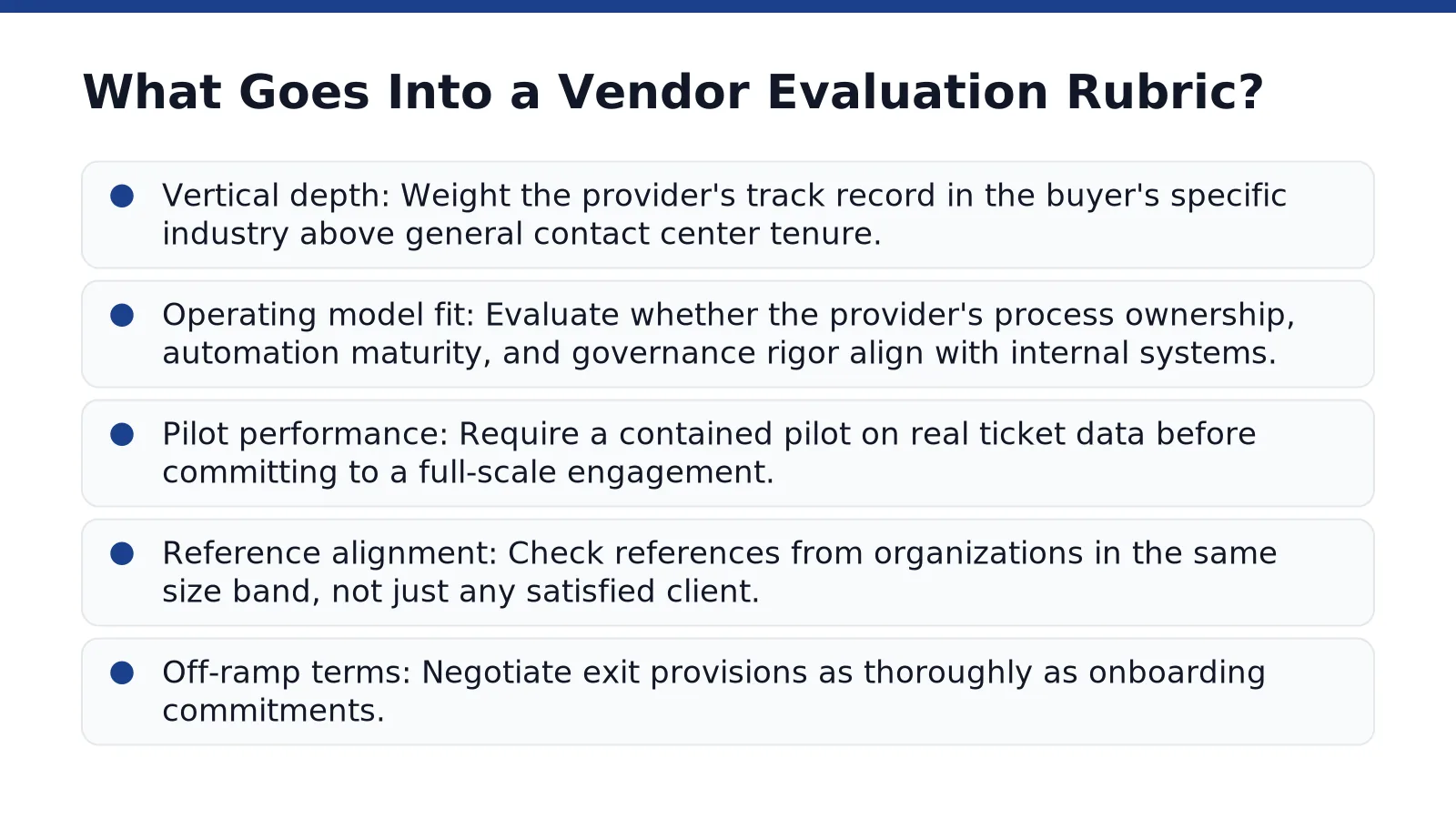
Key criteria that belong in the rubric include:
- Vertical depth: Weight the provider’s track record in the buyer’s specific industry above general contact center tenure.
- Operating model fit: Evaluate whether the provider’s process ownership, automation maturity, and governance rigor align with internal systems.
- Pilot performance: Require a contained pilot on real ticket data before committing to a full-scale engagement.
- Reference alignment: Check references from organizations in the same size band, not just any satisfied client.
- Off-ramp terms: Negotiate exit provisions as thoroughly as onboarding commitments.
How Does the Rubric Address the Outsource vs Insource Decision?
The outsource vs insource question often resolves itself once the operating model is defined. A well-constructed rubric surfaces whether the work requires a partner’s specialized infrastructure or whether internal teams can deliver comparable outcomes at scale. The scoring process makes the trade-offs visible: control versus flexibility, fixed cost versus variable cost, institutional knowledge versus external expertise.
A vendor-neutral CX consultant brings objectivity to this evaluation. Cloud Tech Gurus applies a vendor evaluation rubric that isolates operational requirements from vendor marketing, ensuring the scoring reflects business needs rather than demo theater. This approach proves especially valuable during periods of contact center vendor consolidation, when market shifts can make yesterday’s shortlist obsolete. The rubric provides a stable framework that adapts as the provider landscape changes.
Which Criteria Matter Most in BPO Selection?
BPO selection succeeds or fails on five specific criteria. Scoping the work precisely, weighting vertical operator depth, running a contained pilot on real ticket data, checking references in the client’s own size band, and negotiating the off-ramp as thoroughly as the on-ramp determine whether an outsourcing partnership delivers measurable results.
Many enterprise contact centers treat vendor evaluation as a pricing exercise. That approach proves expensive within a quarter. The cheapest per-seat quote with shallow vertical experience generates hidden costs through missed service levels, re-training cycles, and agent churn that surface downstream.
What question should leaders ask before evaluating BPO vendors?
The productive question is not which BPO provider ranks best. No universal answer exists for that inquiry. Leaders gain more traction by asking which operating model fits the work their contact center actually performs under the constraints it actually faces.
This distinction matters because providers look remarkably similar in proposals. Logos, quality programs, training decks, and leadership biographies appear in every response. Those elements carry weight only after the operating model question receives a clear answer.
How do governance and reporting affect BPO outcomes?
A strong BPO company improves speed, quality, and control through rigorous governance and transparent reporting. Weak partners hide operational problems behind activity metrics that look favorable on a dashboard but mask deteriorating customer experience.
The evaluation rubric must therefore weight these structural elements alongside cost. Vendor-neutral CX consultants at Cloud Tech Gurus help enterprise teams normalize every bid to cost per resolved contact rather than per-seat pricing, surfacing the true economics of each option. Contact center vendor consolidation continues accelerating across the industry, making the vendor evaluation rubric more critical as fewer providers control larger portions of the market.
For most organizations, the outsource vs insource question resolves once leaders scope the work with sufficient granularity. A contained pilot using real ticket data reveals whether the partner can handle the actual interaction complexity rather than the idealized version described in procurement documents.
How Does Contact Center Vendor Consolidation Reduce Risk?
Contact center vendor consolidation reduces risk by shrinking the attack surface of a multi-vendor environment. Fewer contracts mean fewer integration points, fewer security handoffs, and fewer places where accountability dissolves between providers. Organizations running 15 or more distinct contact center tools carry operational fragility that a single vendor failure can exploit. Consolidation replaces that fragility with a smaller, more governable set of relationships.
The risk reduction is not theoretical. Fragmented vendor stacks create blind spots in reporting, compliance, and disaster recovery. When three different platforms handle voice, chat, and workforce management, a degradation in one channel often goes undetected until customer complaints spike. Consolidated environments give operations leaders a unified view of performance and a single escalation path when something breaks.
What Makes a Consolidated Vendor Stack More Resilient?
Resilience comes from simplicity. A consolidated stack eliminates the handoff failures that plague multi-vendor architectures. When one provider owns the telephony, routing, and agent desktop, troubleshooting a dropped call does not require three separate support tickets and a war room. The mean time to resolution shrinks because the diagnostic path is linear rather than distributed across silos.
How Does a Vendor-Neutral CX Consultant Support Consolidation Decisions?
A vendor-neutral CX consultant brings objectivity that internal teams cannot replicate. Internal selection committees inherit vendor relationships, sunk-cost biases, and political constraints that distort evaluation. Cloud Tech Gurus operates within a network of over 250 technology suppliers and 40-plus BPO providers, backed by more than 4,000 hours of vendor evaluations. That breadth lets the firm map consolidation options against an organization’s actual operating model rather than a vendor’s preferred architecture.
The firm’s practitioner-led team, drawn from over 120 former contact center executives, streamlines vendor evaluation rubric design so consolidation choices align with measurable outcomes. Cloud Tech Gurus reduces technology acquisition risks by pressure-testing vendor claims against real operational data. The result is a contact center vendor consolidation path that protects service continuity and delivers measurable return on investment, not just a smaller invoice stack.
What Red Flags Should Trigger Immediate Rejection?
Certain vendor behaviors signal deeper operational failures that no contract can fix. A vendor evaluation rubric must flag these patterns early, before procurement timelines lock an organization into a failing partnership.
The most dangerous red flag is opacity disguised as reporting. A weak BPO partner hides problems behind activity metrics instead of delivering transparent, outcome-based data. Leaders see dashboard green lights while actual service quality erodes. This disconnect between reported activity and real performance destroys trust and delays corrective action by months.
What does shallow vertical experience actually cost?
The price appears in the second quarter. A provider with shallow vertical experience becomes the expensive vendor within a quarter, once missed SLAs, re-training, and churn surface downstream. The per-seat savings vanish. The organization absorbs the cost of rebuilding agent competency while customers experience inconsistent service.
How do you spot a vendor selling a slide deck instead of a partnership?
Look for missing proof of concept. Skipping any of the five core selection steps means the organization bought the slide deck rather than a working partnership. A polished proposal without a contained pilot on real ticket data signals that the vendor sells promises, not operational capability. The bpo selection process must include live testing before commitment.
A vendor-neutral CX consultant helps procurement teams separate genuine operational depth from marketing claims. Cloud Tech Gurus brings practitioner-led assessment to this stage, evaluating whether a provider’s reported metrics reflect actual delivery or merely activity theater. The firm’s methodology catches these red flags before contracts are signed, protecting enterprises from the downstream costs of a failed outsource vs insource decision.
Contact center vendor consolidation adds another layer of risk. When a provider acquires competitors, inherited accounts often suffer from fragmented reporting and misaligned quality programs. Leaders evaluating consolidated vendors must scrutinize whether the operational integration is real or merely financial.
How Can a Vendor-Neutral CX Consultant Guide You?
A vendor-neutral CX consultant brings objectivity to technology decisions that internal teams struggle to achieve. Cloud Tech Gurus provides this independent guidance, helping enterprise contact centers navigate complex CX and AI choices with clarity.
Internal selection committees face a structural disadvantage. Vendor demos look polished. Reference calls stay scripted. The real differences between platforms emerge only after contracts are signed. Without external perspective, organizations risk selecting platforms that fail under production loads.
Cloud Tech Gurus deploys over 120 former contact center executives who have sat in the buyer’s chair. These practitioners assess operational inefficiencies from firsthand experience, not theoretical frameworks. The firm’s vendor evaluation rubric examines technology fit against actual workflows rather than feature checklists.
What does hands-on implementation oversight actually deliver?
Traditional advisory firms produce slide decks and disengage. Cloud Tech Gurus extends engagement through implementation and beyond. Former operators stay embedded during deployment, catching configuration errors before they harden into operational problems. This ongoing guidance prevents the common pattern where sound technology selections fail during rollout.
How does practitioner experience change the outsource vs insource decision?
Most bpo selection frameworks treat outsourcing as a binary choice. Practitioners who have managed both models recognize the spectrum between fully in-house and fully outsourced operations. Cloud Tech Gurus maps specific workflows to the right operating model, avoiding the blanket decisions that create hidden costs. The firm’s CX consulting services address this operating-model design before any vendor conversation begins.
Contact center vendor consolidation introduces another layer of complexity. Organizations managing multiple platforms after acquisitions need guidance that accounts for migration sequencing, contract timing, and agent retraining windows. Practitioner-led advisory identifies consolidation paths that preserve service levels during transition rather than chasing theoretical savings.
Conclusion
The evaluation framework ends where execution begins. Leaders who apply these red-flag tests, consolidation checks, and practitioner-led rubrics convert vendor selection from a procurement exercise into an operational advantage. The next step is pressure-testing shortlisted providers against real workflows, not polished demos. That discipline separates organizations that achieve measurable ROI from those that inherit another layer of complexity. Commit to the framework, run the contained pilot, and let operational data, not slide decks, drive the final decision.