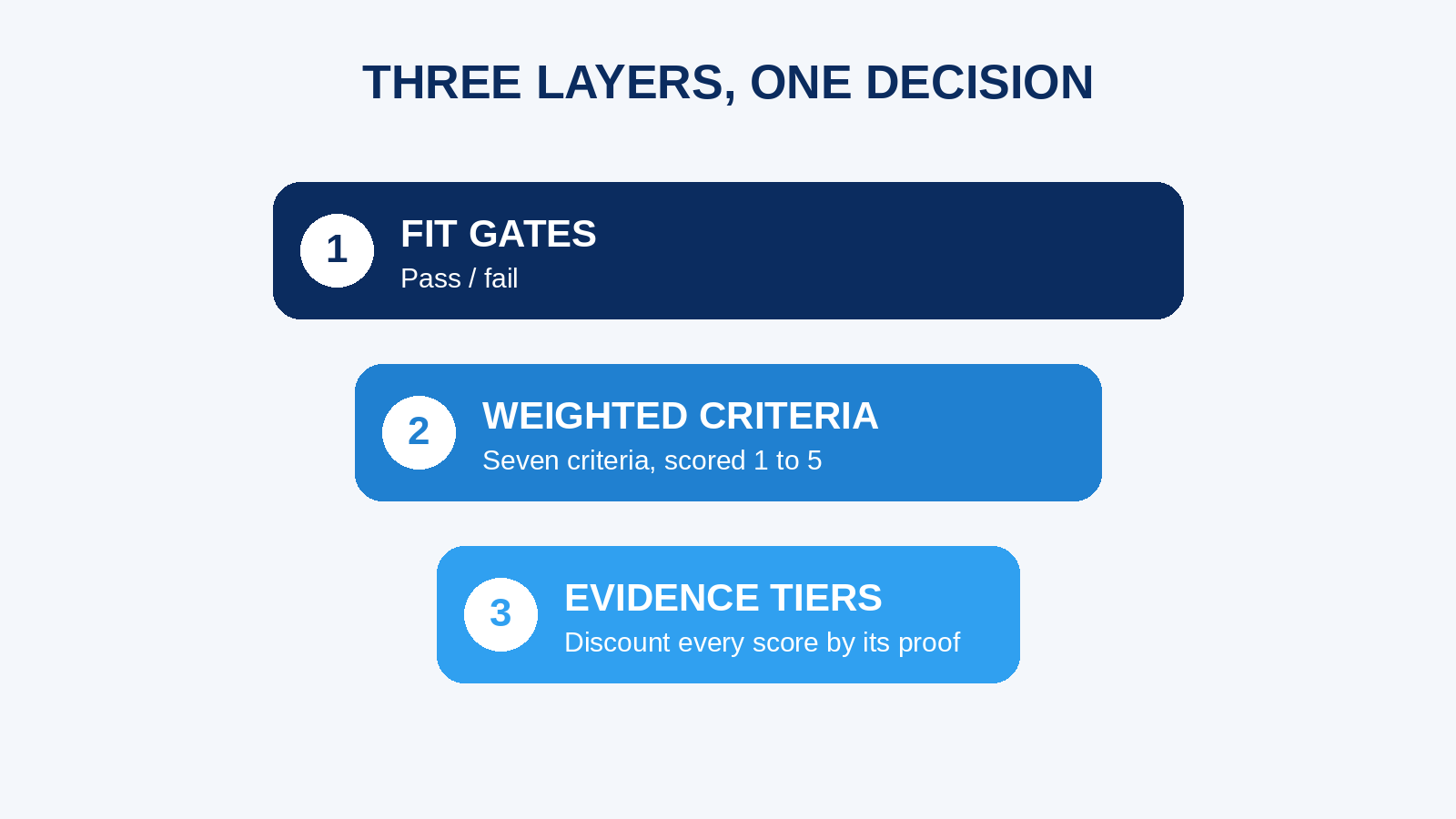
A BPO scorecard is a weighted tool that rates every outsourcing provider on the same criteria, at the specific site that will take your calls. Build it in three layers, pass/fail gates, weighted criteria, and evidence tiers, and the decision rests on proof instead of a headquarters presentation.
Why it matters: Contact center outsourcing locks in your service quality, cost structure, and brand reputation for years. Most selections are still decided by a presentation from the provider’s headquarters, and then the work goes to a site whose agents, supervisors, and attrition nobody on your team has seen.
We learned this from the buyer’s side. Cloud Tech Gurus was founded by former contact center executives who outsourced queues, ran several BPOs at once, and pulled work back in-house when the numbers stopped working. The scorecard below is the one we would use in 2026 for enterprise programs, roughly 500 to 10,000+ seats. It pairs well with a cost per resolved contact comparison of BPO pricing.
Key takeaways
- Score the site, not the logo. Two sites from the same provider can differ more than two different providers.
- Use three layers. Pass/fail gates first, weighted criteria second, evidence tiers last.
- Lock the weights before bids arrive. Changing them after you see proposals is how favorites win.
- Keep the scorecard after signature. The same criteria become your monthly governance review.
What is a BPO scorecard for contact centers?
It is a weighted evaluation tool for outsourcing provider selection. Every provider is rated against the same criteria, with the same evidence standard, at the site level. It does three jobs: it filters a long list down to two or three finalists, it makes bids comparable across different pricing models, and it governs performance once the contract is signed.
Which queues should you outsource at all?
Decide this before scoring any provider. Some work outsources well and some outsources expensively. Rate each queue on five criteria, and write the answer into your CX operating model so everyone knows who owns what.
| Criterion | Outsource-friendly | Keep in-house or hybrid |
|---|---|---|
| Complexity | Scripted, stable, high first contact resolution | Judgment-heavy, frequent exceptions |
| Regulatory exposure | Low, or controls are easy to audit | High, with PHI, PCI, or licensing requirements |
| Customer value | Broad base, low per-contact revenue impact | Top-tier customers, retention and save queues |
| Volume pattern | Seasonal spikes, overflow, 24/7 coverage | Small, steady, deeply specialized |
| Knowledge stability | Processes change quarterly or less | Processes change weekly |
Mostly left-column queues are strong candidates. Mixed results usually point to a hybrid, where the BPO handles tier 1 or overflow and your team keeps escalations. Also check whether the most scripted queues are better candidates for automation first. Paying for human seats on work a virtual agent could resolve is a cost you carry for the whole term. If a queue has no documented reason for being outsourced beyond “cost,” it is a hope, not a business case.
What belongs in the fit gates?
Fit gates are pass/fail. A provider that fails one does not get scored, however good the rate card looks. Anything you cannot negotiate belongs here, not in a percentage.
- Vertical experience. Live programs in your industry today, not adjacent experience.
- Compliance evidence. HIPAA, PCI DSS, SOC 2 Type II, TCPA controls for outbound, and data residency, as they apply. Ask for the audit reports, not the logos.
- Payment and identity controls. How card data stays out of agents’ view, and how identity verification and fraud controls work on account-servicing queues.
- Delivery model. Onshore, nearshore, offshore, at-home, or a blend, matched to your customers and regulations.
- Languages, hours, and size fit. Every language and coverage window on day one, and a program large enough to matter at the proposed site. At 40 seats in a 4,000-seat site, you are a rounding error.
- Technology compatibility. They can work in your CCaaS, CRM, WFM, and QA tools, or you have priced the cost of working in theirs.
How should you weight the criteria?
Providers that clear the gates get scored from 1 to 5 on seven criteria. These are our starting weights. Treat them as a default, document any change, and date it before the first bid arrives.
| Criterion | Weight | What a 5 looks like |
|---|---|---|
| Normalized cost per resolved contact | 25% | Lowest cost after converting every bid to cost per resolved contact at your volume profile |
| Quality and resolution evidence | 20% | FCR, QA, and CSAT results at your seat count and vertical, verified in production data |
| Workforce stability | 15% | Low attrition and long tenure on comparable programs, with supervisor ratios you have checked |
| Contract structure and risk | 15% | Meaningful SLA credits with earnbacks, fair forecast bands, clean exit terms |
| Compliance and security | 10% | Clean audit history, strong work-at-home controls, incident response you have reviewed |
| Ramp and scalability | 10% | Proven hiring pipeline at the proposed site and realistic time to proficiency |
| Operational transparency | 5% | Direct access to their data and your team in calibration sessions |
Price is a quarter of the decision on purpose. Push it much higher and you are running a reverse auction for the lowest-paid agents in the market. Real cost reduction comes from resolution, not rate.
Adjusting weights by vertical
Regulated or seasonal buyers can shift weights before bids arrive. Healthcare and financial services buyers often move compliance up and cost down, because a compliance miss costs far more than a rate difference. Retail and utilities buyers often move scalability up, because surges need capacity that is proven, not promised. The rule is the same everywhere: decide first, document it, and apply it to every provider.
How do evidence tiers keep scores honest?
Every proposal promises strong first contact resolution. Evidence tiers show which promises are real by discounting each score by the strength of its proof.
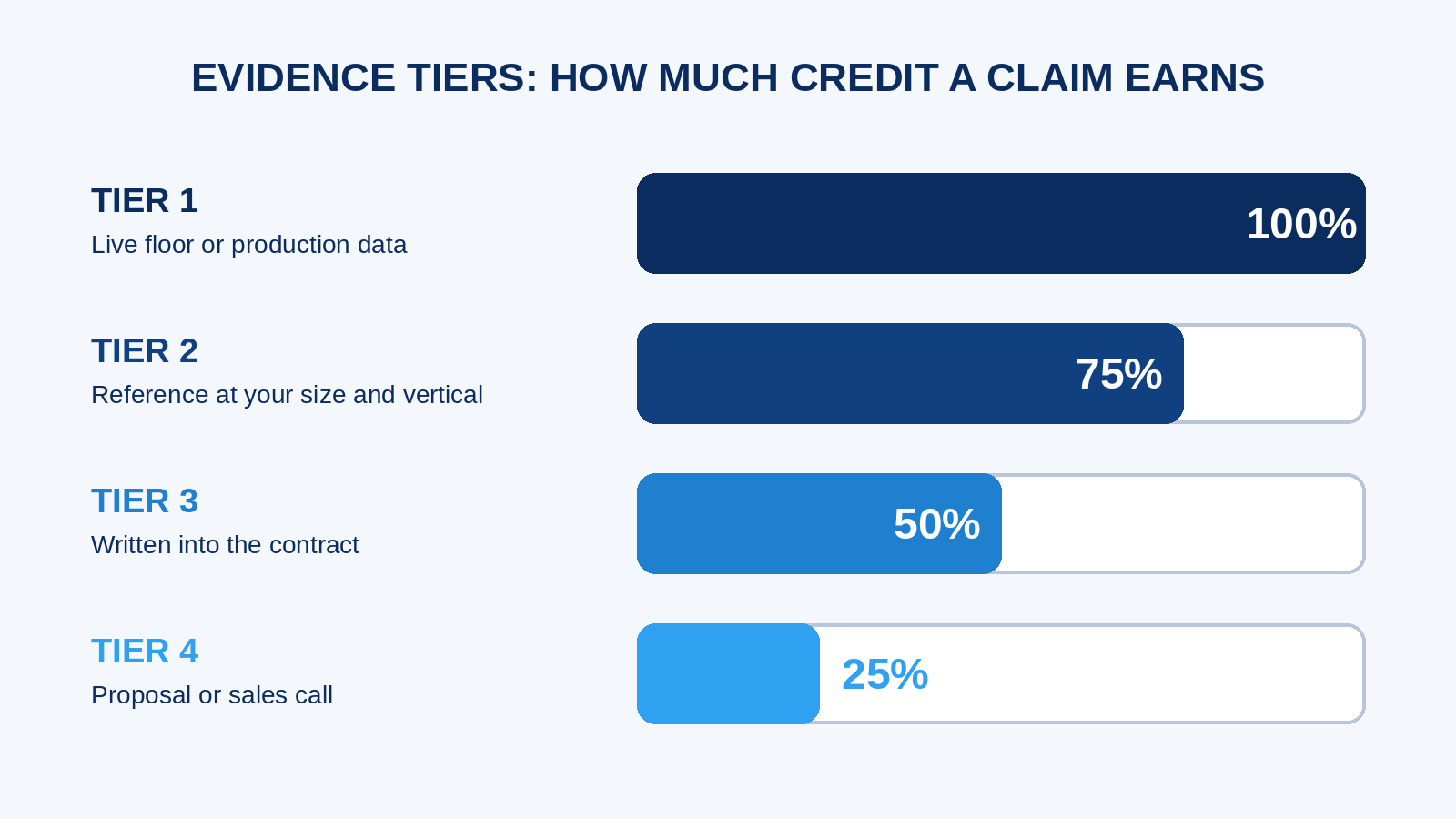
| Tier | Credit | Source of the evidence |
|---|---|---|
| 1 | 100% | Seen on a live floor or in the provider’s production data |
| 2 | 75% | Confirmed by a reference at your seat count and vertical |
| 3 | 50% | Written into the contract or statement of work |
| 4 | 25% | Stated in the proposal or on a sales call |
The adjusted score is the raw score times the tier credit times the weight. A paid pilot of 60 to 90 days on one queue is worth the time for new programs, because it turns tier 4 promises into tier 1 evidence.
Why score the site instead of the provider?
Proposals come from headquarters, but the work comes from a specific site. Make four rules part of the scorecard.
- Name the site in the RFP response. No site named, no score.
- Visit it. Walk the floor, sit with agents, and meet the site director who will run your program.
- Ask for site-level data. Attrition, tenure, and quality for that site, not company averages.
- Name the leadership in the contract. The site director and program manager, with a say for you if they change.
For quality, run a calibration session with each finalist using your own recorded contacts. Providers that score your calls the way you do will coach agents the way you want.
What happens after you sign?
Do not file the scorecard. The same criteria become your monthly review: cost per resolved contact, first contact resolution, QA, CSAT, service level, and attrition, measured in your systems. Rescore quarterly, and benchmark against comparable programs so good means good for the market. If you run several providers, score them on the same card and shift volume toward the leaders. Before renewal, rescore the incumbent against two alternatives. Sometimes the incumbent wins, and now you have the evidence.
A realistic enterprise timeline, with the scorecard locked up front, runs about eight to ten weeks: two weeks for queue decisions and gates, two for the RFP, three for site visits and calibration, one for references and scoring, and two for negotiation. Your timeline will vary with program size and how many sites you visit.
What are the red flags during BPO selection?
- The A-team demo. The executives in the pitch never appear on your program.
- No site named. “We will determine the optimal location” means your program goes wherever they have empty seats.
- Company-wide averages only. Site attrition that is never shared is usually attrition you would not like.
- Quality measured only in their systems. If you cannot audit it, you cannot manage it.
- Compliance by logo. A badge on a slide is not an audit report.
FAQ
What is a BPO scorecard for contact centers?
A weighted evaluation tool that rates outsourcing providers on fit, service quality, compliance, scalability, cost, and contract terms, using site-level evidence. It speeds provider selection and then becomes the governance scorecard after signature, so the criteria you chose carry through the life of the contract.
What criteria matter most in BPO vendor evaluation?
Normalized cost per resolved contact, quality and resolution evidence, workforce stability, and contract structure carry the most weight in our default model. Compliance and vertical experience are screened first as pass/fail gates, so a provider that fails them never reaches the weighted scoring stage.
How do you compare BPO providers fairly?
Lock the weights before bids arrive, require a named site, convert every bid to cost per resolved contact, and discount each score by the strength of its evidence. Give every finalist the same site-visit agenda and the same calibration test so the comparison holds up.
Should I outsource my contact center?
Decide queue by queue, not all at once. Scripted, stable, high-resolution work usually outsources well, though the most scripted queues may suit automation better. Regulated, high-value, and fast-changing work often belongs in-house or in a hybrid model with your team handling escalations.
How do you evaluate work-at-home BPO agents?
Treat at-home delivery as its own model. Check device lockdown, screen monitoring, clean-desk policies, agent identity verification, and access revocation. For HIPAA or PCI DSS work, ask for audit reports that cover at-home agents specifically, not only brick-and-mortar sites.
Where CTG fits
Cloud Tech Gurus is a Phoenix-based customer experience consulting and sourcing firm, founded in 2017 by former contact center executives. We run BPO selection and outsourcing procurement from the buyer’s side: queue analysis, fit gates, RFP design, site visits, calibration testing, evidence-tiered scoring, and contract and KPI design. We work across 250+ suppliers and 40+ BPOs.
There are three ways to work with us: paid CTG Consulting, vendor-funded research shortlists, and guru-led sourcing under a Letter of Agency. Suppliers compensate us when a client buys through us. We disclose that up front, agree the weights with you before any provider is invited, and every recommendation runs through a documented rubric you can audit.
We didn’t study contact centers. We ran them. We have also walked a BPO floor where the “dedicated team” was meeting our program for the first time that morning.