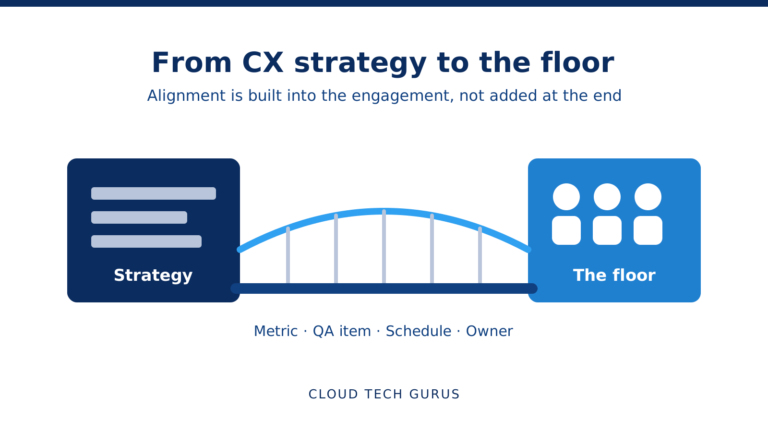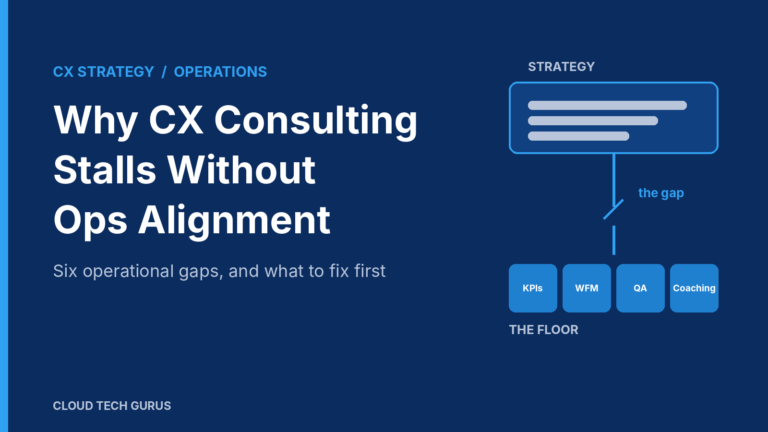
CX consulting stalls when operations is not built into the plan. The strategy lands as a deck while agents are still scored on last year’s metrics, scheduled on old forecasts, and coached on an outdated QA form. Fix KPIs and ownership first, then capacity, QA, knowledge, and coaching time, before buying any technology.
Why it matters: A CX strategy that operations cannot staff, measure, or coach to is just a PDF. When the plan stalls, leadership rarely blames the design. It decides that CX consulting does not work, and the next initiative starts with less trust and less budget.
We have watched this happen from the operations chair. Cloud Tech Gurus was founded by former contact center executives, and we have inherited well-designed strategies that fell apart in week one because nobody asked how agents are scheduled, scored, or supervised. Here is where alignment breaks in 2026, and what to fix first.
Key takeaways
- Most stalls happen after the strategy phase. The plan is fine. The operation is still running on the old one.
- Six operational gaps explain most of it: KPI conflict, no single owner, unmodeled capacity, QA and knowledge lag, thin supervisor bandwidth, and technology bought before process.
- Sequence matters. Decisions that cost nothing come first. Tools come last.
- Test a firm on operations before you sign. Four questions below separate operators from slide builders.
Why does CX consulting stall after the strategy phase?
Because the strategy and the operation are run by different people on different calendars. The strategy team measures success by the quality of the plan. The operation measures it by service level, handle time, and quality scores, reported weekly. Whichever one pays, schedules, and reviews the agent wins.
The sequence is familiar. The strategy lands, with new journey maps, a clear story about empathy and resolution, and executive sponsorship. Operations was either not in the room or was there for a single workshop. Then nothing changes on the floor. Agents keep doing what they are measured on, supervisors keep coaching to the old QA form, and the deck gets a tidy folder on a shared drive.
This is not a people problem. It is a design problem. A strategy that does not account for how the operation actually runs cannot be executed, however good it is. Our piece on why the operating model is the real failure point covers the structural side in more depth.
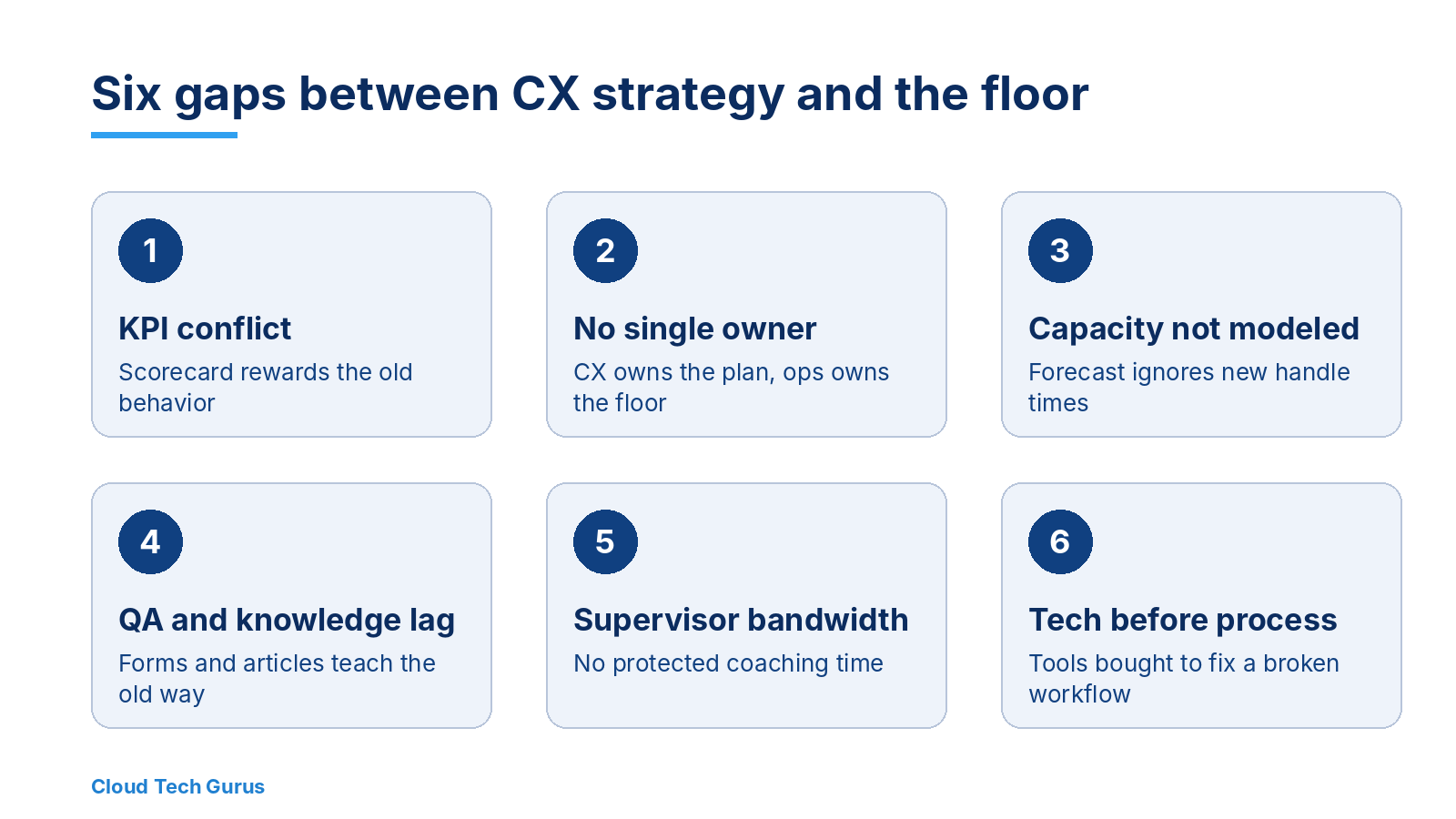
What are the six operational gaps that stall CX strategy?
Six gaps show up repeatedly. Each has a visible symptom and a first fix you can start without a new budget line.
| Gap | What you see | First fix |
|---|---|---|
| KPI conflict | Strategy asks for resolution; agents are scored on handle time | Rewrite the agent and supervisor scorecard to match the strategy |
| No single owner | CX owns the plan, operations owns the floor, nobody owns the result | Name one accountable owner with authority over both |
| Capacity not modeled | Service levels drop the week new behaviors roll out | Rebuild the WFM forecast with new handle times before launch |
| QA and knowledge lag | QA forms grade old behaviors; articles contradict new policy | Update the QA form and the most-used articles before agent training |
| Supervisor bandwidth | Coaching time is lost to escalations and admin | Protect coaching time and review span of control |
| Technology before process | AI pilots and new tools never reach production | Fix the process first, then choose the tool |
How do the six gaps actually play out?
KPI conflict is the most common gap and the cheapest to fix. If the strategy calls for first contact resolution but agents are rewarded on average handle time, they will hit the handle-time goal every time. People do what the scorecard pays for. Contact center KPI design comes first because every other fix depends on it.
No owner means no execution. Most organizational friction in CX comes down to split accountability. In EOS terms, the strategy needs a Rock with one name on it, not a steering committee that meets monthly.
Capacity is where good intentions become missed service levels. Longer, better conversations can cost handle time before they save repeat contacts. If workforce management does not model that change, the queue will expose it on the first Monday.
QA and knowledge are how strategy reaches the agent. Agents do not read the strategy deck. They read the QA form and the knowledge base. If those have not changed, the strategy has not reached the floor.
Supervisors turn strategy into habit. A supervisor with a wide span of control and no protected coaching time cannot reinforce anything new, no matter how clear the goals are.
Technology can speed up a working process but cannot fix a broken one. Stalled AI pilots often trace back to process and data problems rather than the model. If you are weighing that question, our AI readiness work starts with exactly these basics.
What should you fix first?
The order matters. Start with what is cheapest and changes behavior fastest, and leave the expensive items until the foundation holds. The timing below is a sample sequence from our practitioner experience, not a standard. Adjust it to your operation.
| Window | Focus | What it involves |
|---|---|---|
| Weeks 1 to 2 | Align KPIs and name the owner | Decisions, not budget. Removes the biggest source of conflict right away. |
| Weeks 3 to 6 | Model capacity, update QA and knowledge | Rebuild the forecast, rewrite the QA form, and fix the articles agents use most. |
| Weeks 6 to 10 | Equip supervisors | Protected coaching time, calibration sessions, and a shared definition of good. |
| After that | Evaluate technology | By now you know which gaps are process gaps and which are tool gaps. |
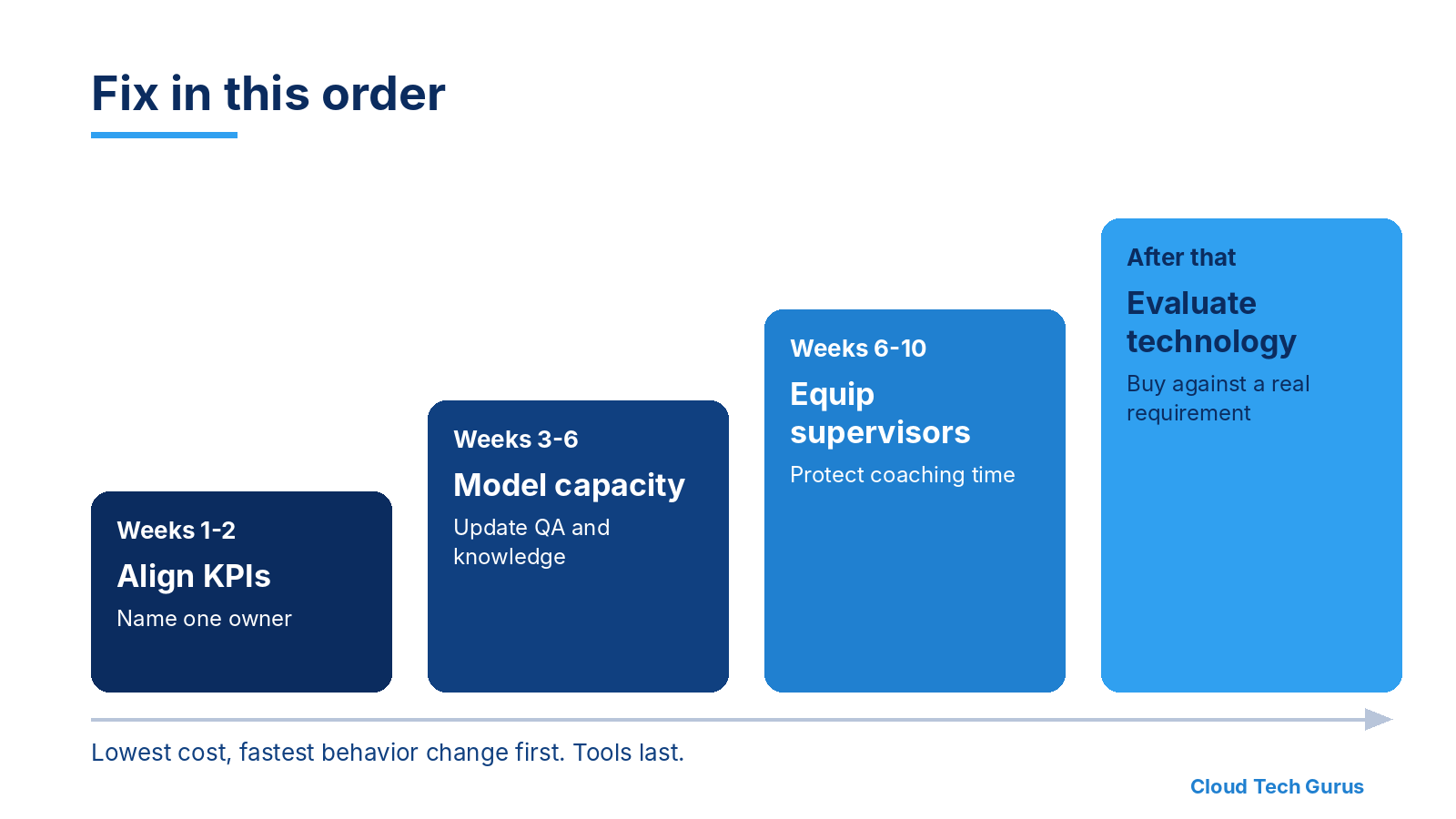
That last row is the one most programs skip to. Buying technology early feels like progress, and vendors are happy to help. But a platform selected before the process is fixed gets scored against a demo instead of a requirement, which is how enterprises end up with a strong pilot and a stalled rollout.
How do you tell if a CX consulting firm understands operations?
Ask these four questions before you sign. They take ten minutes and tell you more than a credentials slide. For a broader scoring approach, see how to evaluate a CX consulting firm.
- “How will this strategy change our agent scorecard?” If there is no answer, the strategy will not reach the floor.
- “What happens to service levels in the first 30 days?” A firm that has run a contact center talks about forecasts and staffing. A firm that has not talks about change management.
- “Who from our operations team do you need, and how often?” The right answer is early, often, and throughout, not only at kickoff.
- “What do you fix before recommending any technology?” If the answer starts with a platform name, keep looking.
Frequently asked questions
Why does customer experience consulting fail?
Usually because operations was not aligned to the strategy. KPIs, staffing models, QA forms, knowledge content, and supervisor coaching still reflect the old model, so agents keep doing what they are measured on. The strategy was sound on paper but never reached the floor.
What is operations alignment in CX?
It means the agent scorecard, workforce plan, QA form, knowledge base, and supervisor coaching all support the same customer experience strategy, with one accountable owner. When any of those five points the other way, agents follow the one that affects their pay, their schedule, or their review.
What should you fix first when a CX strategy stalls?
Start with KPIs and ownership. Both cost little, take weeks rather than quarters, and remove the biggest conflict between what the strategy asks for and what the floor is rewarded for. Capacity, QA, and knowledge fixes depend on those two decisions being made first.
Should you buy new CX technology to fix a stalled strategy?
Not first. Technology speeds up a working process but cannot repair a broken one. Fix measurement, capacity, and process before choosing tools, so you buy against a documented requirement instead of a demo. Many stalled AI pilots trace back to process and data problems, not the model.
How do you know if a CX consulting firm understands operations?
Ask how the strategy will change your agent scorecard and what happens to service levels in the first 30 days. A firm that has run a contact center talks about forecasts, staffing, and coaching. A firm that has not tends to talk about change management and workshops.
Where CTG fits
Cloud Tech Gurus is a Phoenix-based customer experience consulting and sourcing firm, founded in 2017 by former contact center executives. We build CX strategy with your operations team from day one, so the people who run the floor can execute it. That includes CX maturity assessments, operating model and KPI design, and contact center roadmaps that fix process first.
When technology turns out to be the real gap, we run vendor-neutral sourcing across 250+ suppliers and 40+ BPOs. There are three ways to work with us: paid CTG Consulting, vendor-funded research shortlists, and guru-led sourcing under a Letter of Agency. Suppliers compensate us when a client buys through us. We disclose that up front, and every recommendation runs through a documented rubric you can audit.
We didn’t study contact centers. We ran them. We know a strategy only counts once it shows up in the schedule.