A CX operating model is the layer that converts consulting recommendations into named owners, system changes, and measurable leading indicators; without it, strategy stops at the deck. Most enterprise contact centers have a CX strategy and no operating model to run it.
Why it matters: Enterprise contact centers rarely reject good recommendations. They absorb them into a backlog where WFM, IT, QA, and Finance each wait for someone else to move first. The strategy stays true and stops being real.
We didn’t study contact centers. We ran them. The gap between a CX transformation roadmap and a Tuesday shift is not a motivation problem. It’s a translation problem, and almost nobody owns it.
Key takeaways
- Recommendations fail in translation. Consulting speaks in outcomes; the operation runs on configuration, forecasts, QA forms, and SQL.
- Fill five lines per recommendation: owner, system of record, leading indicator, definition change, and kill criteria.
- Start with the meeting you already have. Add a five-minute segment to the weekly ops review before building a new forum.
- If it names no person and changes no system of record, it is a suggestion.
Why do CX consulting recommendations fail in execution?
Because they’re written in a language the operation doesn’t speak.
A consulting deliverable uses outcome language: lift first contact resolution, deflect tier-1 volume, reduce AHT variance across sites. An enterprise contact center runs on something else entirely:
- Routing and config: skills, queues, IVR nodes, disposition codes.
- Workforce management: forecast assumptions, shrinkage, schedule bids, occupancy targets.
- Agent behavior: scripts, knowledge articles, QA form weighting, coaching plans.
- Reporting: the SQL definition of the metric, and who publishes it.
No recommendation crosses that boundary by itself. Someone has to decompose it, assign it, and redefine the metric. When that work is unowned, three predictable things happen: the WFM lead protects occupancy, IT sizes the work as a Q3 ticket, and QA keeps scoring the behavior the strategy just made obsolete.
The blunt version: if your recommendation doesn’t name a person and change a system of record, it’s a suggestion.
| CX strategy deck | CX operating model | |
|---|---|---|
| Unit of work | Recommendation | Owner plus system change |
| Language | Outcome metrics | Config, forecast, QA form, SQL |
| Time horizon | Quarterly outcome | Weekly leading indicator |
| Failure mode | Adopted, never executed | Killed fast, on evidence |
| Who holds it | Executive sponsor | The person who owns the system |
| Ends when | The deck is presented | The metric definition is published |
What is the five-line translation layer?
It is a one-page artifact where every recommendation gets five lines filled in before anyone celebrates a signed SOW. It is the working core of a CX operating model.
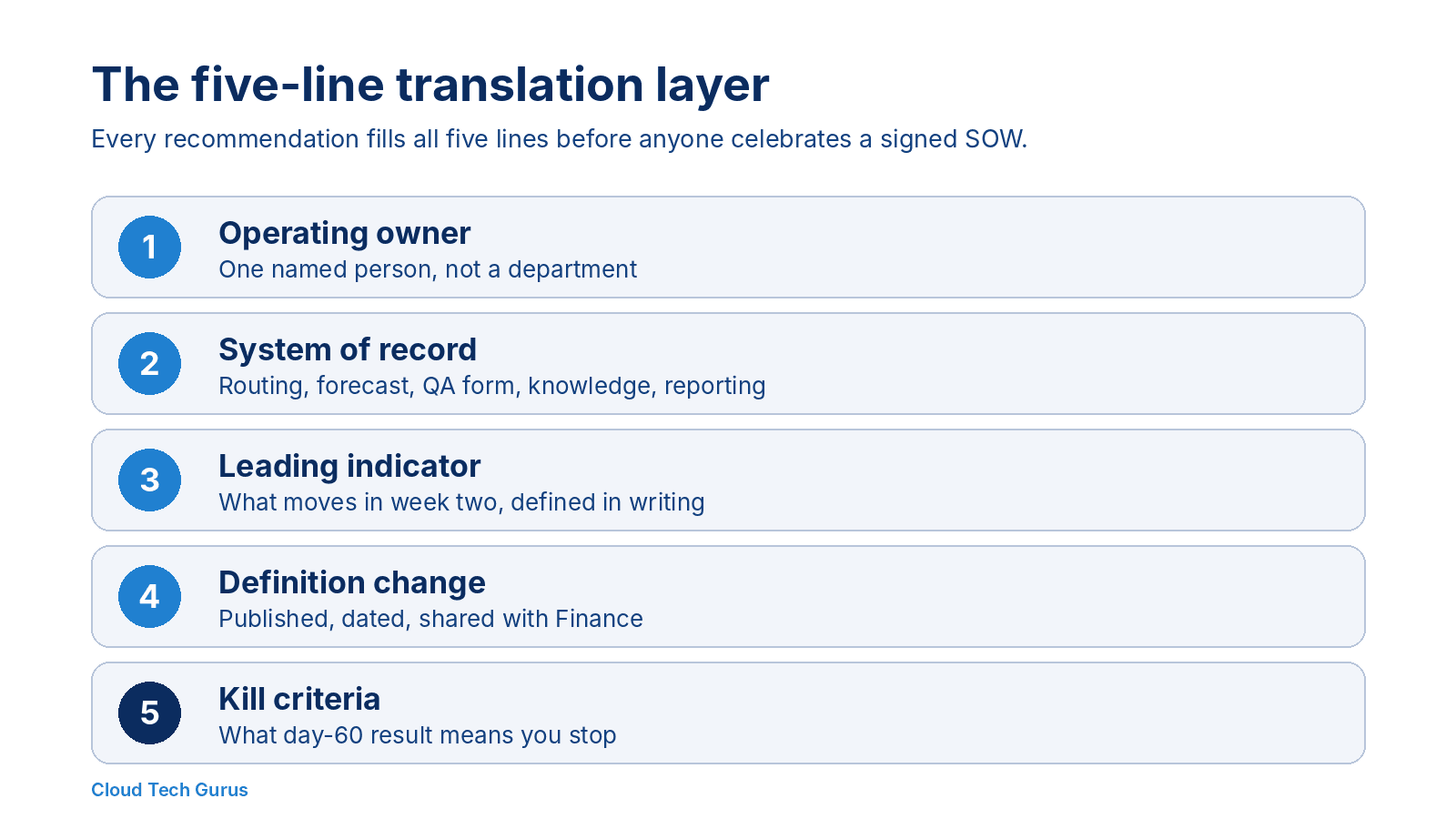
1. The operating owner. Not “Operations.” A named person with authority over the system that has to change. If two names appear, you have an escalation path, not an owner.
2. The system of record that changes. Every real recommendation touches at least one: routing config, the forecast model, the QA form, the knowledge base, or the reporting layer. If you can’t name the system, the recommendation is still an idea.
3. The leading indicator, defined in writing. Not the outcome metric. The thing that moves in week two. “Deflect tier-1 volume” is a quarterly outcome. “Containment rate on the top five intents, measured off the new disposition codes, published Fridays” is something you can steer. This is contact center KPI design, and it is not optional.
4. The definition change, published. Programs often get graded on a metric that quietly changed mid-flight. Write the new definition down, date it, and tell Finance before they build a variance story around the old one.
5. The kill criteria. What result at day 60 means you stop? An operating model that can only say yes is a compliance exercise. Good ones kill weak recommendations fast and cheap, which is the point of piloting.
What does this look like for a real recommendation?
Take a common one: “deflect tier-1 contacts to self-service.” One sentence on a slide. Five owners in reality.
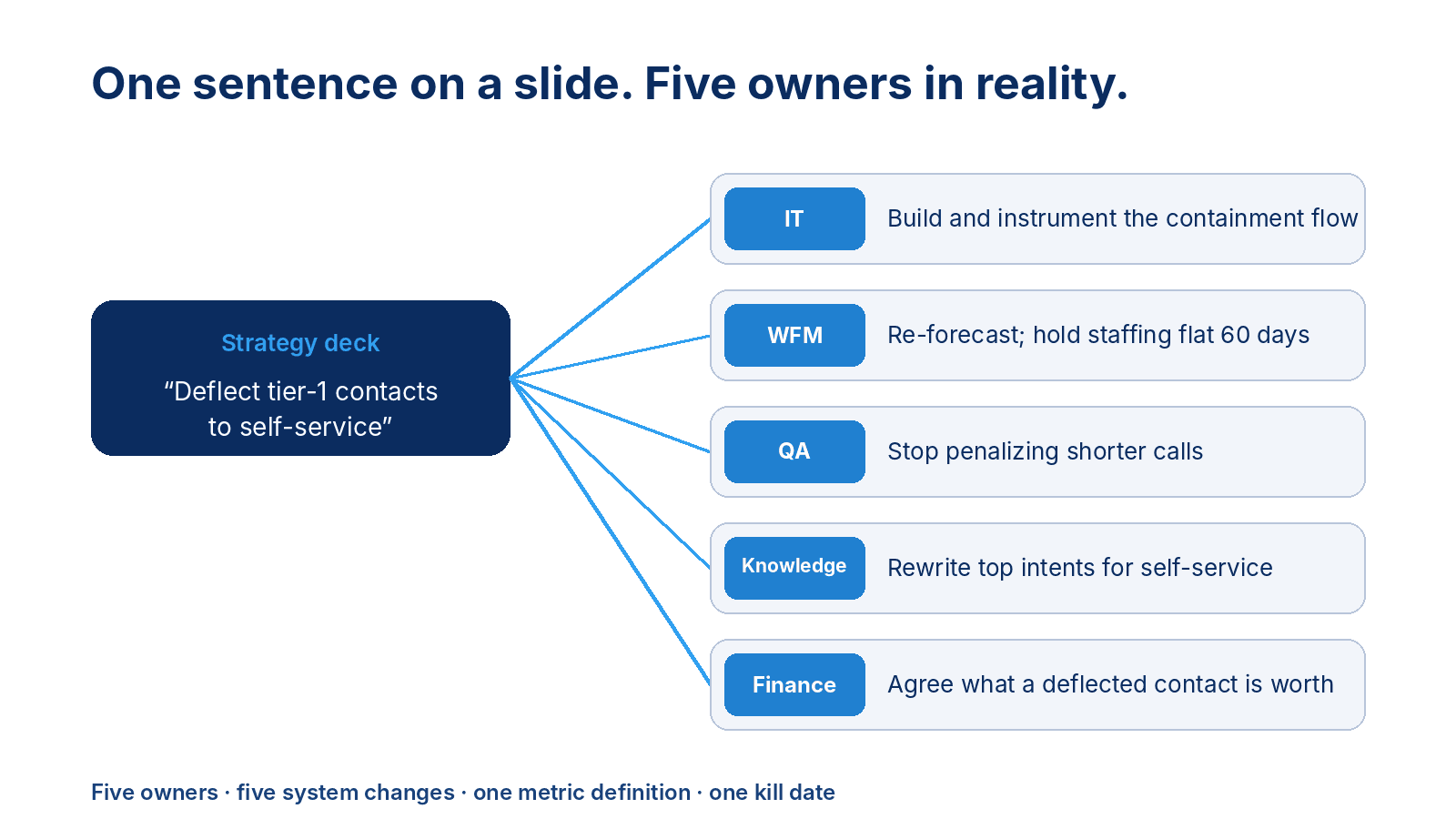
- IT: build or configure the containment flow, instrument the handoff, and expose the events to reporting.
- WFM: re-forecast with a deflection assumption, and hold the staffing plan flat for 60 days so the result is readable.
- QA: stop penalizing agents for shorter calls on the deflected intents, since AHT mix just shifted underneath the form.
- Knowledge: rewrite the top intents for self-service reading level, not agent reading level.
- Finance: agree in advance what a deflected contact is worth, before the savings case gets argued backward from the invoice.
Five owners, five system changes, one metric definition, one kill date. That is the work.
Should you build a new forum or use the meeting you already have?
Start with the meeting you have. The failure mode we see most is a new steering committee, a new deck template, and a new PMO tracker: net-new overhead competing with the work. Both paths carry a real tradeoff.
| Path | Strength | Tradeoff |
|---|---|---|
| Use the weekly ops review | Fast, low overhead, inherits the credibility of a meeting people already attend | Cross-functional items get squeezed if the ops leader running it does not hold the floor for them |
| Stand up a dedicated forum | Better for programs touching four or more functions, or anything with capital attached | Becomes a status meeting within a quarter unless an executive sponsor attends every session |
Our recommendation: add a standing five-minute segment to the weekly ops review where each open recommendation reports leading indicator, blocker, and owner. Anything without a named owner gets closed, not carried. Earn the dedicated forum only when a program provably outgrows the cadence. Most never do.
How do you choose a CX consulting partner?
Ask one question: who executes the day after you present? The answer is almost always your team, and that is fine. Your team knows the routing config, the forecast model, and the QA form better than any outside firm ever will. The problem is being handed a recommendation they cannot act on without six weeks of reverse-engineering what the consultant meant.
So the better question is: will your team be able to run this without us in the room? That is the test we build for. Ask any prospective advisor how they would split the work:
| A partner does | Your team does |
|---|---|
| Builds the translation layer with your system owners | Executes the system changes |
| Writes recommendations in ops language, not outcome language | Runs the weekly cadence |
| Pressure-tests the leading indicator and metric definition | Publishes the numbers |
| Sources and shortlists technology on an auditable rubric | Makes the buy decision |
| Sets kill criteria before the pilot starts | Calls the kill |
Frequently asked questions
What is a CX operating model?
A CX operating model is the layer that converts consulting recommendations into named owners, specific system-of-record changes, and weekly leading indicators. It sits between CX strategy and daily contact center operations, so a recommendation becomes work someone can schedule, configure, measure, and stop if it fails.
Why do CX transformation programs fail?
Most fail in translation, not design. Recommendations are written in outcome language, while operations run on routing configuration, forecast assumptions, QA form weighting, and metric definitions. Without an assigned owner for each translation, the work stalls between WFM, IT, QA, and Finance, each waiting on the others.
Who should own a CX recommendation?
A single named person with authority over the system that has to change, not a department. If two names appear, you have an escalation path rather than an owner. The owner must be able to edit the routing, forecast, QA form, knowledge base, or report without asking permission.
What is the difference between a CX strategy consultant and a contact center transformation partner?
A strategy consultant delivers the recommendation and leaves interpretation to you. A transformation partner delivers it already decomposed, with owner, system of record, leading indicator, metric definition, and kill criteria. Neither staffs your operation. The difference is whether the handoff is runnable on day one.
How do you keep vendor recommendations neutral?
Set scoring criteria and weightings in writing before vendors are shortlisted, share the rubric with the buyer, and disclose the advisor’s commission position on every recommended supplier. Neutrality you can audit beats neutrality you are asked to trust, and it lets your finance and procurement teams check the work.
Where CTG fits
CTG is a vendor-neutral, practitioner-led CX consulting and contact center transformation partner. We don’t staff your operation. We make sure the recommendation arrives in the language your operation already runs on, with the owner, system of record, leading indicator, metric definition, and kill date filled in before we leave.
When technology is part of the answer, we source it through a vendor evaluation rubric: criteria and weightings set in writing before vendors are shortlisted, and our commission position on every recommended supplier disclosed up front. You can audit both.
We didn’t study contact centers. We ran them. That’s why our recommendations name the queue, the form, and the person, not just the outcome. Execution stays yours. It just stops being a translation exercise.
Talk to a Guru →