Let’s be direct: omnichannel is one of the most overused and misunderstood terms in the contact center world. It’s not about just being available on more channels—that’s multichannel, and frankly, that often creates more problems than it solves.
A true omnichannel customer experience treats every customer interaction as a single, continuous conversation, no matter where it happens. The entire history and context follow the customer from a chatbot, to an email, to a live phone call. They never have to repeat themselves.

Why This Distinction Matters
The push for a true omnichannel customer experience accelerated when businesses realized that customers don't think in channels. They think in journeys, and they expect you to keep up.
This isn’t a new idea, but the adoption rate tells the story. Back in 2012, only 20% of companies were focused on omnichannel strategies. By 2026, that number is expected to hit 80%. Why the shift? The results became impossible to ignore.
Companies that get omnichannel right retain 89% of their customers. Those with disconnected, siloed channels? They only keep 33%. That’s a 56-percentage-point gap in customer retention that hits the bottom line, hard.
An omnichannel model is built on a simple premise: a customer’s context should follow them. Whether they start on a chatbot, move to email, and then call your contact center, the agent who answers the phone must have the entire interaction history instantly available. Without that shared context, you're not delivering an omnichannel experience—you're just running a very expensive multichannel operation.
Omnichannel vs Multichannel Operations
For a contact center leader, the difference between these two approaches isn't just semantics—it defines your entire operational reality, from the tech you buy to the experience your agents and customers have. Here’s a breakdown of what that looks like on the ground.
| Operational Aspect | Multichannel Approach | Omnichannel Approach |
|---|---|---|
| Technology Stack | Disconnected, siloed systems for each channel (e.g., separate chat, email, and phone platforms). | A single, unified platform (CCaaS) that consolidates all channels and shares data. |
| Customer Journey | Fragmented. The customer has to start over on each new channel, repeating their issue and information. | Continuous. The conversation picks up where it left off, with full context passed between channels. |
| Agent Experience | High effort. Agents toggle between multiple screens and lack a complete view of the customer's history. | Efficient. Agents see the full, unified customer journey in a single interface, enabling faster resolution. |
| Data & Reporting | Siloed. Metrics are tracked per channel, making it impossible to see the end-to-end customer journey. | Unified. Reporting provides a holistic view of customer behavior, journey analytics, and agent performance across all channels. |
| Primary Goal | Channel presence. Being available on as many channels as possible. | Journey continuity. Delivering a single, consistent, and effortless experience for the customer. |
In short, a multichannel setup throws more channels at the problem, while an omnichannel strategy connects them intelligently to solve it. The latter is an architectural challenge, but the payoff is substantial.
This unified approach delivers clear, measurable wins for your operation:
- It eliminates repetition. Customers dislike repeating themselves. When context follows them, this major source of frustration—and poor CSAT scores—disappears.
- It improves agent efficiency. With the full story in front of them, agents resolve issues faster. This directly lowers your Average Handle Time (AHT) and cost-per-contact.
- It ensures consistency. The answer a customer gets is the same, whether it comes from an IVA, a knowledge base, or a live agent, because everyone is working from a single source of truth.
At Cloud Tech Gurus, we’ve put in over 4,000 hours of vendor evaluation and can confirm that achieving this is an architectural challenge, not a channel-specific one. It demands a technology foundation built from the ground up for data unification—a topic we’ll address next.
The Real Business Impact of an Omnichannel Strategy

It's easy to talk about unified customer journeys, but for any operations leader, the real conversation starts and ends with the P&L. How does an omnichannel strategy actually show up on the balance sheet? The impact is direct, measurable, and it hits the core metrics that define whether a contact center is an asset or a liability.
It goes beyond just being convenient for the customer. A true omnichannel approach is a significant factor in reducing repeat calls, which are a massive driver of operational cost. When an agent sees the entire history—the abandoned cart, the chatbot conversation from last night, the email from last week—they solve the problem on the first try. That’s a direct, measurable improvement in First Contact Resolution (FCR).
This isn't a small thing. Better FCR creates a positive effect across all your other KPIs. Agents with full context don't waste time asking customers to repeat their history. As a result, Average Handle Time (AHT) drops, letting your team handle more volume without you having to hire more people. This isn't about rushing agents; it's about removing friction from the interaction.
Connecting Operational Wins to Executive Priorities
This is how you build a business case that gets a "yes." Lower AHT and higher FCR directly cut your cost per contact, a metric that speaks directly to the CFO. But the wins don’t stop at cost savings. This is where the story gets compelling for the C-suite.
The numbers don't lie. Companies with strong, connected omnichannel strategies see a 9.5% year-over-year increase in annual revenue. Now, compare that to the 3.4% increase for companies with siloed, multichannel setups. You can learn more about these omnichannel shopping statistics to see how that 6.1-percentage-point difference expands over time.
It's not just a one-time revenue bump, either. Customers who interact with a brand across multiple, connected channels are simply more valuable. The lifetime value of shoppers who buy both online and in-store is a full 30% higher than customers who stick to a single channel.
A well-executed omnichannel strategy fundamentally changes the economic model of your contact center. It shifts the focus from a pure cost center to a value-creation engine that directly contributes to revenue growth and customer retention. It’s the language executives understand and the results they expect.
The Foundation for Realizing Gains
Let's be clear: these benefits are not automatic. You don’t just buy a tool and watch the revenue appear. These results are completely dependent on having the right technology architecture underneath it all.
Our 4,000+ hours of vendor evaluation have shown us one thing over and over: trying to stitch together a dozen disconnected, multichannel systems will fail. Every single time. You won't get the business outcomes you're looking for.
Achieving real omnichannel results requires a platform built from the ground up for data unification. Without a shared data layer and a single pane of glass for your agents, context gets lost, efficiency drops, and the whole business case you just built crumbles. The strategy only works when the tech can actually deliver it. This is why a vendor-neutral evaluation focused on architectural integrity—not just a checklist of features—is the most critical first step to realizing the business impact of your what is omnichannel customer experience initiative.
The Core Technology Stack for Your Contact Center
Let's cut through the marketing noise. Building a tech stack that actually works is one of the toughest jobs a contact center leader has. A true omnichannel customer experience isn’t something you buy in a box; it’s an architecture where different systems talk to each other, sharing data and context instantly. The goal is real integration, not just a bunch of expensive tools coexisting on a diagram.
After assessing over 1,000+ vendors across 58 solution categories, we've seen one thing prove true time and again: a vendor's ability to integrate with other systems is far more important than any standalone feature. Your technology has to communicate. If a customer's journey information doesn't flow between systems, you're not running an omnichannel operation—you're just running a disconnected and very expensive multichannel one.
The CCaaS Platform as Your Operational Hub
The foundation of any modern stack is a solid Contact Center as a Service (CCaaS) platform. Think of it as the central nervous system for your entire operation. This is the hub that takes in every customer interaction—voice, email, chat, SMS, social media—and manages them all in one place.
A proper CCaaS solution handles the core routing, queuing, and reporting for every channel. It's what lets an agent see a customer's previous chat transcript while they're on a live phone call. When you’re looking at CCaaS vendors, your main focus should be on how open their APIs are and their track record for integrating with the other critical pieces of your stack.
Essential Integrated Systems
Beyond the CCaaS hub, several other systems need to be woven in tightly to make a true omnichannel strategy work. These aren't just nice-to-have add-ons; they are essential for creating that single, continuous customer journey. Each one plays a specific part in grabbing, sharing, or acting on customer context.
These key systems include:
- Customer Relationship Management (CRM): This is your system of record, the single source of truth for who your customers are and their history with you. A deep, two-way integration lets the CCaaS pull customer data to personalize an interaction and then push interaction data back into the CRM, making the customer profile even richer.
- Workforce Management (WFM): Forecasting and scheduling get a lot more complicated in an omnichannel world. An integrated WFM system pulls data from all channels to accurately predict volume. This ensures you have agents with the right skills working at the right times, no matter which channel gets busy.
- Journey Analytics: These tools give you a map of the entire customer journey, showing you exactly where people are getting stuck or dropping off. You can't fix friction points you can't see, and this insight is critical for making continuous improvements.
To build a robust core, many are turning to customer data platforms (CDPs) to unify customer information across every touchpoint, which is foundational for an omnichannel approach. These platforms are built specifically to create a persistent, unified customer database that all your other systems can tap into.
The ultimate test of your technology stack is simple: can an agent, in a single interface, see the full context of a customer's interactions across every channel without having to switch screens or applications? If the answer is no, your stack is not truly omnichannel.
The Single Source of Truth for Agents and AI
Two final pieces are non-negotiable for both agent effectiveness and successful automation: Knowledge Management and Intelligent Virtual Agents (IVAs). An integrated Knowledge Management (KM) system acts as the single source of truth, feeding consistent, accurate information to both your human agents and your automated systems. This makes sure a customer gets the same answer whether they're talking to a chatbot or a person.
Intelligent Virtual Agents (IVAs), or chatbots, are there to handle the routine questions and tasks, which frees up your agents to tackle more complex problems. But for IVAs to be effective, they have to be fully integrated into the CCaaS platform. This allows for a smooth handoff to a live agent—with the full transcript and context of the bot conversation passed along—so the customer never has to repeat themselves. For a deeper look into the necessary architecture, our guide on omnichannel contact center solutions provides a framework for evaluating vendor capabilities.
Preparing Your Operations for AI and Automation
Let’s be clear: bolting AI onto your contact center isn't about chasing the latest technology trend. For any seasoned leader, the real goal is to use these tools to fix the persistent problems that reduce efficiency and drive up costs. The point is to make smart, targeted improvements—not to rip and replace everything just for the sake of "modernization."
But here’s the hard truth: without a true omnichannel architecture, your AI strategy is dead on arrival.
A unified data layer isn’t just a nice-to-have; it's the absolute foundation. Without it, your expensive AI tools are flying blind, stuck in the same operational silos you’re trying to eliminate. They can't see the full customer journey, so they can't be intelligent. And an unintelligent AI is just another expensive, failed project.
From Siloed Data to Actionable Intelligence
The first, most practical place to put AI to work is journey analytics. Modern AI tools can process millions of cross-channel interactions to show you exactly where customers are getting stuck. They spot patterns a team of human analysts would take months to find—or miss entirely.
Think about identifying a single, broken webpage that generates thousands of otherwise avoidable chats. That's the kind of insight we're talking about.
This isn’t about generating more dashboards. It's about getting a diagnosis. The AI doesn't just tell you there's a problem; it pinpoints the cause so you can fix the source of the issue, not just throw more agents at the symptom.
An omnichannel platform is the only way to feed AI the complete, contextualized data it needs to actually work. When your AI can see everything—from the first web visit to the follow-up email—it can finally start giving you predictive and prescriptive insights instead of just reporting on what already happened.
The diagram below shows how a CCaaS platform acts as the central nervous system, allowing all your core systems to share data. This is what enables effective AI.
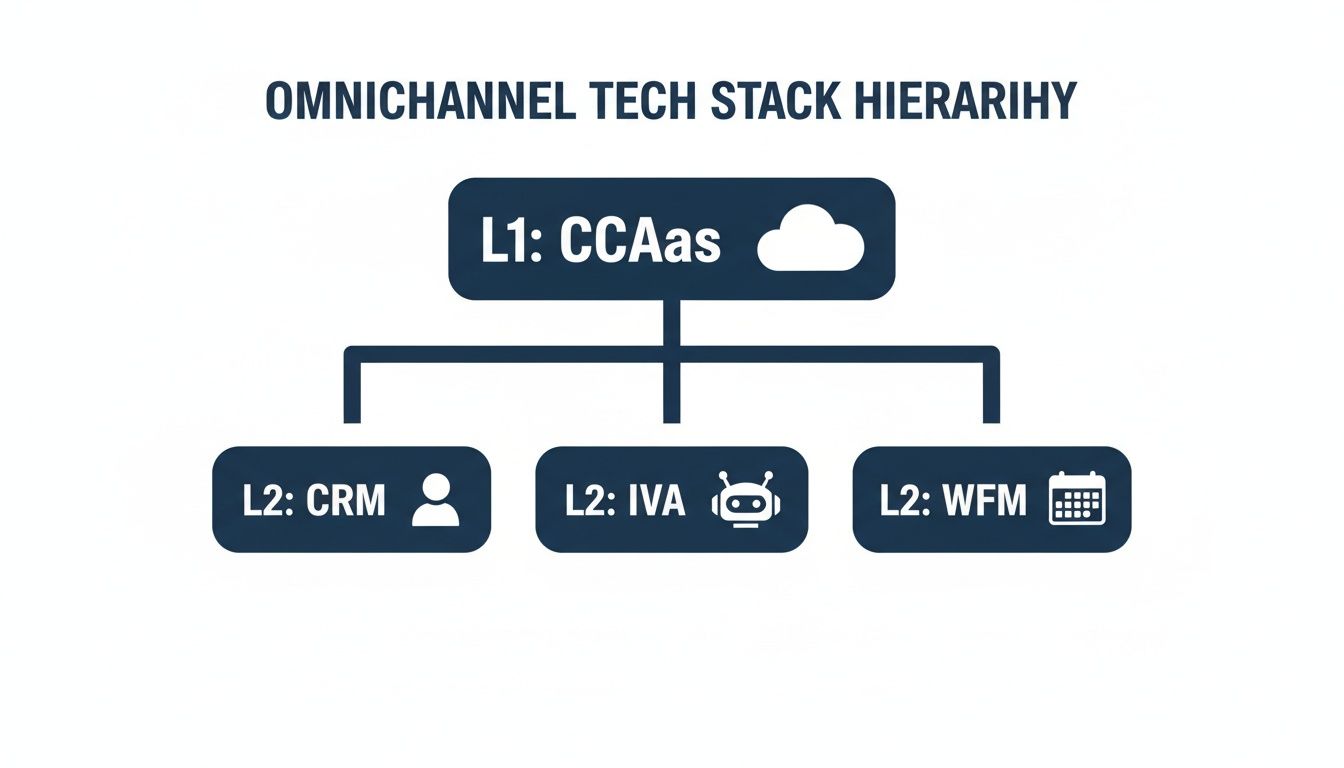
This structure makes it obvious: without that central CCaaS hub connecting the CRM, IVA, and WFM, any AI initiative will fail because it lacks the complete picture.
Practical AI Use Cases in an Omnichannel Environment
Once your data foundation is solid, you can start deploying AI to solve real operational headaches. The focus should always be on two things: automating repetitive work away from your agents or giving them enhanced support in real time.
Here are three high-impact applications that actually move the needle:
Intelligent Virtual Agents (IVAs): Use IVAs for the routine, high-volume stuff—order status checks, password resets, appointment scheduling. But the key is that these IVAs must be fully integrated. When a customer needs a human, the handoff has to be smooth, with the full context of the conversation passed to the live agent. No more making customers repeat themselves.
Agent-Assist AI: This is an important tool. During a live call or chat, an AI assistant listens in and pushes relevant information to the agent's screen instantly. It can pull up the right knowledge base article, summarize the customer's history, or suggest the next best action. This drastically cuts down on agent stress and makes them faster and more accurate. You can learn more about this in our guide to automating customer support with generative AI.
Predictive Routing: Forget routing to the "next available agent." AI can do better. It can instantly analyze the customer's history, the reason for their contact, and their sentiment, then route them to the specific agent best equipped to solve their problem based on skills, experience, and past performance.
Getting ready for AI has less to do with buying new software and everything to do with getting your data architecture right first. If you build that unified omnichannel foundation, you guarantee that your investments in automation will deliver real, measurable results instead of just becoming another underperforming tool in your stack.
Building Your Omnichannel Implementation Roadmap
Making the move from a siloed multichannel setup to a genuinely omnichannel framework is a significant project. It's not about buying new software. It’s a deliberate, phased project designed to transform your operation without causing major disruptions. Trying to do it all at once—a "big-bang" launch—is a recipe for chaos.
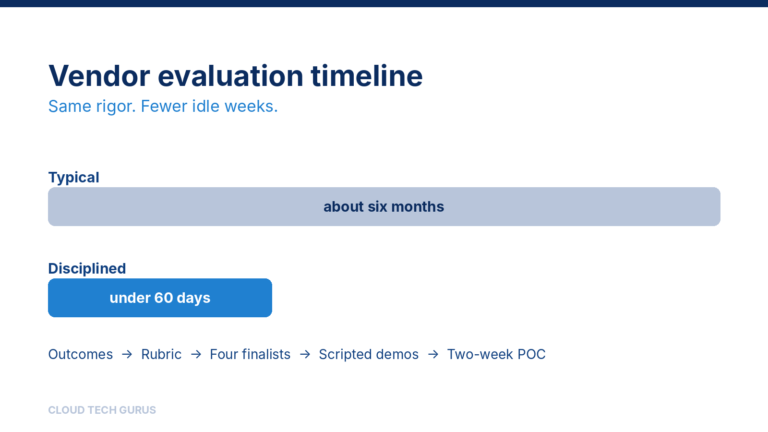
We’ve guided enterprise clients through this shift, and one thing is crystal clear: a structured roadmap is the single biggest predictor of success. The clients who follow a disciplined, vendor-neutral process like this one make their technology decisions up to 70% faster than the industry average. Why? Because it eliminates ambiguity and gets the whole team focused on clear, sequential goals. It’s about de-risking your investment and making sure the final system actually fits how you work.
Phase 1: Audit and Assess the Current State
You can't draw a map to your destination if you don't know where you're starting from. The first phase is a direct, honest audit of your current channels, customer journeys, and the technology holding you back. The goal here is to create a data-backed baseline of your performance and pinpoint every single point of friction for your customers.
This means getting into the details:
- Journey Mapping: Follow your customers. Document your most common and highest-volume journeys from the moment they first contact you to the final resolution. Find exactly where context gets dropped and customers are forced to repeat themselves.
- Technology Gap Analysis: Take inventory of everything you have—CCaaS, CRM, WFM, all of it. Where are the data silos? Which platforms have closed APIs that prevent them from talking to each other? Be thorough here.
- Performance Benchmarking: Collect your baseline numbers. What is your FCR, AHT, and CSAT for every single channel right now? You will need this data later to prove the transformation worked.
This audit gives you the "why" for the entire project. The friction you uncover becomes the business case. It directly links the investment to real, tangible improvements you can measure.
Phase 2: Define and Design the Future State
Now that you have a clear picture of the problems, you can start designing the solution. This is not a tech-first exercise; it’s an operational one. You need to define what the ideal omnichannel customer experience looks like for your business, and only then figure out the tech and processes to make it happen.
This is the most important strategic step. You have to fight the urge to jump straight into vendor demos. A detailed future-state blueprint means you walk into those conversations leading with your requirements, not reacting to their sales pitch.
This blueprint should map out new cross-channel workflows, show exactly how data needs to flow between systems, and lock in the KPIs you'll use to measure success. It also forces you to think about changes to agent roles and what new training they'll need. This is where you lay the groundwork for a change management plan that actually works.
Phase 3: Evaluate Vendors and Pilot the Solution
Armed with your future-state requirements, you can finally start looking at vendors. But now, it’s a structured, efficient process. Because you know exactly what you need, you can disqualify vendors who can’t meet your core architectural and integration needs in minutes. This avoids months of being bogged down in feature-by-feature comparisons that don't solve your main problems.
Once you’ve picked a primary vendor, don’t go all-in. Start with a small, controlled pilot program.
A successful pilot needs a few key things:
- Target a specific customer segment: Pick one journey or customer type to test the new workflow. Don't try to address everything at once.
- Select a dedicated agent group: Use a small team of agents who can give you detailed, honest feedback.
- Measure against your baseline: Track the pilot group's performance and compare it directly to the benchmark data you collected back in Phase 1.
The pilot proves that your technology choice and your new operational design work in the real world. It lets you find and fix issues on a small scale before you commit to a full-scale launch. If you want to dive deeper into this framework, our guide on enterprise roadmap consulting breaks this process down even further. From there, the final phase is about a full rollout, establishing clear governance, and continuously optimizing for the long haul.
Common Omnichannel Pitfalls and How to Avoid Them
Moving to an omnichannel model sounds great in a presentation, but it’s a minefield in practice. We’ve guided hundreds of contact centers through this shift, and I can tell you that even the sharpest leaders stumble into the same predictable traps.
Knowing what these pitfalls are ahead of time is half the battle. Here are the four biggest mistakes we see that can completely sink your strategy, and more importantly, how to sidestep them.
Confusing Multichannel Investment with Omnichannel Strategy
This is the most common and costly mistake, by far. Leaders buy new tools for chat, SMS, and social media, check the "omnichannel" box, and then wonder why customers are still frustrated and agents are burning out.
Adding more disconnected channels just creates more problems. It doesn't solve the core issue: customers having to repeat their story every time they switch from an email to a phone call.
A real omnichannel strategy isn't about how many channels you have; it's about how they talk to each other. Before you sign another software contract, the only question that matters is: how will this new channel share data and context with all my existing channels in real time? If there isn't a clear answer, you're not buying a solution—you're buying another silo.
Underestimating Process Redesign and Agent Retraining
The technology is just the beginning. A unified platform is useless if you drop it on top of an old, siloed operating model. You can't expect your team to work in a new way if you don't redesign the workflows to support it.
Agents who have spent their careers mastering a single channel can't just start juggling concurrent chats, emails, and calls overnight. They need new skills, new training on the unified agent desktop, and a new understanding of how to use a customer's complete history to solve problems faster.
A successful omnichannel transformation is 20% technology and 80% people and process. Skimping on change management and training is the fastest way to guarantee your expensive new software becomes underutilized.
To get this right, you have to bake training and process redesign into your plan from day one. Get your agents involved. They’re the ones on the front lines, and they’ll see the practical gaps in your plan long before an executive does. Their insights are invaluable.
Prioritizing Features Over Integration Capabilities
It's incredibly easy to be impressed by a demo with a long list of features. But after analyzing over 1,000+ vendors, we can tell you with certainty: the single biggest predictor of success is the platform’s ability to integrate with your other systems.
An open architecture with well-documented APIs isn't a "nice-to-have"; it's the price of entry. Your CCaaS platform has to connect cleanly with your CRM, your WFM software, and any other tool that holds customer data. If it can't, you'll never achieve a single view of the customer.
When you're talking to vendors, flip the script. Don't let them lead with a feature checklist. Lead with architectural questions and build your scorecard around the answers:
- API Openness and Documentation: How easy is it for our developers to actually use your APIs? Is the documentation clear and complete?
- Pre-built Integrations: Show us your existing, live integrations with our key systems, especially our CRM.
- Data Consistency: How, specifically, does your platform create and maintain a single, persistent customer record across every interaction and system?
Focusing on these core capabilities ensures you end up with a partner who can deliver a truly unified what is omnichannel customer experience, not just another collection of disconnected tools.
Your Omnichannel Questions, Answered
When we talk to leaders about making the move to omnichannel, the same tough questions always come up. Here are the straight answers from people who have actually run these projects.
What’s the Very First Step to Move from Multichannel to Omnichannel?
Everyone wants to jump straight to the technology. That’s a mistake. The real first step has nothing to do with buying software. It’s all about the journey audit.
Before you even think about looking at a vendor demo, you need to map your most common customer journeys, channel by channel. Pinpoint exactly where the conversation breaks, where context gets lost, and where customers are forced to repeat their story. This is where the pain is.
That audit gives you two things you absolutely need: a rock-solid, data-driven business case for the investment, and a clear blueprint showing you which broken connections to fix first. Don't start by looking for a solution. Start by understanding the problem you're actually trying to solve.
How Do You Actually Measure the ROI of an Omnichannel Strategy?
Trying to justify an omnichannel project on a single metric will get your budget request denied. You need to build a complete ROI story that shows value to operations, the C-suite, and your own team.
Focus your KPIs across these three areas:
- Operational Wins: This is about efficiency. You should see a clear drop in Average Handle Time (AHT) and a significant increase in First Contact Resolution (FCR). These aren't just numbers on a dashboard; they're the direct result of giving agents the full story so they can solve problems faster.
- Business Impact: Now, tie that efficiency to the bottom line. Track the improvements in Customer Lifetime Value (CLV) and customer retention rates. This is how you prove your contact center isn't a cost center—it's a revenue driver.
- Agent Experience: Don't forget your people. Keep a close eye on agent satisfaction scores and turnover. A unified system that just works cuts down on agent frustration, which means they’ll stay longer. That directly lowers your recruiting and training costs.
The real return isn't just one of these; it's the combined effect of all three.
An omnichannel strategy should never be sold on cost savings alone. Its true value comes from creating more efficient agents, more loyal customers, and a more stable, experienced workforce. This is a holistic business upgrade, not just a simple contact center project.
Can Omnichannel Even Work in a Highly Regulated Industry?
Yes. In fact, for industries like finance or healthcare, it's almost a necessity for staying compliant. A true omnichannel customer experience platform is beneficial when it comes to managing risk.
Think about it. Instead of trying to bolt on compliance and security rules across a dozen different siloed channel solutions, a unified platform centralizes everything. Every single interaction—whether it’s a call, chat, or email—is secured, logged, and audited against regulations like HIPAA or PCI DSS from a single point of control.
This consolidation actually reduces your risk profile by creating one auditable system of record for every customer conversation. It makes compliance simpler, not harder.
Cloud Tech Gurus provides vendor-neutral, practitioner-led consulting for contact center and CX leaders. Learn more at cloudtechgurus.com.