Imagine a customer conversation that never breaks, no matter how they contact you. That’s the core promise of omnichannel contact center solutions. As a CX leader, you know the frustration of disjointed interactions. These solutions stitch every customer touchpoint—voice, email, chat, social media, and SMS—into a single, continuous dialogue that follows the customer, empowering your team and delighting your users.
What Are Omnichannel Contact Center Solutions?
At its heart, an omnichannel contact center solution is a platform that integrates all your communication channels into one system. It creates a seamless conversation thread, giving your agents a complete, chronological view of the customer's entire history. The goal is to eliminate the single most frustrating part of customer service: forcing customers to repeat themselves every time they switch channels.
To fully grasp its value, let's contrast it with the more common multichannel approach.
Multichannel vs. Omnichannel: The Critical Difference
The distinction is crucial for any CX leader. Multichannel gives customers options, but omnichannel gives them a unified experience. This table breaks down the fundamental shift in strategy.
| Feature | Multichannel Approach | Omnichannel Approach |
|---|---|---|
| Channel Experience | Channels operate in silos. The chat agent has no idea what the email agent said. | All channels are connected. The experience is seamless across touchpoints. |
| Customer Journey | Disconnected. Each new channel starts a new, separate conversation. | Continuous. The conversation picks up where it left off, regardless of channel. |
| Agent View | Fragmented. Agents only see the interaction on their specific channel. | Unified. Agents see the full customer history across all channels in one place. |
| Core Focus | Being available on multiple channels. | Creating a single, unified customer experience. |
While a multichannel setup is a necessary first step, it still creates the operational headaches and customer friction that a true omnichannel strategy is designed to solve.
Expert Insight: Think of it this way: a multichannel approach is like talking to different clerks in separate departments of a store. The shoe department has no idea you just spoke with someone in electronics. You start over every single time.
An omnichannel approach is like having a dedicated personal shopper who stays with you. They know what you looked at online last night, the email you sent this morning, and the chat you just had on the app.
This shift isn't just a technical upgrade; it's a fundamental change in how you view and manage customer relationships.
Why a Unified View Is Critical for CX Leaders
For anyone leading a CX team, the "why" behind this is simple: breaking down communication silos leads directly to a better customer experience and massive operational wins. When agents have the full context, they deliver faster, smarter, and more empathetic support.
It's also where the market is headed. The global contact center software market, fueled by the demand for these unified solutions, is seeing explosive growth. Valued at $34.1 billion in 2023, it’s projected to hit $150.7 billion by 2030. That’s not just a trend; it's a clear signal that disconnected experiences are no longer acceptable.
The real-world benefits for your team and your customers are impossible to ignore:
- Eliminating Repetition: Customers don't have to re-explain their issue for the third time, a major driver of churn and frustration.
- Empowering Agents: With the full story, agents feel more confident and equipped to solve problems instead of just gathering information.
- Enabling Proactive Support: A complete view of past interactions allows agents to spot patterns, anticipate needs, and offer solutions before the customer even asks.
- Boosting Efficiency: Agents spend less time hunting for information across different systems and more time resolving issues, driving down handle times.
Ultimately, omnichannel solutions turn the contact center from a series of disjointed transactions into a fluid, ongoing relationship. For a deeper dive into how AI supercharges these systems, our article on Omnichannel AI Customer Support breaks it down. Building this cohesive foundation is no longer optional for building loyalty in a competitive market.
The Core Components of an Omnichannel Architecture
To deliver that seamless customer journey, you need an architecture where every piece of technology works together. An effective omnichannel contact center isn't a single piece of software you buy and turn on; it's a carefully assembled ecosystem. Let's look under the hood at the essential components that make this unified experience possible.
This concept map shows how different customer touchpoints—like a phone call, a web chat, or a social media message—all trace back to one central customer profile.
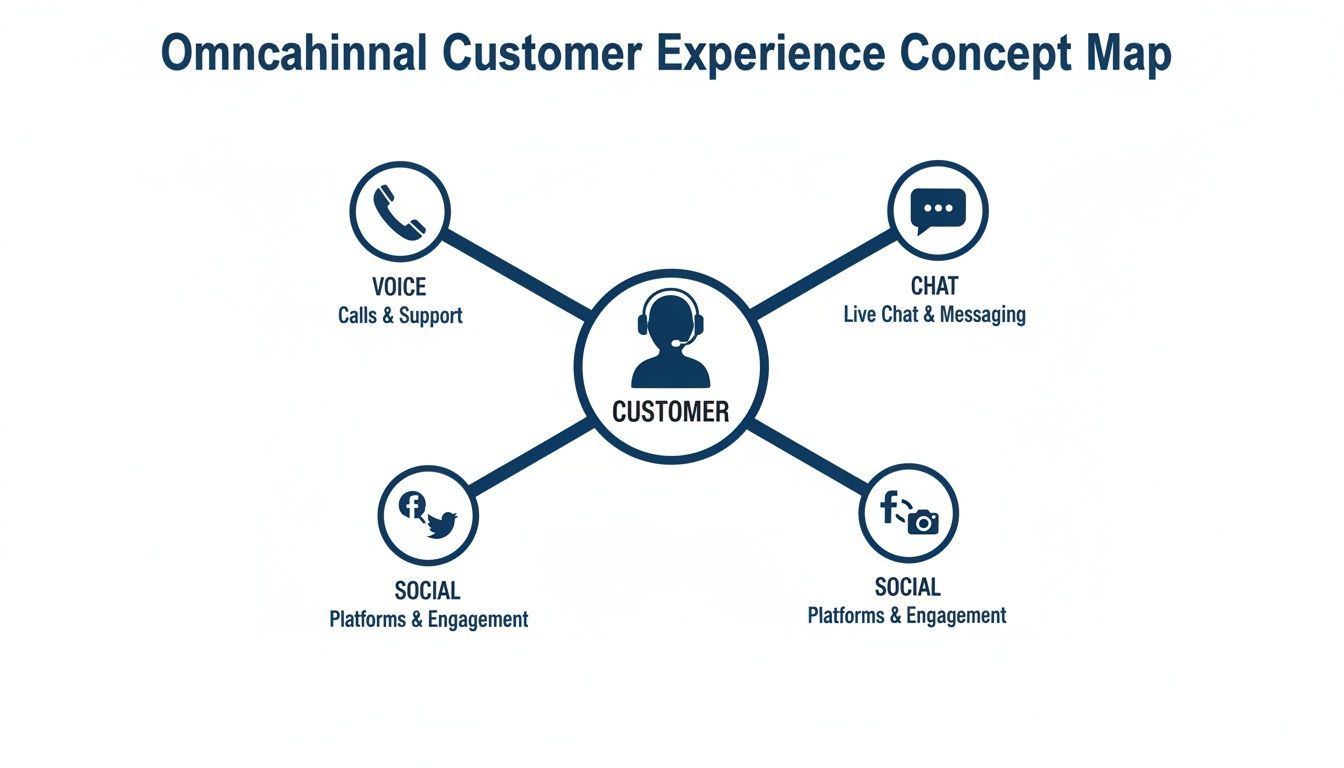
The image makes it clear: no matter how a customer reaches out, their interaction should feed into the same system, creating a single, continuous conversation.
The Central Nervous System: Your CCaaS Platform
At the heart of any modern setup is the Contact Center as a Service (CCaaS) platform. Think of it as the central nervous system for your entire customer service operation. It's the cloud-based foundation that manages, routes, and reports on every interaction, regardless of the channel.
This engine is driving the massive shift to omnichannel. The global CCaaS market was valued at $5.4 billion in 2022 and is expected to rocket to $23.9 billion by 2030. That's not just hype; it reflects how critical these platforms are for unifying customer conversations. You can dig into the data and see how CCaaS is enabling this shift by reviewing the latest market statistics.
A solid CCaaS platform gives you the flexibility to add new channels or plug in other critical systems without needing a massive, budget-busting IT project.
Universal Queue and Intelligent Routing
If the CCaaS platform is the nervous system, then the Universal Queue is the intelligent brain directing all the traffic. It pulls in every incoming interaction—calls, emails, chats, social DMs, and texts—and places them into a single, prioritized line. This is a fundamental break from the old world of siloed, channel-specific queues.
The Universal Queue doesn't just line things up. It makes strategic decisions. It uses business rules and AI to route work based on agent skill, availability, customer value, and the conversation's history.
For example, a VIP customer sends you a message on social media. The universal queue can identify them, see they spoke with Agent Sarah yesterday by phone, and automatically route the new message right back to her. The customer gets to skip the line and talk to someone who already knows their story.
The Unified Agent Desktop
For your team on the front lines, the Unified Agent Desktop is where the real magic happens. It’s that "single pane of glass" you've heard about, giving agents all the information and tools they need in one clean interface. No more flipping between five different apps just to answer one question.
A proper unified desktop pulls everything together:
- Customer Interaction History: A complete, chronological log of every conversation across every channel.
- CRM Data: Integrated customer profiles, past purchases, and other vital context.
- Communication Controls: Tools to handle calls, chats, and emails without ever leaving the screen.
This consolidated view empowers agents to deliver support that’s context-aware. It dramatically cuts down handle times and makes First Contact Resolution (FCR) an achievable goal, not just a metric on a report.
Deep CRM Integration
Finally, deep integration with your Customer Relationship Management (CRM) system is completely non-negotiable. While the CCaaS platform manages the flow of interactions, the CRM is the system of record—the source of truth for the customer relationship.
This integration is what turns a simple interaction into a truly personal experience. When a call or chat comes in, the agent’s screen should instantly populate with the customer's entire history, from their very first purchase to their last support ticket. It ensures every agent is fully armed with context, ready to provide service that feels personal and surprisingly helpful.
Translating Omnichannel Features Into Business Results
Let’s be honest: fancy features and impressive architecture diagrams don’t pay the bills. The only reason to invest in omnichannel contact center solutions is for the real-world results they deliver to your customers, your agents, and your bottom line. It’s all about connecting the dots between the technology and the numbers on your P&L statement.

For any CX leader building a business case, it comes down to two things: a serious improvement in how your contact center runs and a measurable increase in customer loyalty. These aren’t fuzzy goals; they are direct outcomes of getting omnichannel right.
Enhancing the Customer Experience
When a customer’s journey feels connected and seamless, it completely changes their perception of your brand. You’re not just answering a question; you’re eliminating the friction that kills brand loyalty and drives customers to your competitors.
The results show up clearly in your metrics:
- Higher First Contact Resolution (FCR): This is the holy grail of customer service. When your agents see the entire customer history—every chat, every email, every previous call—they can solve the problem on the first try. No more escalations or frustrating callbacks.
- Improved Customer Satisfaction (CSAT): Nothing tanks a CSAT score faster than making a customer repeat their story. An omnichannel setup creates one continuous conversation, making the experience feel smart and respectful of their time.
- Increased Customer Lifetime Value (CLV): This is where CX directly impacts revenue. Happy customers stick around and spend more. Research shows that businesses with strong omnichannel strategies retain an average of 89% of their customers, compared to just 33% for companies with weak omnichannel engagement. You can dig deeper into how omnichannel communication is reshaping retail to see the full picture.
Think about it in real terms. A customer, Maria, starts a return on your mobile app but gets stuck. She opens a web chat, and the agent, David, greets her by name. He already sees the pending return and says, "Hi Maria, I see you're trying to return the blue sweater. What can I help you with?" No order numbers, no twenty questions. The whole thing is over in two minutes, and Maria feels like you actually know who she is. That's omnichannel in action.
Boosting Agent Efficiency and Reducing Costs
On the inside, an omnichannel platform is an efficiency engine. It streamlines how your agents work, which not only makes them more productive but also tackles one of the biggest—and most expensive—problems in the industry: agent turnover.
High agent turnover, which hovers between 30-45% in many contact centers, is a massive drain on resources. Omnichannel platforms help reduce this churn by creating a more empowered and less stressful work environment.
Here’s where you’ll see the savings:
- Lower Average Handle Time (AHT): When everything an agent needs is in one unified desktop, they stop wasting time toggling between screens and hunting for information. They just solve the problem. That efficiency gain translates directly into lower operational costs.
- Reduced Agent Turnover: Burnout is real, and it’s expensive. Giving agents the right tools makes them feel competent and valued. Smart routing and a complete customer view reduce their mental workload, leading to better job satisfaction. That means less money spent on recruiting and training new hires.
- Improved Operational Agility: With a single pane of glass, your managers can see what’s happening across every channel in real time. They can spot a surge in chat volume and shift agents over from voice instantly, all without breaking a sweat.
We've seen countless times how implementing a true omnichannel strategy pays for itself. To help you build the business case, we've compiled a table showing the kind of real-world improvements you can expect.
Business Impact of Omnichannel Implementation
| Metric | Typical Improvement Range | Business Impact |
|---|---|---|
| First Contact Resolution (FCR) | 5-15% increase | Higher CSAT, reduced repeat contact volume, lower cost per interaction. |
| Customer Satisfaction (CSAT) | 10-20% increase | Improved customer loyalty, positive word-of-mouth, higher Customer Lifetime Value. |
| Average Handle Time (AHT) | 5-10% decrease | Increased agent capacity, lower operational costs, improved service levels. |
| Agent Turnover Rate | 10-25% decrease | Reduced costs for recruiting, hiring, and training; improved team morale and expertise. |
| Cross-sell/Upsell Rate | 3-7% increase | Direct revenue growth from turning service interactions into sales opportunities. |
These aren't just aspirational numbers; they represent the tangible returns that companies see when they move from a collection of siloed channels to a truly integrated customer experience.
By streamlining workflows and empowering agents, omnichannel contact center solutions transform the contact center from a cost center into a strategic engine for business growth.
How to Choose the Right Omnichannel Solution for Your Business
Picking a partner for your CX overhaul is a major decision—one that goes way beyond just buying a piece of software. When you’re looking at omnichannel contact center solutions, you’re not just trying to solve today’s problems. You’re finding a platform that can grow with you. To do that, you must look past the flashy demos and slick feature lists to see what really matters for a long-term win.
The right vendor won’t just sell you a license; they'll provide the foundation for your entire customer experience strategy. This means you need to think like a partner, not a buyer, and prioritize your business goals above any single piece of technology.
Evaluate Core Technical Capabilities
Before you get pulled into a dozen different demos, you need to lock down your non-negotiables. A platform's underlying architecture dictates its flexibility, its reliability, and whether it can connect to the tools your business already runs on. These are the fundamentals—don't compromise on them.
Here are the technical areas you absolutely have to grill vendors on:
- Integration Power: How good is their API, really? Look for a platform with a well-documented, open API. Better yet, check for a marketplace of pre-built connectors for your CRM, ERP, and business intelligence tools. If the integration story is weak, you'll never achieve a true omnichannel experience.
- Scalability and Reliability: Your contact center can't afford to go down. Period. Scrutinize their uptime SLAs. For any serious enterprise solution, a 99.999% uptime SLA should be the standard. Ask them how the platform handles sudden traffic spikes and if it can scale across the globe as you expand.
- Security and Compliance: This is make-or-break, especially if you're in finance, healthcare, or insurance. The vendor has to prove they're serious about security with certifications like SOC 2 Type II, ISO 27001, and full HIPAA or GDPR compliance. Make them show you how they handle data encryption, both in transit and at rest.
Scrutinize the AI and Automation Roadmap
AI isn't some futuristic add-on anymore; it’s a core function of any modern omnichannel contact center solution. But here’s the catch: not all AI is built the same. You need to figure out if a vendor’s AI is native and deeply woven into their platform or just a third-party "bolt-on" that will likely cause data silos and security headaches.
A vendor with a real AI strategy will have their own proprietary engine. This is the only way to ensure that features like real-time transcription, sentiment analysis, and agent coaching are seamlessly part of the workflow, not just slapped on top.
Ask them direct questions about their AI. How does it learn? How does it get better? Can it pull insights from unstructured data, like old conversation transcripts or PDFs, to make your chatbots smarter? A partner who is truly thinking ahead will have concrete answers that show a real vision for automation, not just buzzwords.
Create a Vendor-Agnostic RFP
Your Request for Proposal (RFP) is the best tool you have for making vendors compete on a level playing field. To get answers that actually mean something, frame your questions around outcomes, not just a checklist of features. This forces vendors to explain how their platform will solve your specific business problems.
Make sure your RFP includes pointed questions about:
- Platform Architecture: Is this a single, unified platform for both your contact center (CCaaS) and internal communications (UCaaS), or is it a Frankenstein's monster of acquired products? A truly unified platform will save you a ton of complexity and money down the road.
- Implementation and Support: What does the onboarding process actually look like? Who is our dedicated point of contact? Get a clear picture of their support model—is 24/7 global support included, or is that an expensive add-on?
- Customer Success Model: What happens after they make the sale? How will they work with you to make sure you're hitting your ROI goals? Ask about their customer success methodology, how often they conduct business reviews, and what they do to help drive agent adoption.
Choosing an omnichannel solution is a strategic move that will define your customer and agent experiences for years to come. If you focus on integration, scalability, AI maturity, and a genuine partnership model, you’ll find a solution that doesn’t just work for today—it sets you up for the future.
Your Phased Roadmap to Omnichannel Implementation
Jumping into an omnichannel contact center project without a detailed plan is like building a house without a blueprint. You might end up with something standing, but it will be chaotic, expensive, and probably won't be the house you wanted. You can't just flip a switch and expect decades of siloed channels to magically unify.
This is a strategic migration, not an overnight software update. The goal is to turn a massive, complex project into a series of manageable steps that deliver real value along the way, minimize disruption, and get your agents on board.
Phase 1: Strategy and Discovery
Before anyone configures a single setting, you have to define what success actually looks like. This phase is all about discovery and alignment. You can’t build the future if you don't have an honest, unvarnished view of the present.
The first job is to audit your current state. Take a hard look at every system, workflow, and performance metric you have. Where is the friction? What makes customers hang up and agents want to quit?
This critical first step has to include:
- Current Systems Audit: Map out every single tool your team uses to talk to customers. Your phone system, chat software, email platform, social media tools—everything goes on the list.
- Customer Journey Mapping: Forget the journey you think customers take. Trace the actual, messy paths they follow when they need help. It's no surprise that 71% of business leaders plan to revamp this journey; this is where you start.
- Defining Success Metrics: What does a "win" look like for this project? Is it a better First Contact Resolution (FCR) rate? A lower Average Handle Time (AHT)? Higher Customer Satisfaction (CSAT)? Get these KPIs down on paper now.
Phase 2: Phased Rollout
One of the biggest mistakes we see is companies trying to boil the ocean by launching every channel at once. It’s a recipe for disaster. A phased rollout is smarter, safer, and far more effective. It lets you prove value, learn from mistakes, and build momentum.
Start small. Win early. Scale intelligently.
Begin by integrating just two of your most important channels. For most, that means voice and web chat. This gives your team a chance to get used to the unified agent desktop and new routing rules in a controlled environment. Once that’s stable and you’re seeing good results, you can start layering in email, SMS, and social media.
Proactive change management isn't optional here. Your agents are the key to making this work. If they hate the new system, the project will fail. Keep them in the loop, ask for their feedback, and celebrate the small wins to turn resistance into buy-in.
You also have to set a realistic timeline. A full implementation can easily take months. Rushing it only leads to technical debt, frustrated agents, and angry customers.
Phase 3: Agent Training and Adoption
Your shiny new omnichannel contact center solution is only as good as the people using it. Just sending out a new login and a PDF guide is setting your team—and your investment—up for failure. This phase is all about equipping your agents with the skills and confidence to master the new system.
Training has to be hands-on and based on real-world scenarios. Don't just show them features on a PowerPoint slide. Make them practice handling an interaction that starts on chat and moves to a phone call, all from the same screen.
Your training needs to hit these key areas:
- Navigating the Unified Desktop: Can agents quickly find customer history, manage multiple conversations at once, and pull up integrated CRM data without fumbling?
- New Routing Logic: Explain how the universal queue works. They need to understand how interactions are prioritized based on skill, channel, and customer value.
- Channel-Specific Etiquette: The tone for a formal email is completely different from a quick-fire social media reply. Train agents on the right way to communicate on each channel.
Phase 4: Continuous Optimization
The work doesn’t stop at go-live. In fact, that's when the real work begins. A true omnichannel strategy isn't a project; it's an ongoing process of analysis and refinement.
Once the platform is running, your focus must shift to using the wealth of new data to make smarter decisions. This is where your investment starts paying for itself.
Look for opportunities in the analytics. Are certain questions taking way too long to resolve over chat? Maybe those need a better self-service article or a dedicated agent queue. Is your FCR rate tanking after 3:00 PM? You might have a staffing or routing issue. This is how you turn your contact center from a cost center into a finely-tuned engine for operational excellence.
Omnichannel Use Cases Across Industries
Theory is one thing, but seeing omnichannel contact center solutions actually fix real-world problems is another. You can talk about a "unified customer view" all day, but the real power shows up when you see it applied to the messy, specific challenges of your industry.
Let’s get concrete. The goal isn't just to be "available" on a bunch of channels. It's about building intelligent conversations that remember what happened yesterday and use that context to make today's interaction better. Here’s how different industries are making that happen right now.
Frictionless Journeys in Retail and E-commerce
In retail, the customer journey is everything. Omnichannel is the glue that keeps that journey from breaking apart between your website, your app, and your support team. Imagine a shopper who browses on your mobile app and adds a jacket to their cart but gets distracted and leaves.
Later, they open a web chat to ask a question about sizing. A disconnected system treats this as a brand-new interaction. An omnichannel one doesn't. The agent immediately sees the abandoned cart and can say, "I see you were looking at the Sedona Jacket. I can confirm the medium runs true to size. Would you like me to help you complete that order?" That's not just support; that's sales.
This connected approach lets retailers:
- Bridge the Online/Offline Gap: An agent on a call can check real-time inventory at the customer's local store and put an item on hold for pickup. No more "I don't know, you'll have to call the store."
- Make Returns Painless: A customer can start a return online, get a shipping label via SMS, and receive a confirmation email, all logged as a single, continuous conversation.
- Turn Service into Sales: By seeing a customer's full history, agents can spot opportunities. A simple question about a past order can turn into a relevant upsell, because the agent has the context to make it helpful, not pushy.
In the cutthroat e-commerce world, this level of service is what separates you from the competition. Tools built for this space, like Conversational AI for E-Commerce, are designed specifically to drive these kinds of profitable, loyalty-building interactions.
Security and Compliance in Finance and Healthcare
For anyone in finance or healthcare, every single interaction is under a microscope. Security and compliance aren't just best practices; they're non-negotiable requirements. This is where a true omnichannel contact center solution earns its keep, providing a secure and auditable framework for sensitive conversations that satisfies regulators like HIPAA and PCI-DSS.
Think about a patient scheduling a follow-up appointment.
- The journey might start on the hospital’s secure patient portal, where they use a chatbot to find an available time slot.
- After selecting a time, the system sends a two-factor authenticated SMS asking them to confirm.
- The day before, an automated voice call gives them a final reminder.
The critical part? Every one of these touchpoints is logged in a single, secure thread tied to that patient's record. You have a complete, unbroken audit trail. This isn't a "nice-to-have." With 73% of customers willing to switch to a competitor after just a few bad experiences, you simply cannot afford the risk of a disjointed—or, worse, a non-compliant—journey.
Scalability for Business Process Outsourcers (BPOs)
BPOs have a uniquely complex job. They have to manage completely different customer service operations for multiple clients, each with its own brand voice, business rules, and channel mix. Trying to do this with separate, siloed systems is an operational nightmare.
This is exactly what omnichannel platforms with multi-tenant architectures were built for. They allow a BPO to run distinct, walled-off environments for each client, all from one platform.
This setup means a BPO can have one team of agents handling a retail client's high-volume chat and social media support, while another team handles a banking client's secure voice and email channels. Supervisors get client-specific dashboards, and agents are only routed interactions they're trained for. It's the only way to deliver specialized, high-quality service at scale when you're serving a dozen different masters.
Frequently Asked Questions
When you start digging into a modern CX model, a few key questions always come up. Leaders we talk to are usually trying to get straight answers on what this shift actually involves.
To help you get clarity and build a solid plan, we've pulled together the most common questions we hear from teams vetting omnichannel contact center solutions.
What Is The Main Difference Between Multichannel and Omnichannel
Lots of people use these terms interchangeably, but they represent two completely different operational philosophies. The core difference is integration.
A multichannel setup is just about having options. You offer phone, email, and maybe a chatbot. But these channels are islands—they don't talk to each other. The chat agent has zero clue what the customer just spent 20 minutes discussing on the phone, forcing the customer to start over. It’s a disconnected, frustrating experience.
Omnichannel, on the other hand, is about creating one unified experience. It weaves every channel into a single, continuous conversation that travels with the customer. An agent sees the entire interaction history, no matter how the customer got in touch. That frustrating "let me get you up to speed" a customer has to do? It’s gone.
How Long Does An Omnichannel Implementation Take
There's no one-size-fits-all timeline. The complexity of your project dictates the clock. A more straightforward rollout with a couple of channels (like voice and chat) and a standard CRM hookup might take 3 to 6 months.
But if you’re looking at a project with tons of channels, complex custom integrations, or a massive data migration, you should plan for a year or even more.
A phased rollout is your best strategy. By starting small—integrating two core channels first—you can score early wins, work out any kinks, and build momentum before expanding to channels like social media or SMS. This approach minimizes disruption and maximizes your chances of a successful launch.
Can We Integrate Omnichannel Solutions With Our Existing CRM
Absolutely. In fact, if a solution can't deeply integrate with your CRM, it isn't a true omnichannel platform. It's non-negotiable.
Leading omnichannel contact center solutions are built on open APIs for this exact reason. They're designed to connect seamlessly with major CRMs like Salesforce, HubSpot, and others. This is the plumbing that makes the "single customer view" a reality. When a call or chat lands, the agent's screen should immediately populate with the customer's full history from the CRM. That context is what empowers your team to stop asking repetitive questions and start delivering personalized, efficient service that actually builds loyalty.
As vendor-neutral CX and AI advisors, Cloud Tech Gurus provides practitioner-led strategy and deep technology intelligence to help you choose and implement the right solution without bias. Our team of 120+ former contact center executives reduces risk and accelerates your transformation. Learn how we can help you build your roadmap.