Enterprise contact center leaders cut multi-vendor sprawl by consolidating around a single CX platform and retiring overlapping niche tools. Industry research indicates that conversational AI adoption is accelerating rapidly, making platform unification critical. Consolidation reduces contract fatigue, integration silos, and hidden costs from unused applications.
Why Is Multi-Vendor Sprawl So Costly?
Multi-vendor sprawl drains enterprise budgets through overlapping licenses, unused seats, and ungoverned renewals. The average enterprise company uses more than 1,000 different applications across separate departments, which are often siloed, according to MuleSoft’s 2023 Connectivity Benchmark Report. That fragmentation carries a price tag measured in millions.
Vendor sprawl starts small. Marketing picks up a new analytics tool. Sales finds something that talks better to the CRM. HR grabs an engagement platform. Each decision solves a real problem at the moment.
Two years later the organization pays for dozens of tools, many overlapping, some barely used, and almost none properly governed. Leadership cannot answer basic questions about application counts, ownership, security, or actual usage.
What Hidden Costs Does Vendor Sprawl Create?
Vendor sprawl introduces several hidden costs and operational burdens. When each department selects its own specialized SaaS tool, the IT environment becomes a patchwork of disconnected systems.
Integration work multiplies. Security reviews repeat across every new contract. Procurement cycles stretch as teams negotiate with dozens of suppliers instead of a few strategic partners.
Not addressing vendor sprawl issues continues to cost companies millions, resulting in greater inefficiencies. The losses compound quietly through:
- Duplicate licenses for overlapping functionality
- Unused seats that renew automatically each year
- Integration maintenance across disconnected platforms
- Security gaps from unvetted departmental purchases
- Negotiation fatigue across dozens of small contracts
Why Does Departmental Buying Make Sprawl Worse?
Each department optimizes for its own workflow, not the enterprise technology estate. A contact center team selects a workforce management tool while IT standardizes on a different platform.
The result is a patchwork environment where data stays trapped in silos. Contact center leaders lose visibility into total technology spend and cannot consolidate negotiating leverage.
Contact center vendor consolidation reverses this pattern by reducing the supplier count and restoring governance. Organizations that treat sprawl as a strategic problem, rather than an administrative nuisance, recover control over budgets and roadmaps. CX procurement consulting helps leaders tie vendor decisions to real service outcomes before contracts multiply further.

What Drives the Push for Consolidation?
Vendor consolidation dominates 2025 CIO priorities. Mounting complexity, runaway costs, and stalled AI initiatives force contact center leaders to reduce their technology footprint. ADAPT’s CIO Edge research, a study of more than 140 CIOs, reports that 68 percent of technology leaders plan to consolidate their vendor landscape. Organizations that delay consolidation carry the cost as unrecovered staff time and lost negotiating leverage.
Why is multi-vendor sprawl so damaging to contact center performance?
Multi-vendor sprawl turns IT from a strategic enabler into a reactive cost center. IT leaders juggle dozens of contracts while facing negotiation fatigue and persistent integration silos. These distractions drain resources that should fuel innovation. Without a coherent vendor evaluation rubric, procurement teams struggle to identify redundancy and systematically improve their stack.
How does consolidation unlock stronger AI outcomes?
Artificial intelligence demands unified data to perform. Fragmented platforms scatter customer signals across disconnected systems, degrading routing accuracy and reporting trust. Contact center platform consolidation creates the clean data foundation that AI models require. Organizations that remove redundancy before scaling automation avoid the expensive risk of automating broken workflows.
What role do practitioner-led migration services play in reducing risk?
Practitioner-led CX consulting closes the gap between procurement targets and operational reality. Consolidation initiatives fail when the team understands contracts but not contact center workflows. A CCaaS migration services engagement led by former operators ensures routing design, agent experience, and reporting integrity stay intact as the vendor count shrinks. Without operational oversight, the drive to cut vendors creates new friction instead of measurable efficiency gains. Cloud Tech Gurus brings that operational lens to every consolidation initiative, aligning technology decisions with the daily realities of contact center leadership.
How Do You Build a Vendor Evaluation Rubric?
A vendor evaluation rubric starts with diagnosis, not feature comparison. Most failed contact centers do not fail from bad tools. They fail because nobody diagnosed the real break first. A strong contact center AI consultant does not just compare tools; the job starts with diagnosis, connecting intent, workflow, and governance.
Cloud Tech Gurus builds rubrics from practitioner experience. The firm deploys over 120 former contact center executives who assess operational inefficiencies before any scoring begins. That operational lens separates a useful rubric from a demo-driven checklist.
What Belongs in a Vendor Evaluation Rubric?
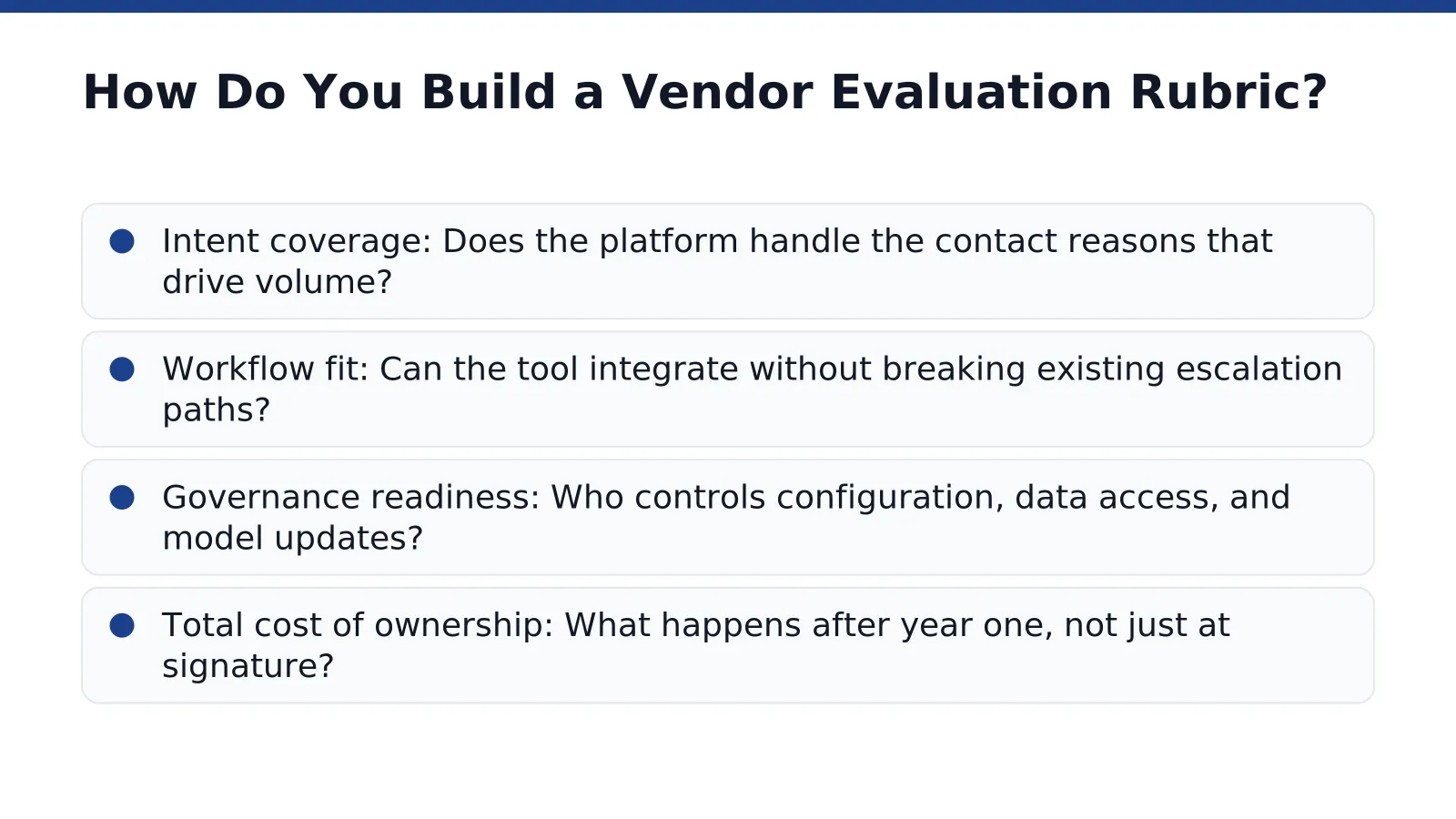
A scoring framework only works when criteria reflect actual operating requirements. Cloud Tech Gurus structures rubrics around four pillars:
- Intent coverage: Does the platform handle the contact reasons that drive volume?
- Workflow fit: Can the tool integrate without breaking existing escalation paths?
- Governance readiness: Who controls configuration, data access, and model updates?
- Total cost of ownership: What happens after year one, not just at signature?
Why Does Practitioner Input Matter for Rubric Design?
Practitioner-led CX consulting changes what gets weighted. Cloud Tech Gurus operates within a network of 250+ technology suppliers and 40+ BPO providers. The firm has invested over 4,000 hours in vendor evaluations. That depth enables rapid, accurate recommendations without vendor bias.
A well-designed vendor evaluation rubric moves beyond subjective opinions and demo bias. It establishes clear criteria, performance levels, and a weighting system. Teams that skip this step carry acquisition risk into every contract renewal.
What Does a Safe Consolidation Migration Look Like?
A safe consolidation migration runs live operations without interruption. Contact center leaders must plan the shift in parallel with business-as-usual, not after a contract ends.
Migrating involves moving beyond multi-vendor sprawl into a unified environment. This transition recognizes that contact center modernization means moving from split channels to one coordinated service model. Voice, chat, self-service, analytics, and agent tools must share context in this new architecture.
How Do Leaders Avoid Breaking the Routing Logic During Migration?
Teams often buy cloud telephony and keep broken routing logic intact. Cloud Tech Gurus has watched modernization fail too many times when knowledge remains buried across six different systems. Contact center platform consolidation only delivers value when the new platform connects cleanly to a single source of truth for customer data.
The migration sequence matters more than the technology selection. A practical vendor evaluation rubric moves beyond feature checklists to measure how a platform handles live routing handoffs and knowledge retrieval during the transition period.
A Contact Center Technology Assessment Framework provides the structure for this evaluation. Leaders who skip this step inherit a new billing relationship atop old operational failures.
Why Is Execution Oversight Critical for CCaaS Transitions?
CCaaS migration services without operational oversight leave implementation gaps unaddressed until go-live. Cloud Tech Gurus deploys over 120 former contact center executives to assess operational inefficiencies, offer data-driven strategies, and guide technology adoption. These practitioners defend the agent and customer experience before, during, and after the cutover.
The company embraces a partnership-focused approach that combines expertise in contact center operations with cutting-edge technology insights. This structure keeps clients supported and informed throughout their transformation journey.
Practitioner-led CX consulting prevents the common pattern where technical migration succeeds but service quality collapses. A safe migration treats the platform move as an operational program, not an IT project.
Conclusion
Consolidation succeeds when leaders treat vendor reduction as an operational transformation, not a procurement exercise. A practitioner-built rubric and migration oversight protect routing logic, agent workflows, and reporting integrity as the vendor count shrinks. Enterprise CX leaders who diagnose before they consolidate eliminate sprawl without introducing new friction, turning a fragmented stack into a unified foundation for AI-driven service.