
Cloud Tech Gurus | AI Readiness for Contact Centers
Enterprise contact centers find themselves at a pivotal crossroads as AI technologies mature rapidly. Many contact center AI pilots deliver promising technical results: chatbots contain contacts, AI agent assist tools identify relevant articles, and workflows pass initial demonstrations. Yet, these pilots frequently stall when transitioning into full production. This operational pause is less about technical shortcomings and more about cracks in the operational foundation: untrusted disposition codes, handoffs that lose critical context, unapproved disclosure language, and frontline incentive misalignment.
AI readiness for contact centers is therefore not a question of technology alone but of whether your entire operation, from data through customer experience, is equipped to implement, sustain, and scale AI successfully. It involves examining the operational pillars that must function cohesively beyond the technology itself.
Key Takeaways
- AI readiness for contact centers is fundamentally an operational condition, not just a technical capability; the strongest technology cannot compensate for operational gaps.
- Your weakest pillar sets your overall readiness; poor governance or incomplete data quality will limit progress despite strengths elsewhere.
- AI maturity assessment and readiness must be matched to use cases phased by operational capability; you do not have to be fully ready to start, but you must start where operational readiness is highest.
What is AI Readiness for Contact Centers?
AI readiness for contact centers is a practitioner-grade measure of your operation’s ability to support AI-powered customer service beyond pilot phases in real-time, production environments. It integrates four essential pillars that must be assessed, scored, and improved before scaling:
- Data Quality: The completeness, accuracy, and trustworthiness of your disposition codes, transcripts, and knowledge base.
- Workflow Design: The operational processes and system interactions including handoffs, containment definitions, and system integration.
- Governance: Clear ownership, legal and compliance approvals, and contract provisions controlling AI usage and risks.
- Customer Experience: An established baseline of customer sentiment, preferences, and seamless human fallback paths.
A rigorous approach like the four-gate AI readiness assessment scores these pillars to reveal gaps and prioritize remediation aligned with your chosen contact center AI use cases.
Is Your Data Ready?
1. You Can Tell Why Customers Called
The Sign: Your disposition codes are regularly audited and trusted, with fewer than fifteen percent of contacts categorizing as “Other,” “General inquiry,” or default options.
Operational Why This Matters: AI tools like intent prediction routing and speech analytics rely on accurate disposition data; if agents select disposition codes out of fatigue or confusion, AI will learn and amplify these inaccuracies.
The Diagnostic Test: Review contact reason reports for supervisor trustworthiness and confirm a disposition audit within the last 12 months.
2. Your Voice Contacts Are Transcribed Accurately
The Sign: Greater than ninety percent of voice interactions are transcribed with proven accuracy calibrated to your customers’ accents, industry acronyms, and product terminology.
Operational Why This Matters: Voice AI contact center workflows depend on reliable transcripts for speech and text analytics, quality assurance automation, and AI agent assist. Neglecting transcription accuracy affects AI knowledge management and generative AI customer service.
The Diagnostic Test: Validate vendor transcription accuracy and pilot testing on representative voice samples from your call center.
3. Your Knowledge Base Has Owners and Lifecycle Governance
The Sign: Every knowledge article has a named owner accountable for content review, with a refresh cycle no longer than 12 months.
Operational Why This Matters: AI knowledge management tools and AI agent assist must rely on current, accurate information to prevent hallucinations and customer misinformation.
The Diagnostic Test: Randomly check articles for review dates and identify owners; more than two in ten out-of-date articles indicate a gap.
Are Your Workflows Ready?
4. You Can Distinguish True Containment from Customer Abandonment
The Sign: The operational definition of “contained” distinguishes genuinely resolved contacts from premature customer drop-offs.
Operational Why This Matters: AI benefits are misunderstood if containment metrics falsely count abandonments as success; repeat contact rate analysis is essential to measure ROI accurately.
The Diagnostic Test: Confirm whether your reporting differentiates containment and abandonment, supplemented by repeat-contact tracking.
5. Escalation Handoffs Preserve Complete Context
The Sign: When AI escalates to a human agent, the full transcript, actions attempted, and customer verification status are visible and accessible to the agent.
Operational Why This Matters: Losing context during handoffs frustrates customers and wastes agent time, often signaling split channel ownership and channel disintegration.
The Diagnostic Test: Audit cases where agents ask for repeated explanations after AI escalation; a prevalent occurrence indicates failures.
6. Core Systems of Record Support Bi-Directional API Access
The Sign: Critical systems including order management, billing, claims, and scheduling offer APIs that allow AI to both read and write data.
Operational Why This Matters: Agentic AI customer service requires write-back capability to automate tangible actions beyond simple deflection; legacy screen toggling signals operational readiness issues.
The Diagnostic Test: Verify end-to-end API connectivity and documented permissions enabling AI to complete actions without manual agent intervention.
Is Your Governance Ready?
7. A Single Executive Leader Owns Contact Center AI Decisions
The Sign: A named executive owns AI governance across legal, security, compliance, and operations, with clear decision authority.
Operational Why This Matters: Shared or committee ownership delays regulatory responses and slows AI implementations.
The Diagnostic Test: Identify the executive owner who can speak authoritatively and decisively to regulators and stakeholders.
8. Customer Disclosures Are Approved by Legal and Compliance
The Sign: All customer-facing disclosure language regarding AI use, recording, and transcription is finalized and approved, particularly for HIPAA contact center compliance and PCI DSS contact center standards.
Operational Why This Matters: In regulated industries, unapproved disclosures can stall AI deployment for months, increasing risk and compliance burden.
The Diagnostic Test: Confirm legal signoff on all AI-related consumer communications.
9. Vendor Contracts Explicitly Govern Data Rights and Model Changes
The Sign: Contracts clearly define data usage rights including vendor training permissions, notification processes for model updates, and provisions enabling rollbacks.
Operational Why This Matters: Silent or vague clauses mean vendors unilaterally dictate AI behavior changes impacting your contact center without your input or control.
The Diagnostic Test: Review contract language to ensure these controls are explicit and enforceable.
Is Your Customer Experience Ready?
10. You Know Which Intents Customers Actually Want Automated
The Sign: Voice of customer programs and contact data segment intents by complexity, emotional content, and customer acceptance of automation.
Operational Why This Matters: Customers generally accept automation for transactional requests like order status but resist it for disputes or emotionally charged contacts. Automation mismatches increase effort and reduce trust.
The Diagnostic Test: Validate segmentation with customers through surveys or feedback mechanisms derived from voice of customer programs.
11. You Have an Established CX Baseline by Intent
The Sign: You have collected metrics such as CSAT, first contact resolution (FCR), repeat contacts, and customer effort scores (CES) by individual intent prior to AI deployment.
Operational Why This Matters: Without intent-level benchmarks, evaluating AI impact is imprecise, obscuring whether improvements are due to AI or other factors.
The Diagnostic Test: Confirm that CX metrics are segmented and tracked by intent in your operational reporting.
12. Customers Have an Immediate, Measured Escape Path to a Human
The Sign: Every automated interaction includes a well-defined, easily accessible path to speak with a human agent, with steps counted and monitored.
Operational Why This Matters: Restrictive automation leads to customer frustration and attrition. Increasing synthetic voice fraud heightens the need for robust contact center identity verification at handoffs.
The Diagnostic Test: Test routes for friction-free human contact and review call abandonment rates at automated endpoints.
Bonus Operational Sign: Frontline Agents and QA Are Aligned to AI
The Sign: Quality assurance scorecards, compensation plans, and headcount discussions have been updated and communicated prior to AI launch.
Operational Why This Matters: Misalignment leads agents to bypass AI tools, undermining deployment success and adversely impacting morale and workflow adoption.
The Diagnostic Test: Review QA documentation and compensation structures and gauge agent sentiment on AI integration.
Matching AI Readiness to Contact Center Use Cases
This table supports a sequenced AI implementation strategy: begin where readiness strengths exist, prove value incrementally, and allocate resources to close operational gaps before expanding to riskier use cases.
Five Red Flags That Signal You Are Not Ready
- The first AI use case is vendor-driven, not derived from your own contact center data and operational priorities.
- The ROI case uses vendor-supplied containment rates without verifying them against your own customer intents and contact data.
- The pilot lacks a clear end date and success criteria, leading to indefinite expenditures without defined outcomes.
- Quality assurance forms have not been updated to reflect new AI-assisted workflows, introducing misaligned agent incentives.
- There is no transparent communication regarding agent headcount or role changes, increasing workforce uncertainty and resistance.
How to Score Your Operational Readiness
Begin by honestly checking off operational signs within each pillar: Data (1-3), Workflows (4-6), Governance (7-9), Customer Experience (10-12).
Key guidance:
- An area with no operational signs represents a critical blocker. Remediate fully before proceeding.
- Two or three signs per pillar indicate readiness for piloting focused AI use cases with predefined scope and timelines.
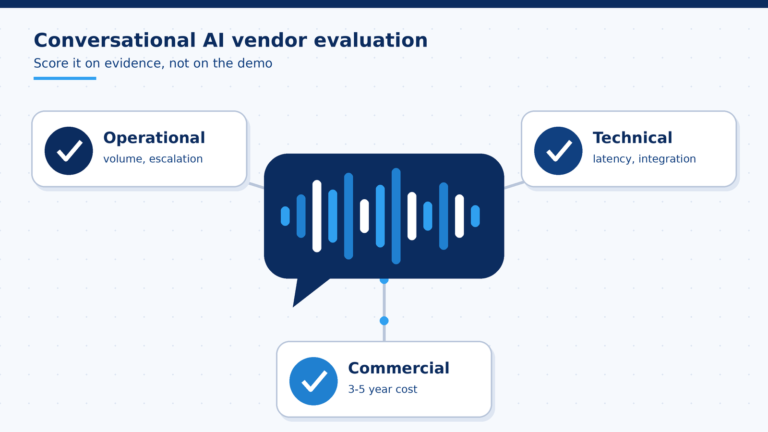
- Full completion across all signs shifts priority to vendor selection and contract negotiation. Use frameworks like score verified AI to guide vendor evaluation.
- Formal AI maturity assessment instruments such as the four-gate AI readiness assessment provide scoring and actionable gap lists.
- When outsourcing contact center tasks, integrate AI terms in your BPO RFP to safeguard readiness forward.
Frequently Asked Questions
How do I know if my contact center is ready for AI?
Evaluate readiness across data quality, workflow design, governance, and customer experience baselines. Trustworthy dispositions, accurate voice transcription, clear ownership, approved disclosures, and baseline CX by intent are critical. The weakest pillar determines your overall readiness.
Which contact center AI use case should we start with?
Start with use cases that align with your strongest operational readiness. After-contact summaries and AI agent assist are lower risk since agents remain in the loop, while self-service AI and agentic AI require mature data and governance.
Why do contact center AI pilots stall before production?
Operational gaps such as outdated or untrusted disposition codes, poor escalation handoffs, unapproved disclosure language, and misaligned QA forms usually stall pilots. Technology succeeds; scaling requires operational readiness.
What should an AI maturity assessment include?
Comprehensive assessments examine data quality, workflows, governance, customer experience, and frontline readiness, scoring each against established benchmarks to produce prioritized gap lists for closing before vendor selection.
Is agentic AI different from other contact center AI?
Agentic AI takes actions like order modifications or refunds autonomously, requiring secure write-back APIs, human review workflows, audit trails, and strict contract controls, raising operational and governance demands.
Where CTG Fits
CTG offers practitioner-led AI readiness assessments tailored for enterprise contact centers, starting with disposition codes and QA forms rather than technology demos.
- AI readiness assessment. The four-gate diagnostic spanning data, workflows, governance, and frontline readiness, culminating in a sequenced gap remediation plan.
- Contact center AI strategy. Use-case prioritization, CX baseline establishment, and AI governance structures aligned with your operational readiness.
- Vendor-neutral AI sourcing. When ready to procure, we provide a documented shortlist from over 250 suppliers, evaluated via a published rubric to score verified AI solutions.
CTG’s standard: evaluation criteria are established collaboratively before vendor engagement, and all vendor relationships are disclosed prior to shortlisting. We understand the complexities; we have seen a successful AI pilot sit dormant for two quarters awaiting a single paragraph of approved disclosure language.