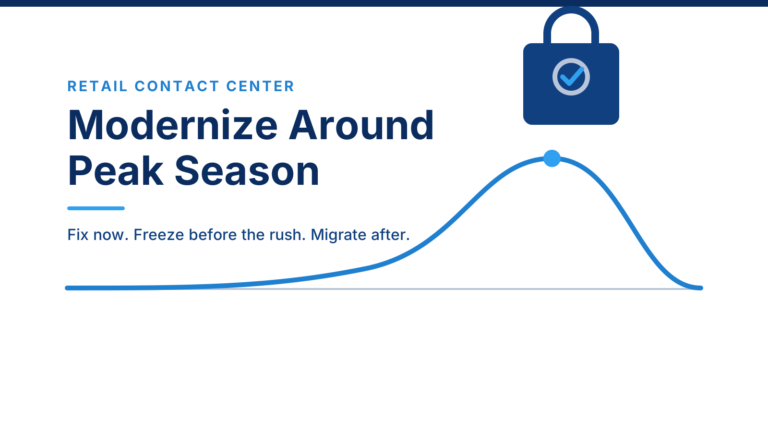
A retail contact center should modernize around peak season, not through it. Freeze risky changes before the holiday rush, fix the known failure points in routing, self-service, and staffing now, and schedule platform migrations and new AI launches for the quiet weeks after peak. The rush is where weak design shows, so plan for it first.
Why it matters: Retail demand does not ask permission. Order-status questions, delivery delays, returns, and payment problems arrive together, and customers are impatient. A contact center that is mid-migration or running an untested AI flow in peak weeks fails in public, on the days that carry the most revenue and the most reputation.
Cloud Tech Gurus was founded by former contact center executives. We have run operations through seasonal spikes, and the lesson repeats: peak is won by design, rehearsal, and discipline about what you leave alone. This is how we would approach retail contact center modernization in 2026, starting from where most teams actually are in November.
Key takeaways
- Separate fixing from changing. Repair what you know is broken. Do not launch anything new that cannot be rolled back in hours.
- Deflect the predictable. A small set of questions drives peak volume. Answer them before the customer has to call.
- Protect the hard contacts. Payment problems, fraud, and upset customers need a path that never sits behind a status question.
- Decide before the rush. Surge approvals and change authority need names attached, including at 2 a.m.
- Modernize in January. Migrations and AI pilots belong in the quiet window, scored against a rubric you set in advance.
Why does peak season expose retail contact center weaknesses?
Because peak turns small design flaws into queues. On a normal day, an IVR menu that buries order status costs a few extra minutes. During the holidays, the same menu pushes thousands of avoidable contacts onto agents who are already stretched. Nothing new broke. Volume simply removed the slack that hid the problem.
The common failure points are predictable: order data that lags between the commerce platform and the contact center, self-service that cannot see shipping status, return policies that differ by channel, messaging approvals that take a day, and staffing plans that assume overflow help can be found on the day. Each can be designed out, but only if someone owns it before the rush.
What should you fix now, and what should you freeze?
Think in four phases. The goal is to use the weeks you have to remove known friction, then stop changing the system before volume arrives.
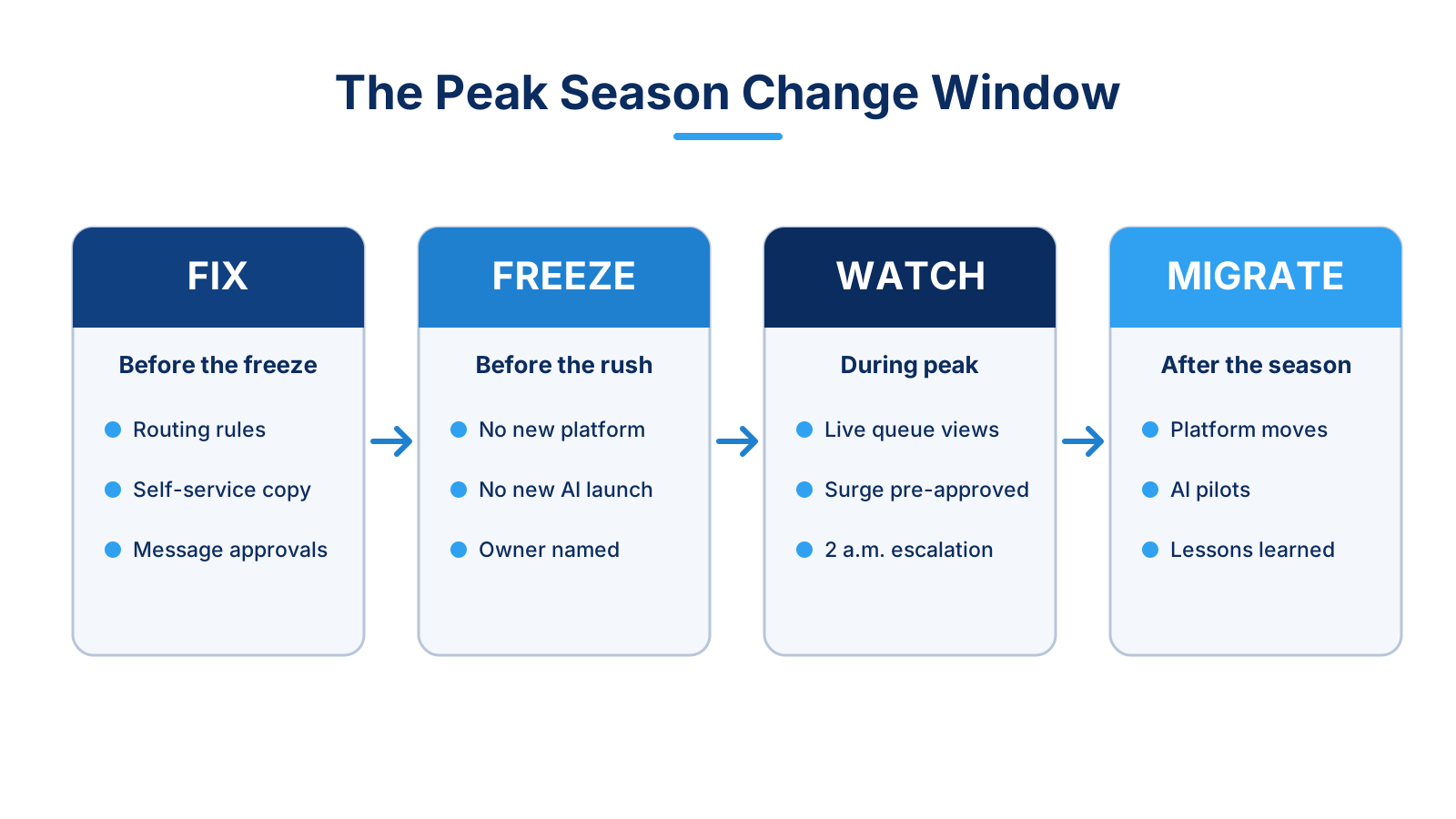
- Fix. Repair routing rules that send contacts to the wrong queue, correct self-service answers that contradict policy, and clear any approval that would slow proactive messaging.
- Freeze. No new platform, no new AI launch, and no unreviewed call-flow changes once the freeze date passes. Name one person who can approve an exception, and make the bar high.
- Watch. Give supervisors live queue views, pre-approve surge staffing triggers, and define who is called when the overnight queue climbs.
- Migrate. After the season, move platforms, launch pilots, and write down what the rush taught you. That list becomes next year’s requirements.
A freeze is not stagnation. It is a decision to take on risk when you can absorb it, and to avoid it when you cannot.
Which parts of the contact center stack matter most at peak?
Not every layer deserves equal attention. For a retail peak, these decide the result:
| Layer | What it must do at peak | Question to ask |
|---|---|---|
| Order and customer data | Give agents and self-service the same current order, shipping, and return status | How stale can the data get, and who owns the feed? |
| IVR and voice | Offer order status early and offload simple callers fast | Can we change the call flow in hours, not weeks? |
| Digital messaging | Send proactive delay and delivery notices at volume | What are the sending limits and approvals? |
| Routing | Prioritize payment, fraud, and high-value contacts over status inquiries | Can rules change without a vendor ticket? |
| Workforce management | Trigger flex, overtime, and BPO capacity on defined thresholds | Who can approve extra capacity overnight? |
| Platform capacity | Hold call and chat quality at surge volume | Has it been load-tested at our peak, not the vendor’s demo? |
Notice what is missing: a feature checklist. What matters is whether these layers work together under load, with the same facts in every channel.
Which peak contacts belong in self-service, and which need a person?
Match the contact to the cheapest channel that can resolve it well. Order status and simple returns are strong candidates for self-service. Payment disputes, suspected fraud, and upset or high-value customers need an agent with full context. The mistake is forcing the second group through the first group’s flow.
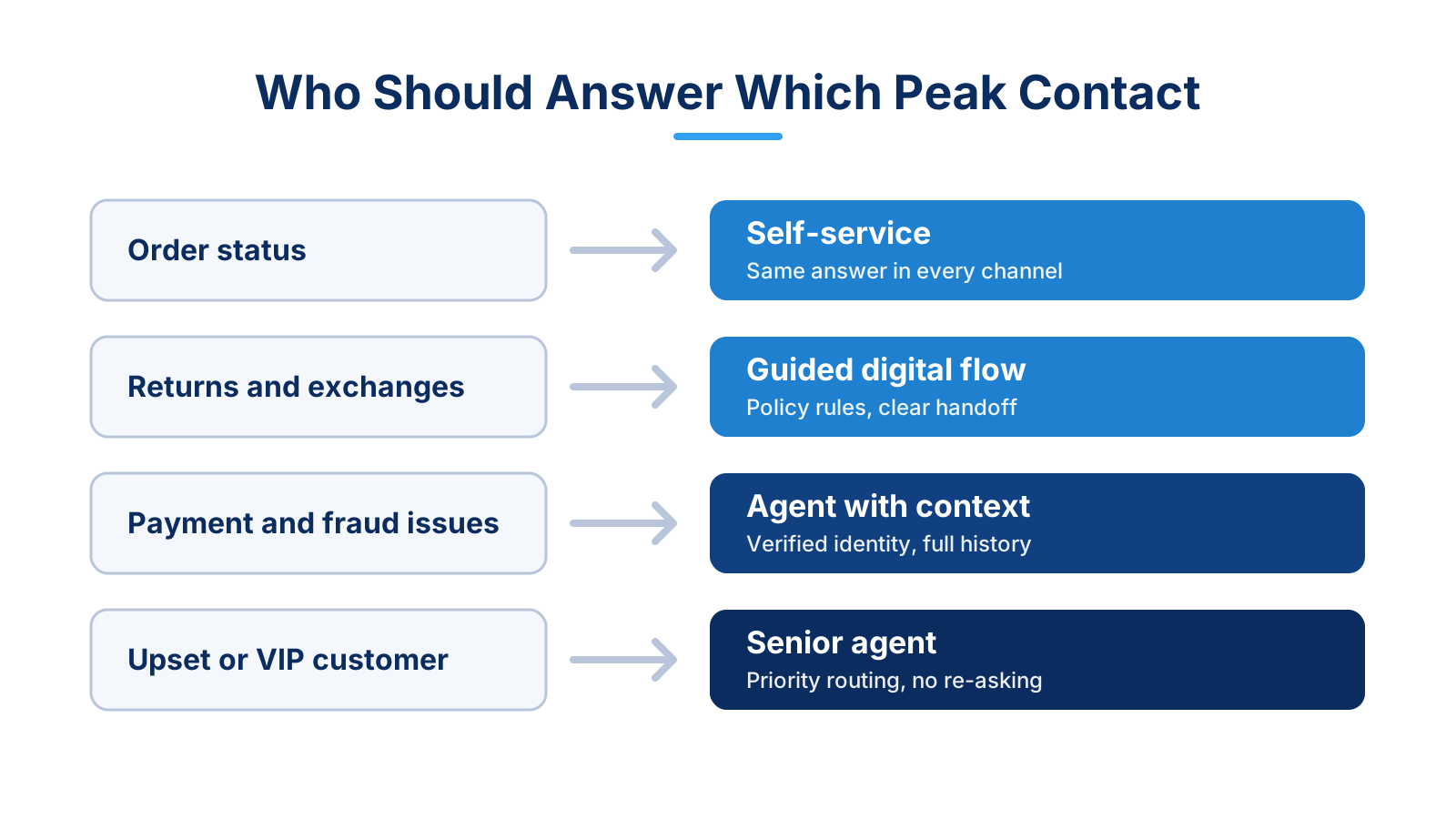
Two rules keep this honest. First, build the handoff before you automate: when a customer asks for a person, the agent should see the conversation so far, not start over. Second, make sure every channel quotes the same order and delivery facts. Conflicting answers create the repeat contacts you were trying to prevent.
Where does AI help in retail peak, and where should it wait?
AI earns its place on repetitive, high-volume questions: order status, delivery windows, and return policy. It is a poor fit for fraud, payment disputes, and customers whose frustration needs a person. It is also a poor fit for a brand-new launch in the middle of peak, because you will be debugging it with real customers on your busiest days.
If AI is on your 2026 roadmap, test it before the freeze or schedule it after the season. Before buying, check whether the data and knowledge content behind it are ready. Our AI readiness work starts with those gates, because an AI agent that quotes a wrong delivery date is worse than a short wait.
How do you rehearse peak before it arrives?
Run a drill, not a document review. Push realistic volume through the real routing, messaging, and staffing paths, using scenarios your operations and e-commerce teams recognize: a carrier delay, a promotion code that fails, a site slowdown. Then measure.
- Containment of order-status contacts across voice and digital.
- Wait and abandon rates in priority queues.
- How many customers contacted you twice about the same order.
- How long each surge approval took, and who gave it.
Write down the delays. They are the findings. A fix list from a one-week drill is worth more than a polished readiness plan nobody tested.
Should you replace the platform before or after peak?
After, in almost every case. If your drill shows the platform cannot scale, route, or integrate the way your plan needs, you have a documented case for migration, and that case is stronger in January than in a panic in November. Read our guide to planning a CCaaS migration without service disruption, because the cutover date should never land inside your busiest weeks.
How should you compare vendors for retail peak readiness?
| Evaluation area | What to require | Red flag |
|---|---|---|
| Scale proof | Evidence of performance at retail-scale peaks, with references in similar operations | Demo environments only |
| Integration | Documented connection to your commerce, order, and customer systems | Custom work with no owner |
| Control | Your team can change routing and call flows quickly | Every change needs a vendor ticket |
| Commercials | Pricing that holds in a surge, with defined overage terms | Surprise capacity fees |
| Neutrality | Recommendation based on your requirements, with partnerships disclosed | Preferred platform before requirements |
Weight the criteria before you see demos, and share the weights with the team. That makes the final choice easier to defend to finance, IT, and your own operations staff.
FAQ
How should a retail contact center modernize before peak season?
Fix known failure points first: routing rules, self-service answers, and messaging approvals. Then freeze platform and AI changes before the rush, name a change owner, and pre-approve surge staffing. Save migrations and new launches for the quiet weeks after the season ends.
Should a retailer migrate its contact center platform right before the holidays?
Generally no. A cutover adds risk exactly when volume and customer patience are least forgiving. If the current platform is failing, document the evidence now, choose a vendor on a scored rubric, and schedule the move for after the season, with rollback plans.
Can AI handle holiday contact volume for a retailer?
For repetitive questions like order status and return policy, often yes, if the AI draws on live order data and hands off cleanly. A new AI launch in the middle of peak is risky. Test it earlier or hold it until January.
What should a retail contact center measure during peak?
Measure whether customers got resolved, not only how fast calls ended. Track containment of order-status contacts, repeat contacts on the same order, abandon rates in priority queues, and how long surge approvals took. Those numbers show where design failed.
How early should a retailer start preparing its contact center for peak?
Months before, but if you are reading this in November, start with a one-week triage: lock the change freeze, test the top five contact flows end to end, confirm surge contacts and approvals, and write down who decides what overnight.
Where CTG fits
Cloud Tech Gurus is a Phoenix-based customer experience consulting and sourcing firm, founded in 2017 by former contact center executives. We help retail and e-commerce operations and other enterprise teams write peak-first requirements, assess AI readiness, and run vendor evaluations across the 250+ suppliers and 40+ BPOs in our network, scored against a documented rubric you can audit.
There are three ways to work with us: paid CTG Consulting, vendor-funded research shortlists, and guru-led sourcing under a Letter of Agency. Suppliers compensate us when a client buys through us. We disclose that up front, agree the weights with you before any provider is invited, and disclose our relationship with each provider in writing before a shortlist is built.
We didn’t study contact centers. We ran them.