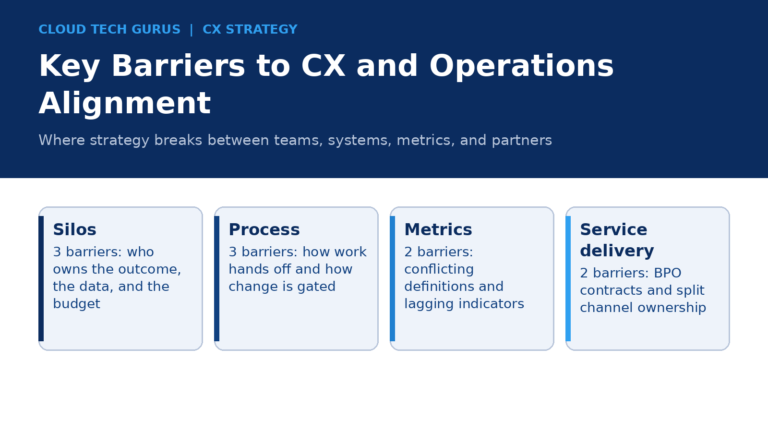
CX strategy and contact center operations misalign at four seams: organizational silos, broken processes, conflicting metrics, and service delivery gaps such as BPO contracts and split channel ownership. Every barrier leaves evidence in a document you already own, so you can find them in a week and fix most with decisions, not new budget.
Why it matters: Enterprise contact centers spend heavily on customer experience strategy, then watch service delivery stay the same. The strategy was rarely wrong. It hit a reporting line, a dashboard definition, a BPO contract, or a chatbot owned by another department that nobody had mapped.
We learned this from both sides of the seam. Cloud Tech Gurus was founded by former contact center executives who sat on the CX side and the operations side, sometimes in the same week. Here is the 2026 field guide we would hand an enterprise leader before any alignment program starts.
Key takeaways
- Four lenses. Barriers sit in silos, processes, metrics, and service delivery.
- Look at artifacts. An org chart, a dashboard, a QA form, or a contract shows each barrier.
- Diagnose first. Most fixes cost a decision, not a budget line.
What is CX and operations alignment?
It means the CX strategy, the daily contact center operation, and every service partner work toward the same outcomes, with the same definitions, the same data, and one accountable owner. When alignment holds, a strategy change shows up on the agent scorecard within weeks. For the day-to-day gaps in staffing, QA, and coaching, see our six-step alignment framework. This post covers the structural barriers.
Where do organizational silos block alignment?
1. CX and operations report to different executives
Looks like: CX sits under marketing or a chief customer officer, while the contact center reports to the COO or CFO. Diagnose it: Put both org charts on one page and find the first person who owns both CX outcomes and contact center cost. First fix: Name one accountable owner with authority over both budgets. In EOS terms, one Rock with one name on it, not a steering committee.
2. Customer data lives in separate systems
Looks like: Survey results sit in the CX platform while handle time and repeat contacts sit in operations tools. Diagnose it: Take ten detractor surveys from last month and try to pull the matching recordings. If it takes more than an hour, the data is siloed. First fix: Link survey responses to contact IDs before buying anything new. The join key comes before any analytics platform.
3. One side owns the budget, the other owns the cost
Looks like: CX funds the initiative while operations absorbs longer handle times and training hours. Diagnose it: Ask who pays for the first 90 days of a CX change. If the answer is operations, out of its existing budget, expect quiet resistance. First fix: Fund the operational cost of change inside the CX business case, including a temporary staffing buffer.
Where do processes break the handoff?
4. Journey maps stop at the front door
Looks like: The map shows what the customer sees but skips the transfer to billing, the back-office ticket, and the callback nobody owns. Diagnose it: Mark every internal handoff behind each customer step. Any handoff with no owner and no service target is a break. First fix: Add a backstage layer to every journey map with an owner and a target per handoff.
5. Policy changes arrive without floor input
Looks like: A new refund policy arrives by email on Friday and goes live Monday, so agents improvise the exceptions. Diagnose it: Pull the last five policy changes. How many had supervisor review and updated knowledge articles before launch? First fix: Add a floor-readiness gate: supervisor review, knowledge updates, and a QA form change before the effective date.
6. No capacity gate on change
Looks like: Marketing campaigns, product releases, and new channels all land on the floor with nobody checking whether it can absorb them. Diagnose it: Count the changes that touched agents last quarter. If you cannot produce the list, nobody manages change intake. First fix: Create one change calendar owned by operations, with a weekly limit on changes that reach agents.
Where do metrics pull teams apart?
7. Two definitions of the same metric
Looks like: CX reports first contact resolution from a survey question while operations reports it from repeat-contact data, and the numbers can disagree materially. Diagnose it: Ask each team to write down its definition of FCR, CSAT, and resolved, separately, then compare. First fix: Publish one metric dictionary, signed by both leaders, with a single source per shared KPI.
8. Strategy metrics lag while operations metrics run live
Looks like: The strategy is measured on quarterly NPS while the floor runs on hourly service level, and the hourly number wins every conflict. Diagnose it: Check the supervisor real-time dashboard. If nothing on it connects to the CX strategy, the strategy is invisible during the workday. First fix: Put one or two leading indicators, such as repeat contact or transfer rate, on the live dashboard. Pair any handle time target with a resolution target.
Where does service delivery break the chain?
9. BPO contracts still pay for the old strategy
Looks like: The strategy emphasizes resolution while the contract pays for handle time and service level, and the provider optimizes for what it is paid on. Diagnose it: Read the SLA and credit sections next to the CX strategy. Every mismatch is a queue where the strategy will not land. First fix: Renegotiate SLAs to match your internal scorecard, measured in your systems. A BPO scorecard that mirrors your internal KPIs keeps outsourced delivery aligned.
10. Digital and voice are owned by different teams
Looks like: The digital team owns chat and the bot and is measured on containment, while voice inherits every frustrated customer with no context. Diagnose it: Sample calls that follow a failed bot session. Does the agent see what the customer already tried? First fix: Measure self-service on resolution, not containment, and require context handoff before expanding automation.
How do you diagnose misalignment in one week?
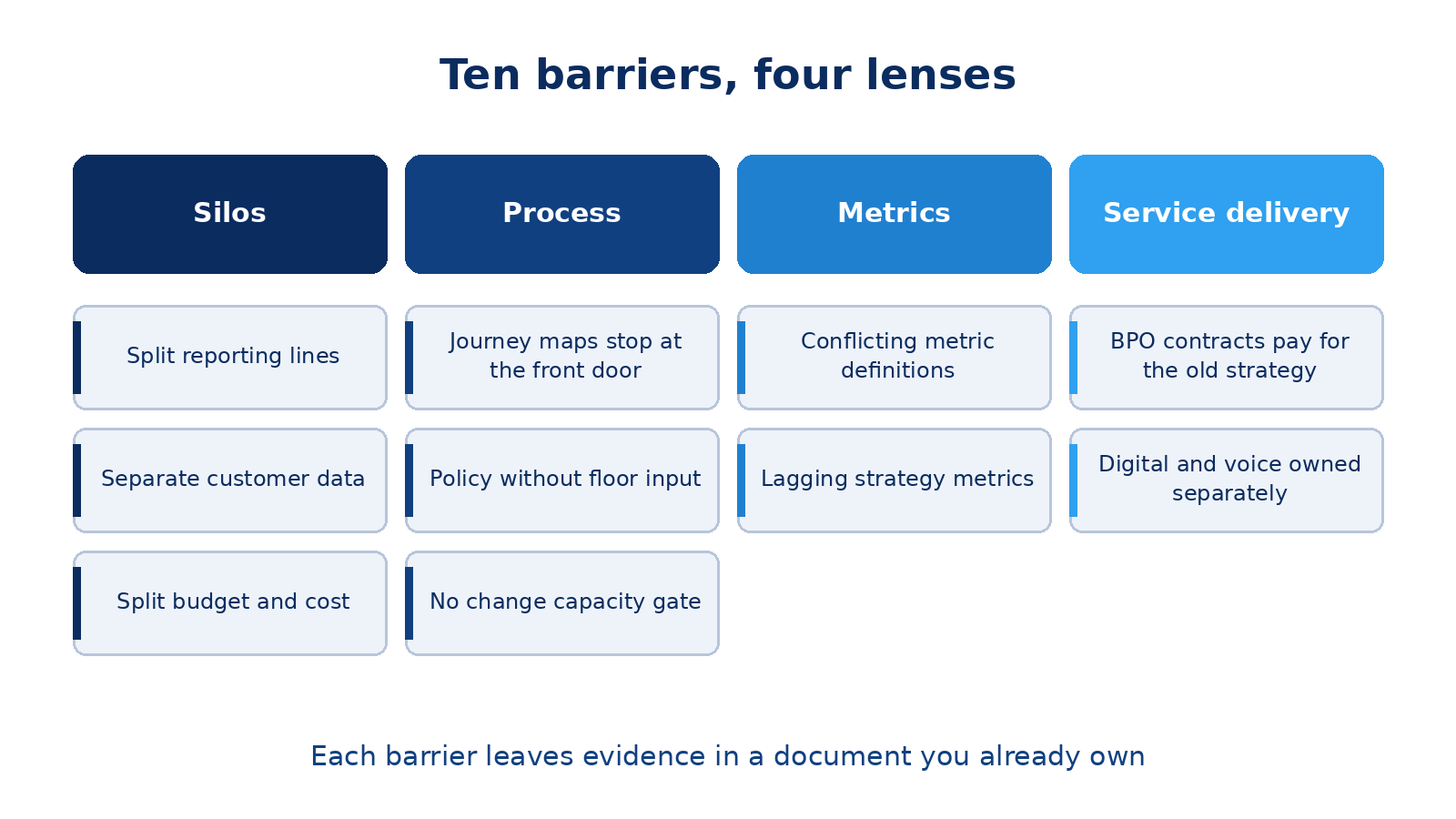
You do not need a six-month assessment. Every barrier leaves evidence in documents you already have, so a five-day walk is enough to start.
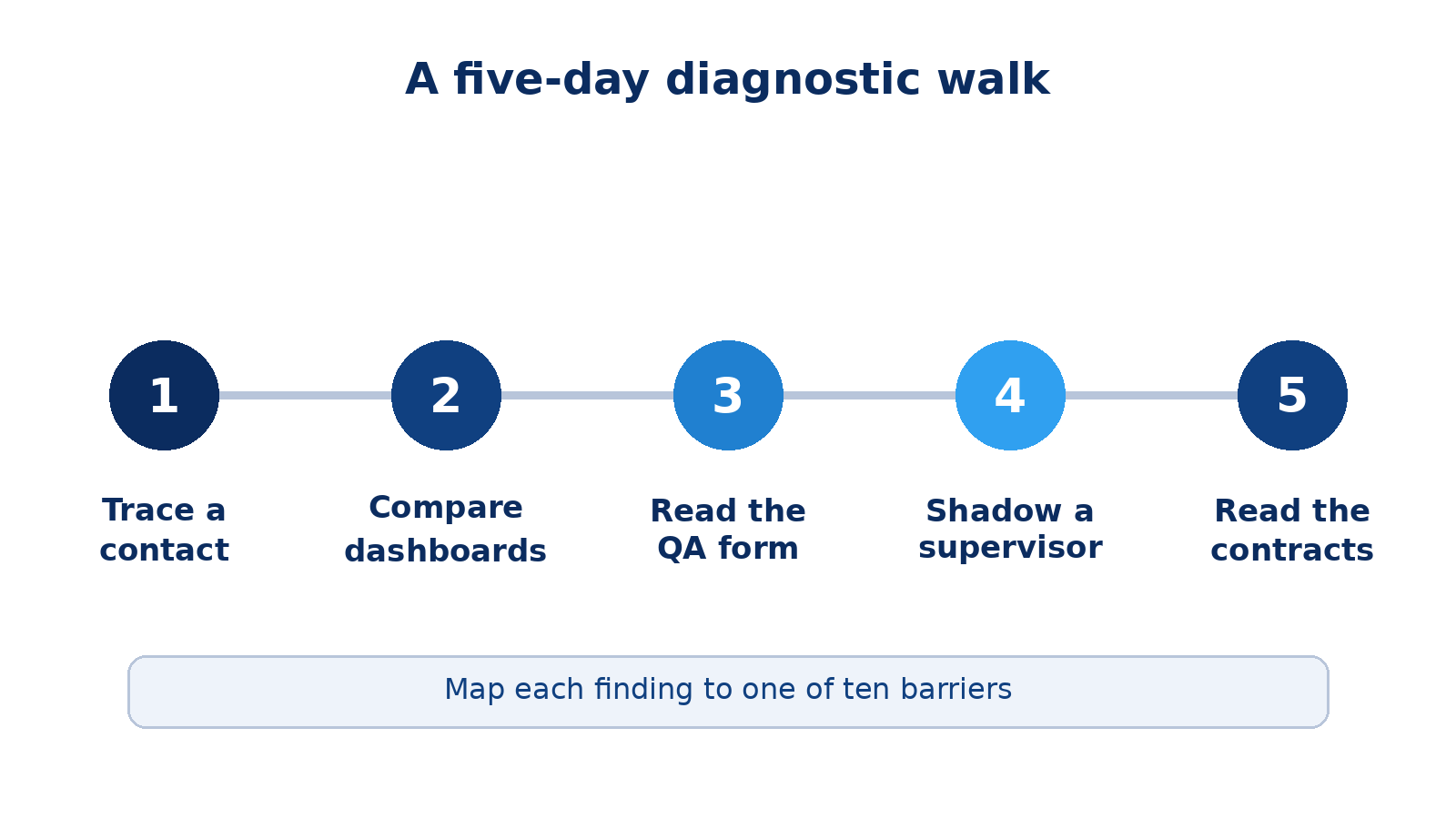
- Day 1, trace one contact. Follow a complex contact from first touch to resolution and mark every handoff.
- Day 2, compare dashboards. Put the leadership dashboard beside the supervisor dashboard and list what appears on only one.
- Day 3, read the QA form. Highlight every line that supports the strategy and every line that works against it.
- Day 4, shadow a supervisor. Spend four hours counting minutes spent coaching versus escalations and admin.
- Day 5, read the contracts. Compare BPO and vendor SLAs with the strategy’s target outcomes.
Then map each finding to one of the ten barriers. The top two or three usually explain most of the gap, but your mix will depend on your structure and partners.
What should you check first?
| Lens | Barrier | Evidence to check |
|---|---|---|
| Silos | Split reporting lines | Combined org chart |
| Silos | Separate customer data | Time to match a survey to a recording |
| Silos | Split budget and cost | Who funds the first 90 days |
| Process | Front-stage-only journey maps | Handoffs without owners |
| Process | Policy without floor input | Last five policy changes |
| Process | No change capacity gate | Quarterly change list |
| Metrics | Conflicting definitions | Written FCR and CSAT definitions |
| Metrics | Lagging strategy metrics | Supervisor real-time dashboard |
| Service delivery | BPO contracts misaligned | SLA and credit sections |
| Service delivery | Split channel ownership | Post-bot call sample |
FAQ
What are the main barriers to CX and operations alignment?
They fall into four groups. Silos include split reporting lines, separate data, and split budgets. Process barriers include journey maps without handoffs and no change gate. Then come conflicting metric definitions, and service delivery gaps such as misaligned BPO contracts and split channel ownership.
Why does CX strategy not reach the contact center floor?
Agents do what they are measured, coached, and scheduled to do. If the scorecard, QA form, knowledge base, and partner contracts do not change, the strategy never reaches daily service delivery, however clear the vision is.
How do organizational silos affect customer experience?
Silos split accountability, data, and budgets. Customers feel it as transfers, repeated explanations, and inconsistent answers across channels. Each team can hit its own targets while the end-to-end experience gets worse, because nobody owns the whole journey.
What is business process integration in a contact center?
It connects the front-stage customer journey with the backstage handoffs that resolve it, such as billing, back office, field service, and partners. Each handoff has an owner and a target, so contacts do not stall between teams or queues.
Should you hire a CX consultant to fix alignment?
Only one who has run operations. Ask how the strategy will change your agent scorecard, staffing forecast, and BPO contracts. If the answer is about change management slides instead of schedules and service-level terms, keep looking for someone with floor experience.
Where CTG fits
Cloud Tech Gurus is a Phoenix-based customer experience consulting and sourcing firm, founded in 2017 by former contact center executives. We diagnose alignment barriers with your operations team from day one, not after the strategy is written. Our CX consulting and transformation work covers three areas.
- CX maturity assessment. A structured diagnostic of where strategy, operations, and partners are out of sync, and the order to close the gaps.
- CX operating model and KPI design. One metric dictionary, clear ownership, and scorecards that point every team at the same outcome.
- CX transformation roadmap. A sequenced plan that fixes structure and process first, with BPO and technology decisions made against documented requirements.
There are three ways to work with us: paid CTG Consulting, vendor-funded research shortlists, and guru-led sourcing under a Letter of Agency. Suppliers compensate us when a client buys through us. We disclose that up front, and every recommendation runs through a documented rubric you can audit.
We didn’t study contact centers. We ran them. We have also been the operations leader who learned about the new policy from an agent.