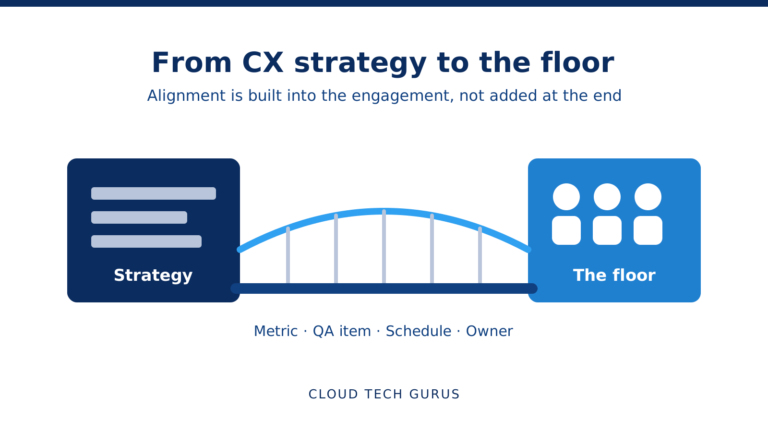
To align customer experience consulting with operations, make operations co-own the engagement, turn every strategic goal into a metric, QA item, and staffing impact, pilot with one team, and agree an exit date. Alignment is built from day one, not handed over at the end. Here is the six-step framework we use in 2026.
Why it matters: Customer experience consulting only creates value when service delivery changes. That happens when the people who run the floor help build the plan instead of receiving it. If operations is invited in at the end, the strategy becomes a deck, and leadership starts to doubt CX consulting itself.
We learned this from the operations side. Cloud Tech Gurus was founded by former contact center executives, and we have been on the receiving end of strategies nobody could staff. If you want the diagnosis first, read where alignment breaks. This post covers the other half: how to build alignment in from the start.
Key takeaways
- Alignment is how the engagement runs, not a phase. Operations co-owns it from the first working session.
- Every goal needs four translations. Agent behavior, metric, QA item, and staffing impact, all tied back to the strategy statement.
- Test before you scale. Model the peak day, then pilot on one team before any wider rollout.
- Define the exit up front. The work is done when operations can run it without the consultant in the room.
How do you align CX consulting with operations?
You run the engagement as a joint effort between CX and operations, and you check each step with a simple test before moving on. The test matters more than the step. A strategy that passes all six tests can be staffed, scored, and coached. One that fails any of them is still a presentation.
We call it the Floor-Ready Framework. Six steps, each ending with one question. If the answer is no, do not move forward.
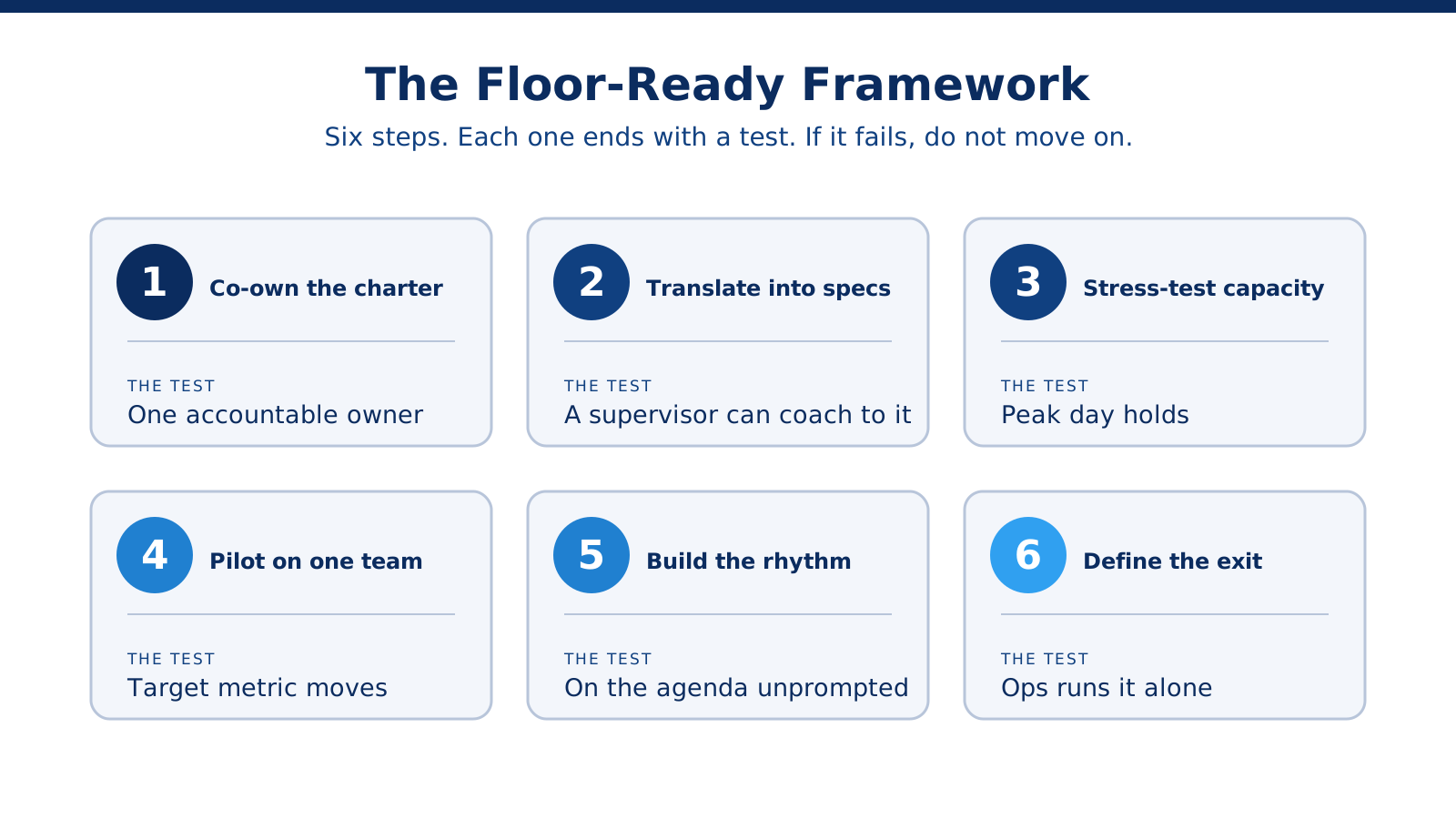
| Step | What you do | The test |
|---|---|---|
| 1. Co-own the charter | Ops and CX lead the engagement together, with one accountable owner | Can one person say yes or no to changes on the floor? |
| 2. Translate strategy into specs | Turn every goal into a behavior, metric, QA item, and staffing impact | Could a supervisor coach to it tomorrow? |
| 3. Stress-test capacity | Model the staffing impact before anything launches | Do service levels hold on your busiest day? |
| 4. Pilot on one team | Launch with one team, measure, and adjust | Did the target metric move without breaking others? |
| 5. Build the operating rhythm | Put the new metrics into daily, weekly, and quarterly reviews | Is it on the agenda without anyone asking? |
| 6. Define the exit | Agree on when the consultant’s work is done | Could ops run this if the consultant left today? |
Who should co-own the CX engagement?
Operations, from day one. Most CX engagements start with the CX team and invite operations later. Reverse that order. Three moves make the difference.
- Name one accountable owner. Someone with authority over the floor, not only the strategy. In EOS terms, it is a Rock with one name on it.
- Put an ops leader on the core team. Not an advisory seat. An ops leader who attends every working session.
- Include a frontline supervisor. They will tell you on day three what the consultants would otherwise learn in month three.
How do you turn CX strategy into floor-ready specs?
You translate each strategic goal into four things operations can act on: the agent behavior, the metric, the QA item, and the staffing impact. This is the step most customer experience strategy skips. If a statement cannot fill every column, it is not ready for the floor.
| Strategy says | Agent behavior | Metric | QA item | Staffing impact |
|---|---|---|---|---|
| “Customers shouldn’t have to repeat themselves.” | Review the prior-contact summary before greeting | Repeat contact rate within 7 days | “Acknowledged prior contact” | Small handle-time increase; model it before launch |
| “Resolve it the first time.” | Own the issue through to resolution; limit transfers | First contact resolution | “Resolved or owned the handoff” | Handle time may rise before repeat contacts fall |
| “Make it easy.” | Offer the fastest channel for the customer’s specific need | Customer effort score | “Offered the right channel” | Self-service can shift volume, so forecast by channel |
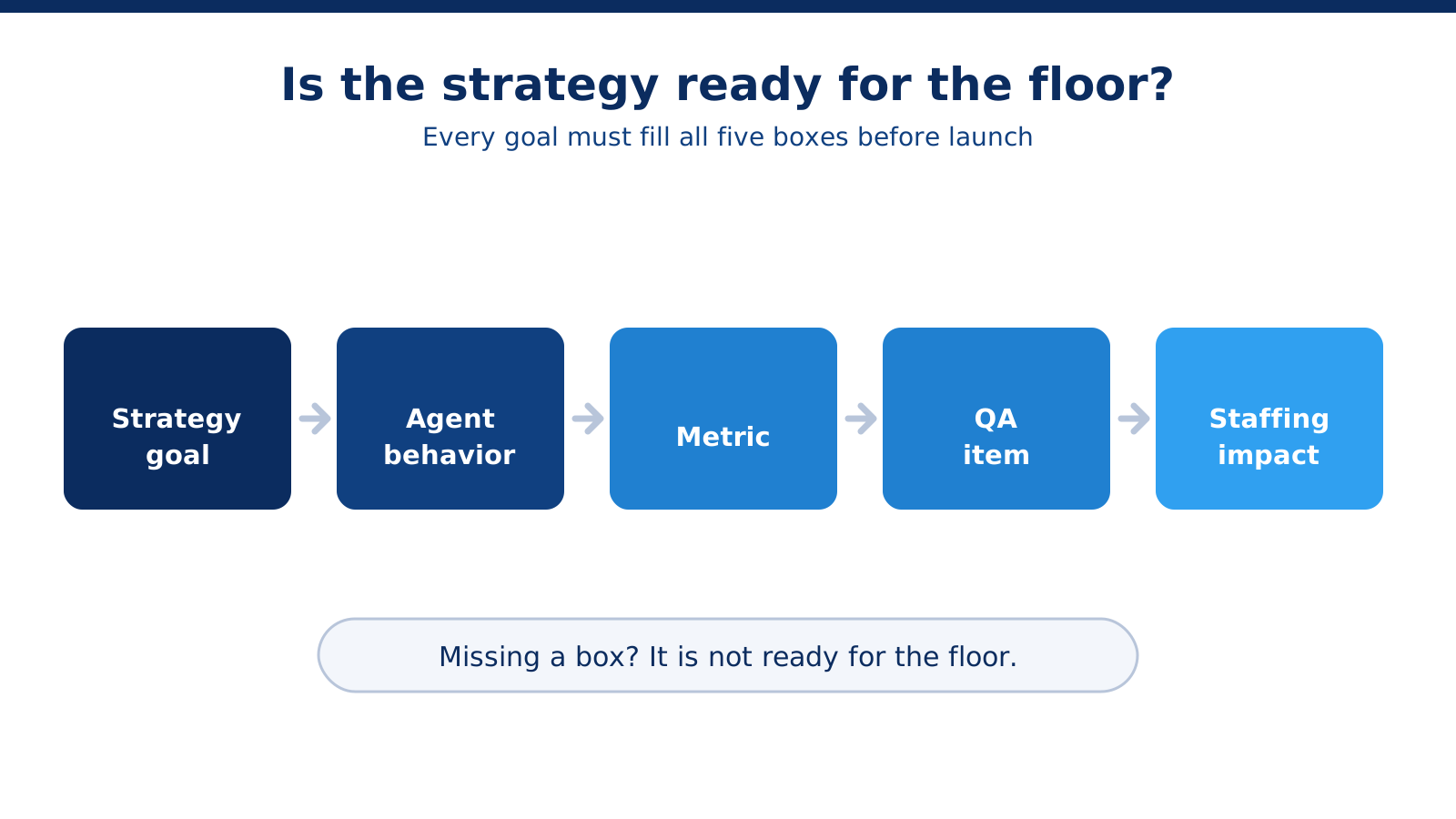
This is where contact center KPI design and a clear CX operating model earn their place. Without them, the strategy and the scorecard pull in different directions.
How do you stress-test capacity and pilot before launch?
Rerun the workforce management forecast with the new handle-time assumptions before anyone trains an agent, then launch with one team. New behaviors change handle times, and handle times change staffing. Skipping the model is how service levels drop the week a good idea goes live.
- Model your peak day, not your average one. Strategies rarely fail on a quiet Tuesday afternoon.
- Decide the tradeoff up front. If service level dips during ramp, leadership needs to agree to it on the record.
- Pilot for three to four weeks on a single team. Watch the target metric and the guardrails: handle time, service level, and agent attrition.
- Listen to the supervisor. If they cannot coach it, the QA item or the behavior needs rewriting.
A pilot that exposes a flaw is not a failure. It is the cheapest version of the lesson.
How do you make alignment last after the consultants leave?
You attach the new metrics to meetings that already happen, and you agree on the finish line at the start. Alignment fades when new metrics live in a separate CX dashboard nobody opens.
- Daily: team huddles cover the new behavior and yesterday’s results.
- Weekly: the scorecard review shows new metrics next to the old ones. In an EOS shop, they go straight into the L10.
- Monthly: QA calibration confirms everyone scores the new behaviors the same way.
- Quarterly: the next alignment gap becomes a Rock with one owner.
Good customer experience consulting also has a finish line. The engagement is done when scorecards have run for one full cycle, QA forms and knowledge articles are rewritten and calibrated, the WFM forecast is rebuilt, and the operating rhythm runs without the consultant in the room.
Is your CX strategy aligned with operations? A five-question check
Answer yes or no to each:
- Does one person own both the CX strategy and the floor results?
- Has every strategic goal been turned into a metric and a QA item?
- Has the WFM forecast been rerun with the new handle-time assumptions?
- Do the new metrics appear in your weekly operations review?
- Could your supervisors explain the strategy in one sentence?
Three or fewer yeses usually means the strategy is still stuck at the leadership level. Fix the first no, not all five at once.
FAQ
How do you align customer experience consulting with operations?
Co-own the engagement with operations, turn every strategic goal into a behavior, metric, QA item, and staffing impact, stress-test capacity, pilot with one team, build the new metrics into existing reviews, and define clear exit criteria before the work begins.
What is operations alignment in CX strategy?
It means your scorecards, workforce plans, QA forms, knowledge base, and meeting cadence all support the same customer experience strategy, with one accountable owner. When any of those points the other way, agents follow what they are measured on, not what the strategy says.
Who should own CX strategy execution?
One leader with authority over both the strategy and floor operations. Split ownership between CX and operations is one of the most common organizational reasons programs stall, because each side can reasonably say the result belongs to the other.
When should a CX consulting engagement end?
When scorecards, QA, knowledge, and forecasts have been updated and the operating rhythm runs without the consultant. Agree on those criteria at the start, so the finish line is a test your team can check rather than a date on a contract.
Why pilot with one team before rolling out a CX change?
A single-team pilot lets you see whether the target metric moves and whether handle time, service level, or attrition pay for the gain. It also shows whether supervisors can coach the new behavior. Finding a flaw with one team is far cheaper than finding it across the floor.
Where CTG fits
Cloud Tech Gurus is a Phoenix-based customer experience consulting and sourcing firm, founded in 2017 by former contact center executives. We build strategy with your operations team, turn it into specs your supervisors can coach to, and hand it off once it runs without us. Your team runs the operation, and the design is built for that. That includes CX maturity assessments, CX operating model and KPI design (EOS-aligned if that is how you run), and contact center roadmaps that fix process first.
When technology turns out to be the real gap, we run vendor-neutral sourcing across 250+ suppliers and 40+ BPOs. There are three ways to work with us: paid CTG Consulting, vendor-funded research shortlists, and guru-led sourcing under a Letter of Agency. Suppliers compensate us when a client buys through us. We disclose that up front, and every recommendation runs through a documented rubric you can audit.
We didn’t study contact centers. We ran them. We know a strategy only counts once it shows up in the schedule.