Avaya’s 200-seat minimum for its Experience Platform, effective June 30, 2025, forces smaller contact centers to evaluate CCaaS migration. Cloud Tech Gurus deploys former contact center executives to assess operational inefficiencies, offering vendor-neutral guidance that reduces technology acquisition risks and ensures measurable ROI through hands-on implementation oversight.
Why Is Avaya Migration Consulting Critical Now?
Avaya’s 200-seat minimum requirement for its Experience Platform (AXP) takes effect on June 30, 2025. This policy shift forces contact center leaders running smaller deployments into an immediate strategic corner.
Organizations with fewer than 200 agents now face three uncomfortable options. They can stay with Avaya and pay for unused capacity. They can migrate to a modern CCaaS platform sized to their actual operations. Or they can attempt a transition without a clear plan and risk operational disruption. None of those paths reward delay.
What Makes the 200-Seat Rule So Disruptive?
The rule creates a hard commercial boundary. Contact centers below the threshold lose the economics that made the platform viable. Leaders who postpone the decision absorb mounting cost pressure while competitors lock in migration timelines and vendor commitments.
Avaya migration consulting addresses more than vendor selection. Most failed contact centers do not fail from bad tools. They fail because nobody diagnosed the real break first. Cloud Tech Gurus deploys former contact center executives who identify those breaks before technology decisions get made.
How Does Practitioner Expertise Change the Migration Outcome?
A legacy contact center replacement project exposes years of accumulated workflow complexity. Routing vectors, holiday schedules, and after-hours logic often look impenetrable to outside evaluators. Practitioner-led assessment maps those dependencies before migration begins, preventing the kind of blind handoff that stalls go-live dates.
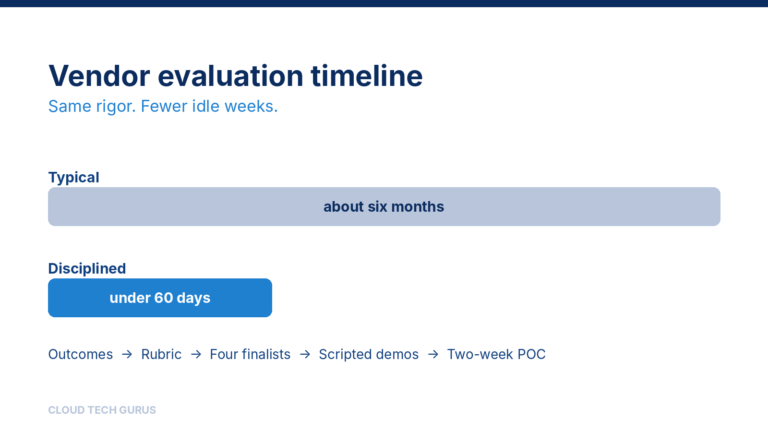
The 200-seat rule Avaya migration timeline compresses what would normally be an 18-month evaluation cycle. Organizations that treat this as a procurement exercise rather than an operational redesign carry hidden costs into their new platform. Cloud Tech Gurus brings vendor-neutral intelligence across 250-plus technology suppliers to accelerate on-prem to cloud migration without skipping the diagnostic phase.
What Should Leaders Prioritize When Evaluating CCaaS Platforms?
How to choose a CCaaS platform starts with stack fit, not feature count. Routing architecture, workforce management integration, and AI readiness determine whether the platform supports or constrains the operation. A rushed selection based on demo impressions routinely produces a platform that fits poorly within six months.
Contact center leaders managing voice infrastructure transitions face parallel pressure points. Lumen Technologies will stop writing new voice contracts on August 1, 2026, creating an impending decision window for organizations running on that carrier. Coordinating both transitions demands sequencing expertise that generalist consultancies rarely provide.
What Makes Legacy Contact Center Replacement So Complex?
Legacy contact center replacement fails most often because the real complexity hides in routing logic that nobody fully documents. Organizations discover this only after migration stalls and service levels drop.
The core problem sits inside Avaya Call Center Elite vectors. These workflows make perfect sense to the engineers who built and maintained them over years. To everyone else, they look almost impenetrable. A single vector may begin by checking whether the day is a holiday, then branch to service hours. When the business is closed, it plays a specific announcement or offers voicemail. Further down the flow, variables influence queue behavior while staffing checks determine routing decisions. Each exception, each business rule, each workaround added over a decade of operational changes compounds the opacity.
Why does routing logic break during cloud migration?
Routing logic breaks because the original context is lost. Engineers who understood every branch and condition have often left the organization. The remaining documentation, if it exists at all, rarely captures the why behind each decision point. A legacy contact center replacement project that treats these vectors as simple configuration files to be lifted and shifted discovers the gaps only after go-live.
What happens when channels stay disconnected after migration?
Contact center modernization demands moving from split channels to one coordinated service model. Voice, chat, self-service, analytics, and agent tools must share context. A team can buy cloud telephony and keep broken routing logic while knowledge stays buried in six systems. Leaders then wonder why service levels barely move. The technology changed, but the operational fractures remained untouched.
This is why Avaya migration consulting that skips deep workflow discovery creates risk. The legacy contact center replacement process must excavate every vector, every exception, and every undocumented dependency before any platform decision occurs. Otherwise, organizations trade one set of problems for another, more expensive set.
How Do You Plan an On-Prem to Cloud Migration?
An on-prem to cloud migration succeeds when leaders frame the initiative around orchestration, not replacement. The platform matters, but the operating model matters more. Organizations that skip diagnostic rigor before selecting technology lose months of productivity to integration failures no one predicted.
Contact center consulting once centered on labor models, queue design, and telecom cleanups. Those disciplines remain relevant. Yet AI shifted the center of gravity toward routing, knowledge, QA, WFM, analytics, automation, and governance. These pieces cannot behave like loose parts anymore. They must work as one system, and that is where many migration plans break.
What Gets Assessed Before Technology Selection?
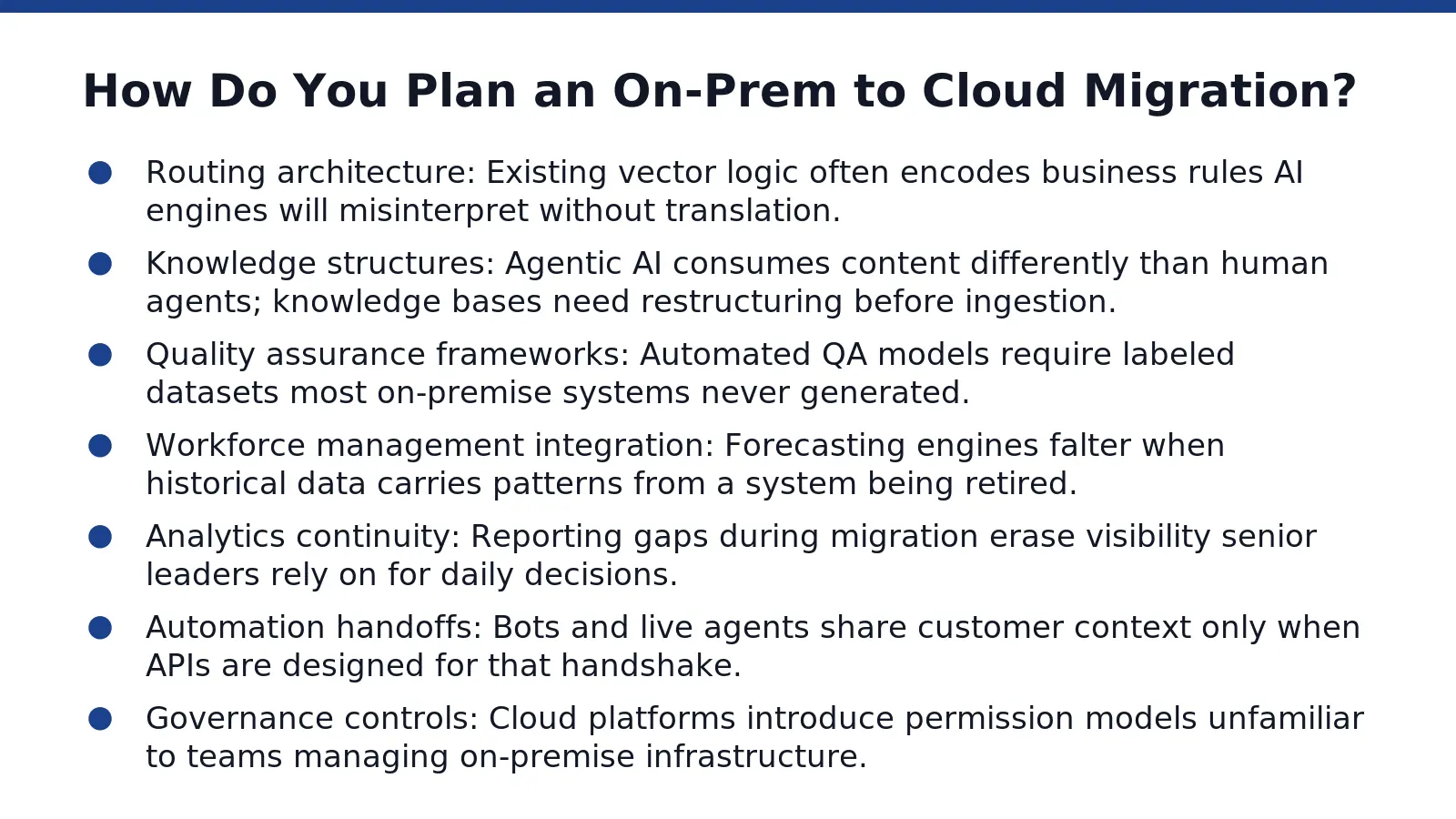
Proper legacy contact center replacement demands scrutiny across seven interconnected domains. Ignoring any one of them introduces fragility a platform alone cannot fix.
- Routing architecture: Existing vector logic often encodes business rules AI engines will misinterpret without translation.
- Knowledge structures: Agentic AI consumes content differently than human agents; knowledge bases need restructuring before ingestion.
- Quality assurance frameworks: Automated QA models require labeled datasets most on-premise systems never generated.
- Workforce management integration: Forecasting engines falter when historical data carries patterns from a system being retired.
- Analytics continuity: Reporting gaps during migration erase visibility senior leaders rely on for daily decisions.
- Automation handoffs: Bots and live agents share customer context only when APIs are designed for that handshake.
- Governance controls: Cloud platforms introduce permission models unfamiliar to teams managing on-premise infrastructure.
How Does Vendor Intelligence Accelerate the Timeline?
Cloud Tech Gurus deploys over 120 former contact center executives who bring Avaya migration consulting expertise into every engagement. The firm operates within a network of 250-plus technology suppliers and 40-plus BPO providers. More than 4,000 hours of vendor evaluations enable rapid, accurate recommendations. This intelligence compresses the selection window while ensuring the chosen stack aligns with how the organization actually operates.
Leaders navigating the 200-seat rule Avaya migration face a compressed decision window. Many discover their existing workflows contain undocumented logic built over a decade of incremental changes. Skilled contact center consulting surfaces those dependencies before contracts are signed. How to choose a CCaaS platform ultimately depends on knowing what breaks before the migration, not after.
What Should Drive How to Choose a CCaaS Platform?
A how to choose a CCaaS platform decision starts with platform architecture, not feature count. The right platform solves specific workflow breaks and governance requirements that generic demos never surface.
Decision-makers at mid-market and enterprise contact centers face a changed landscape. On-prem to cloud migration no longer means a one-size-fits-all multi-tenant public cloud deployment. Modern CCaaS spans single-tenant, hybrid, and on-premises cloud architectures. These configurations give enterprises direct control over data sovereignty, AI governance, and choice of large language model integration.
Why Do Architecture Options Matter for Contact Center AI?
CCaaS is an AI-infused platform managing omnichannel customer interactions. Automatic Call Distribution and inbound voice routing anchor the system. Digital channels, predictive analytics, workforce management, and generative AI capabilities extend from that core.
Architecture dictates how deeply those AI capabilities integrate with existing workflows. Without architecture alignment, even advanced AI tools underperform.
What Fails When Teams Skip Discovery?
Most failures start when teams buy fast and diagnose late. A contact center AI platform never fixes a broken workflow. Organizations that skip structured diagnosis routinely deploy tools that sit unused or create new bottlenecks.
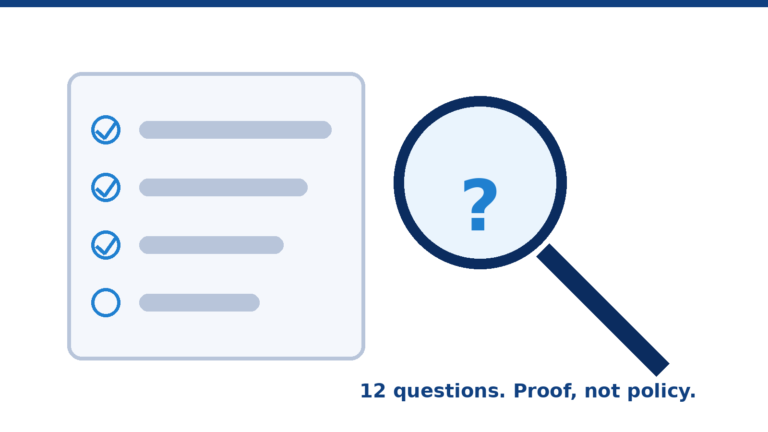
The selection process connects intent, workflow, governance, and outcomes before any contract review. Cloud Tech Gurus applies this diagnostic methodology across engagements, including specialized Mid-Market CX Solutions scaled for 100 to 500-employee operations.
Three non-negotiable selection criteria emerge:
- Workflow diagnosis must precede any vendor conversation
- Platform architecture aligns with data sovereignty and compliance needs
- AI capabilities integrate into measured operational outcomes
Teams that reverse the order and start with vendor demos lose months and budget to misaligned deployments. The right platform choice reflects operational reality, not a polished presentation.
How Can Executives Reduce Migration Risk and Lock-In?
Executives reduce migration risk by engaging practitioner-led advisory teams early. Cloud Tech Gurus deploys over 120 former contact center executives who assess operational inefficiencies before any technology decision gets made.
Most failed migrations trace back to undiagnosed workflow breaks, not bad platform choices. A vendor-neutral diagnostic uncovers those breaks first. This advisory work helps leaders diagnose issues, redesign workflows, and judge technology fit with clarity. Without that step, organizations lock into platforms that replicate existing problems at higher cost.
Avaya migration consulting engagements begin with operational assessment, not vendor demos. The firm’s practitioner-led approach blends operational experience with broader industry insights. That combination reduces technology acquisition risks directly.
What makes a practitioner-led migration different from vendor-led migration?
Vendor-led migrations start with a product. Practitioner-led migrations start with the operation. Cloud Tech Gurus examines routing logic, queue behavior, staffing models, and governance gaps before evaluating any platform. The result is a legacy contact center replacement strategy built on operational truth rather than sales narratives.
How does the 200-seat rule change migration urgency?
The 200-seat rule Avaya migration deadline forces organizations under that threshold to decide quickly. Rushed decisions increase lock-in risk. Cloud Tech Gurus accelerates vendor evaluation through extensive supplier intelligence while maintaining vendor-neutral guidance. Executives gain speed without sacrificing due diligence.
On-prem to cloud migration success depends on workflow translation, not just infrastructure lift. The firm’s partnership-focused approach combines contact center operations expertise with technology insights. Clients receive implementation oversight and ongoing guidance through every phase. For organizations navigating how to choose a CCaaS platform, this cloud migration support ensures measurable ROI from the transformation.
Conclusion
The 200-seat rule compresses the decision window, but speed without operational truth creates lock-in. Executives who start with workflow diagnosis and architecture alignment, not vendor demos, reduce migration risk directly. Practitioner-led advisory surfaces undocumented logic and governance gaps before contracts lock terms. That sequence (diagnose, align, then select) transforms a forced migration into a strategic CCaaS deployment built on how the contact center actually operates.