The best questions for contact center BPO selection ask about the specific site, the named people, and what happens when a program goes wrong. Every provider passes a standard checklist. Ask for proof at the site level, score what you see against evidence, and you will learn which BPO still performs after the sales team leaves.
Why it matters: Generic RFP checklists ask whether a provider has quality assurance, compliance certifications, and workforce management. Every serious provider checks every box. In 2026, BPO selection is decided by how providers answer harder questions about the actual site, the actual people, and the last time something broke.
We didn’t study contact centers. We ran them. We sat across the table from BPO sales teams, then managed the programs those teams sold us. These are the questions we learned to ask, trimmed to the twelve that separate providers fastest.
Key takeaways
- Ask about the site, not the company. Company averages hide the site you will actually get.
- Ask for proof, not policy. “Show me” beats “tell me” on every question.
- Ask about failure. How a provider handled a program that went bad tells you more than any reference.
Why do generic BPO checklists fail?
A checklist asks, “Do you have X?” The answer is always yes. A better question asks, “Show me X at the site that will run my program,” and “What happened the last time X broke?” Those questions separate providers with real operating discipline from providers with a good proposal team. Use them at the right stage, and score the answers in your BPO scorecard.
What should you ask yourself before you ask a BPO?
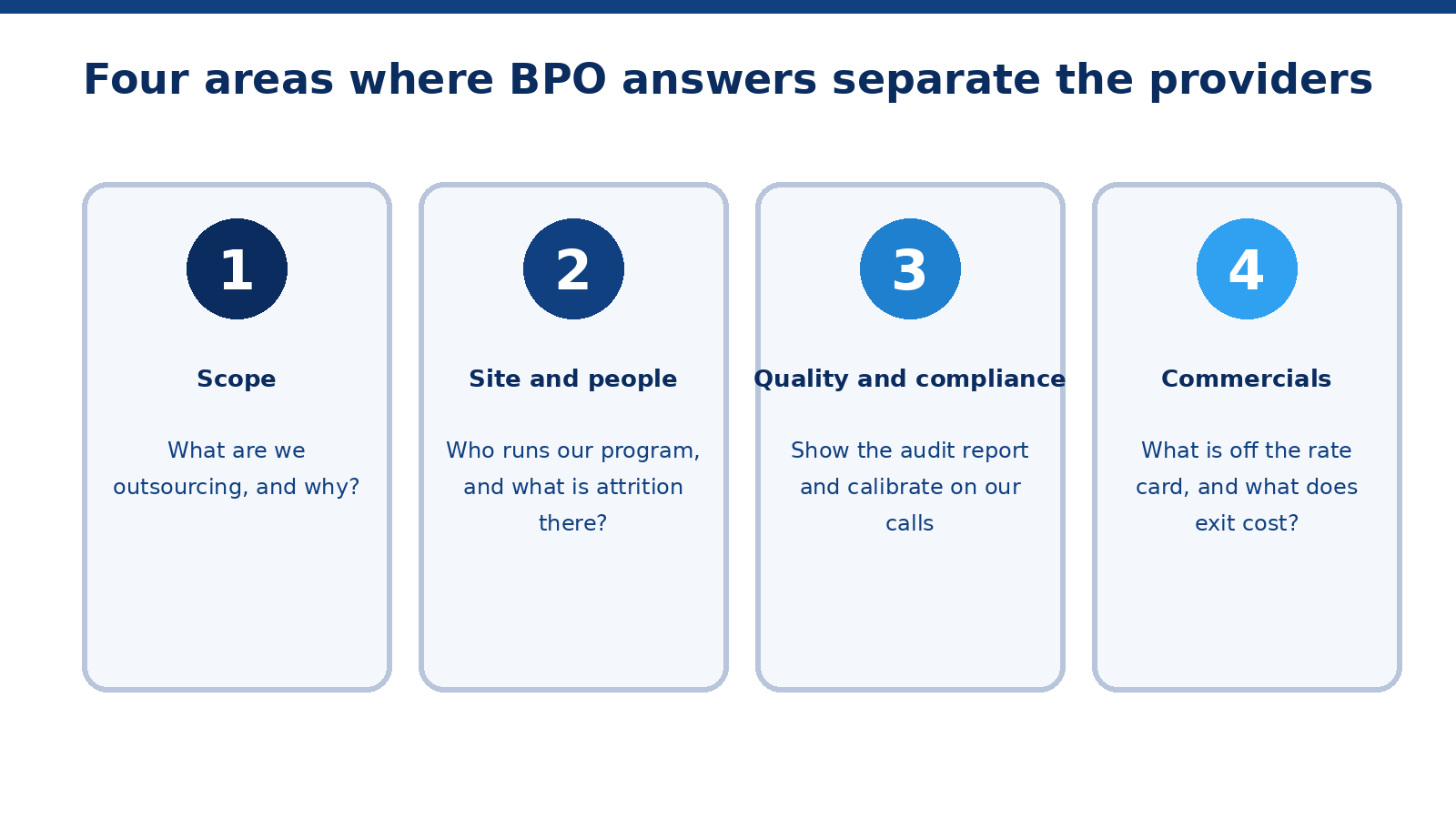
1. What exactly are we outsourcing, and why?
Why ask: “Reduce cost” is a budget target, not a strategy. Some queues outsource well, and others should be automated or kept in-house. Good answer: A queue-by-queue list with reasons: volume swings, 24/7 coverage, scripted work, or skills you cannot hire locally. Red flag: “All of tier 1,” decided before anyone looked at contact types.
2. What does “resolved” mean, and in whose system?
Why ask: If you and the provider define first contact resolution differently, every SLA conversation becomes an argument. Good answer: One written definition, measured in your systems, agreed before the RFP goes out. Red flag: Planning to “align on metrics during transition.”
What should you ask about the site and the people?
3. Which site will run our program, and who leads it?
Why ask: Two sites run by the same provider can differ more than two different providers do. Good answer: A named site, a named site director, and a named program manager, all of whom you will meet before you sign. Red flag: “We’ll determine the optimal location after contracting.”
4. What was agent attrition at that site over the last 12 months, on programs like ours?
Why ask: Attrition drives retraining costs, nesting cycles, and repeat contacts, and you pay for all three. Good answer: Site-level numbers by program type, with a clear definition and a plan for agent attrition reduction. Red flag: Company-wide averages only, or a number with no definition behind it.
5. Who in this room will I see after signature?
Why ask: The executives in the pitch are rarely the people who run your program. Good answer: Program leadership is in the room, named in the contract, with a say for you if they change. Red flag: Everyone in the meeting has “global” or “vice president” in their title.
How do you test quality, compliance, and scale?
6. Can we calibrate on our own calls before we sign?
Why ask: A calibration session shows whether the provider’s QA team scores the way yours does. If they score differently, they will coach differently. Good answer: Yes. Their QA leads score ten of your recorded contacts alongside your team, and the scores land close to yours. Red flag: “We’ll calibrate during transition.”
7. How do you measure quality: sample or full coverage?
Why ask: Evaluating a small sample of contacts misses patterns that full coverage catches. Good answer: Quality assurance automation or speech and text analytics across all contacts, with human QA focused on coaching. Red flag: A few evaluations per agent per month, and that is the whole program.
8. Show us the audit report and the last finding you fixed.
Why ask: A certification logo proves an audit happened. The findings show how the provider operates. Good answer: Current HIPAA, PCI DSS, or SOC 2 Type II reports as they apply, plus an example finding and how it was remediated. Red flag: Logos on a slide, with reports “available after contracting.”
9. How do you control at-home agents on day one?
Why ask: At-home and gig models extend the security perimeter to every agent’s kitchen table. Good answer: Device lockdown, clean-desk rules, identity verification at every login, and same-day access revocation. Red flag: “Agents sign an acceptable use policy.”
10. Tell us about a program where performance went bad. What did you do?
Why ask: Every provider has one. How they handled it tells you how they will handle yours. Good answer: A specific story with the root cause, the fix, the timeline, and the process change that followed. Red flag: “We haven’t had a program underperform.” Nobody believes this, including them.
Which commercial terms should you pressure-test?
11. What isn’t on the rate card?
Why ask: Training, backfill, premiums, and technology pass-throughs can add a meaningful share to your real spend. Good answer: A full cost model covering training, nesting, attrition backfill, shrinkage definitions, and premiums, normalized to cost per resolved contact so it compares to every other bid. Red flag: “Those are standard and we’ll cover them in the MSA.”
12. Which SLAs will you put money behind, and what does it cost to leave?
Why ask: A provider’s confidence shows in what it will put at risk, and exit terms are cheapest to negotiate before you sign. Good answer: Credits tied to resolution, quality, CSAT, and attrition, with earnbacks, plus clear termination-for-convenience and transition assistance terms. Red flag: Credits on service level only, and a long pause when you ask about exit.
When should you ask each question?
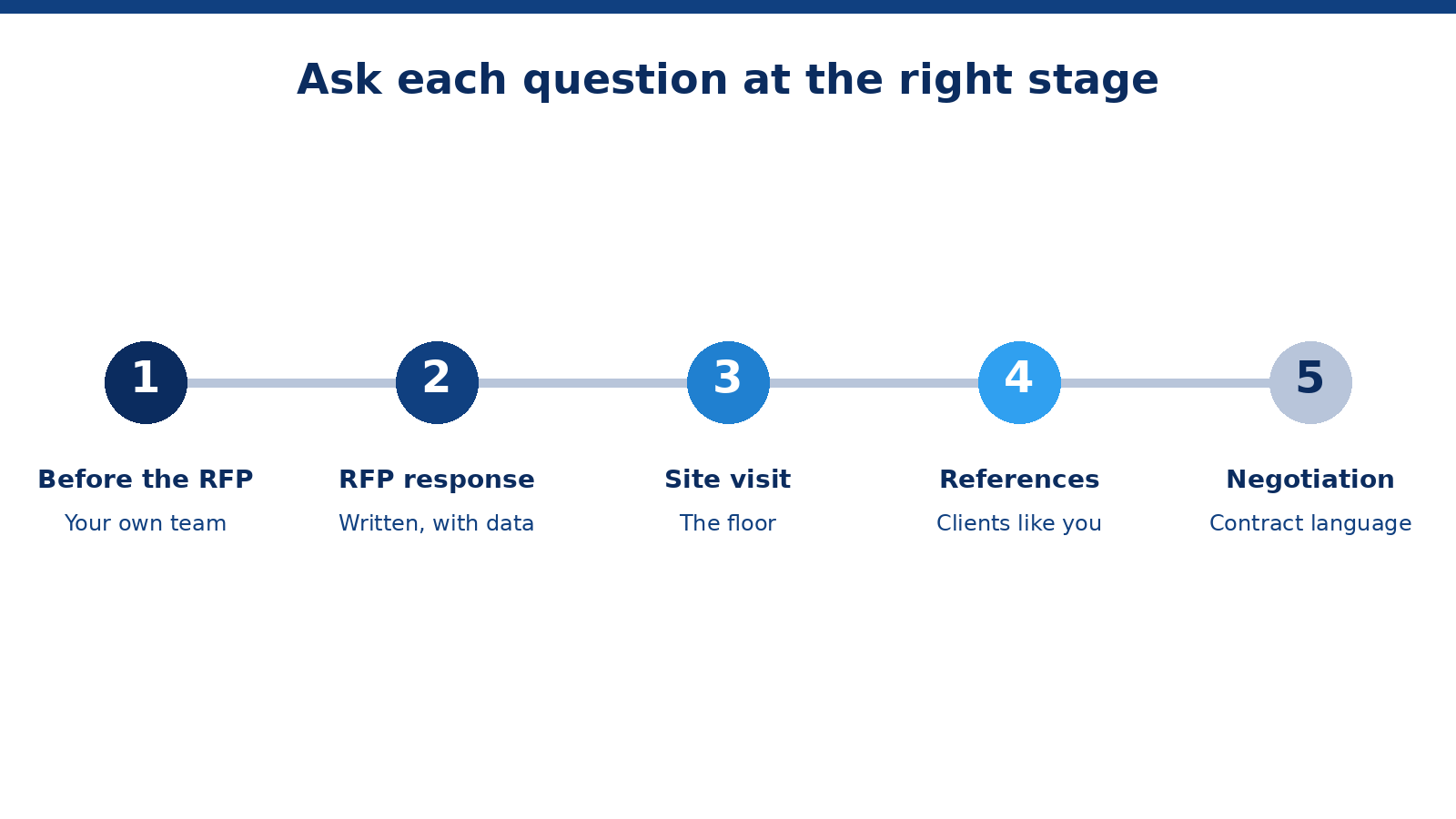
| Stage | Questions | Where the answer comes from |
|---|---|---|
| Before the RFP | 1–2 | Your own team |
| RFP response | 3–4, 8, 11–12 | Written, with data |
| Site visit | 5–7, 9–10 | The floor, the site director, the QA team |
| Reference calls | 4, 10 | Clients at your seat count and vertical |
| Negotiation | 11–12 | Contract language |
How should you score the answers?
Score every answer by evidence tier, and keep the tiers the same across every provider. Something you saw on the floor counts more than something written in the contract, and both count more than a claim made in the pitch.
| Evidence tier | What it looks like | Credit |
|---|---|---|
| Tier 1 | Seen on a live floor or in production data | 100% |
| Tier 2 | Confirmed by a reference at your seat count and vertical | 75% |
| Tier 3 | Written into the contract or SOW | 50% |
| Tier 4 | Stated in the proposal or on a call | 25% |
Tier credits are an example, not a standard. Agree them with your stakeholders before any provider is invited, then hold them constant.
Frequently asked questions
What questions should I ask a BPO before signing?
Ask which site will run your program and who leads it, what that site’s attrition was over the last 12 months, whether you can calibrate on your own calls first, what is missing from the rate card, which SLAs carry credits with earnbacks, and what it costs to leave.
What are the biggest red flags when choosing a BPO?
No named site, company-wide averages in place of site data, compliance shown as logos instead of audit reports, and quality measured only in the provider’s systems. A provider that claims it has never had a program underperform is another warning sign worth probing.
How do you compare contact center outsourcing providers fairly?
Ask every provider the same questions at the same stage, require site-level data, and normalize pricing to cost per resolved contact. Then score answers against a rubric you agreed on before bids arrived, using evidence tiers so claims and proof are not weighted equally.
How is BPO vendor evaluation different from a technology evaluation?
You are evaluating people and a site, not a product. Attrition, leadership, hiring markets, and coaching quality change month to month, so site visits, calibration sessions, and reference calls matter more than polished demos or written proposals alone.
Should I use a consultant for contact center BPO selection?
It helps when the program is large, regulated, or spread across several providers. Look for advisors who have managed outsourced programs from the buyer’s side, who disclose provider relationships in writing, and who will show you the scoring rubric before they show you a shortlist.
Where CTG fits
Cloud Tech Gurus advises enterprise contact centers on CX strategy, AI readiness, and technology and BPO sourcing across a network of 250+ suppliers and 40+ BPOs. Our BPO and outsourcing procurement work puts these questions to providers at the site level, then scores the answers against a rubric built with you.
Our standard, stated plainly: weights are agreed with you before any provider is invited, and we disclose our relationship with each provider in writing before a shortlist is built. If a rubric cannot survive being published, it is not a rubric.
We have asked question ten and watched a sales team look at each other for a very long time. That silence is data. Score it.